One-Party Consent States: Recording Laws in All 50 States and DC
 Meetlens Editorial10 min read
Last reviewed: October 9, 2026. Fact-checked against the statute texts linked in this article.
On this page
- What does one-party consent mean?
- Which states are one-party consent states?
- Which states are two-party (all-party) consent states?
- Which states have mixed or disputed recording laws?
- Recording consent laws by state: full table
- What happens when a call crosses state lines?
- Do one-party consent laws apply to video recording?
- Recording a video meeting with people in several states
- One state in detail: Florida
Most US states and Washington, D.C. are one-party consent states: you can record a conversation or call you're part of without telling anyone. A smaller group requires everyone's consent and a few are mixed or disputed, so the answer to is it illegal to record a conversation depends on where everyone is. Covered below: meaning, the 1 party consent states list, all-party and disputed states, the table, cross-state calls, video.
What does one-party consent mean?
One-party consent means a conversation or phone call can be recorded as long as one participant agrees, and that participant can be the person recording. Nobody else has to be told.
Federal law sets this floor. The Wiretap Act, now Title I of the Electronic Communications Privacy Act (ECPA), lets a party to a call or conversation, or someone with a party's consent, "intercept" it (18 U.S.C. § 2511(2)(d)); "intercept" is the federal statute's word for capturing what's said in a call or conversation with a device (§ 2510(4)). The exception fails if the purpose is "committing any criminal or tortious act"; law enforcement officers get the rule without that limit (§ 2511(2)(c)). State wiretapping laws, which decide when you can record conversations in that state, can be stricter.
All-party consent, often called two-party consent, means every participant in a call or private conversation must agree. Consent can be active (express), a clear yes, or passive (implied): people warned about a recording who keep talking are presumed to agree, says the Reporters Committee for Freedom of the Press (RCFP).
Can I sue someone for recording me without my permission? Only if the recording broke your state's rule or federal law; otherwise there is no wiretap lawsuit.
One-party vs. two-party consent: what's the difference?
| One-party consent | All-party (two-party) consent | Mixed or disputed | |
|---|---|---|---|
| Who must agree | One participant, which can be you | Every participant | Depends on the medium or the court |
| Can a participant record without telling anyone? | Yes | No | Sometimes |
| Recording a call or private conversation you're not part of | Illegal without a participant's consent | Illegal without everyone's consent | Illegal without consent |
| Share of states | Most states and DC | A minority | A handful |
Which states are one-party consent states?
36 states and Washington, D.C. follow one-party consent for both in-person conversations and phone calls:
- Alabama
- Alaska
- Arizona
- Arkansas
- Colorado
- Georgia (video in private places needs everyone's consent, even from a participant)
- Hawaii (devices in private places need consent of those entitled to privacy there)
- Idaho
- Indiana (state law covers only electronic communications)
- Iowa
- Kansas
- Kentucky
- Louisiana (smart glasses: notify everyone, with exceptions such as your home, workplace or car; since August 1, 2026)
- Maine (devices in private places need consent of those entitled to privacy there)
- Minnesota
- Mississippi
- Missouri
- Nebraska
- New Jersey
- New Mexico (state law covers only telephone and telegraph)
- New York
- North Carolina
- North Dakota
- Ohio
- Oklahoma
- Rhode Island
- South Carolina
- South Dakota
- Tennessee
- Texas
- Utah
- Vermont (no state recording statute)
- Virginia
- West Virginia
- Wisconsin
- Wyoming
- District of Columbia
These single party consent states, sometimes called one-party recording states, are the answer to which states allow recording without consent. No one else has to agree, but you must take part in the conversation or have a participant's consent. Where state law is silent (Vermont) or covers only calls (Indiana, New Mexico), the federal one-party rule applies.
Connecticut and Nevada are one-party only in person, Oregon only on the phone; Michigan and Delaware are disputed (see below).
Which states are two-party (all-party) consent states?
Nine states require everyone's consent, or in some cases everyone's knowledge, before you record a phone call or a private conversation: California, Florida, Illinois, Maryland, Massachusetts, Montana, New Hampshire, Pennsylvania and Washington State.
No state bans recording outright; these 2 party consent states require everyone's agreement. Massachusetts, Montana and Illinois ban only secret recording, so recording openly, with everyone aware, can be enough there. For in-person talk, most of these laws protect only conversations held with a reasonable expectation of privacy; the Massachusetts and Montana bans don't depend on privacy.
| State | Statute | What the law protects | Key nuance |
|---|---|---|---|
| California | Cal. Penal Code § 632 | "Confidential communication," in person or by phone | Excludes talk people expect to be overheard or recorded and a recorder everyone knows about (§ 632(b), (c)); § 632.7 covers cell or cordless calls regardless |
| Florida | Fla. Stat. § 934.03 | Calls; in-person "oral communication" made with an expectation of privacy (§ 934.02) | Since 2024, a parent may record a child's conversation to capture evidence of abuse (§ 934.03(2)(l)) |
| Illinois | 720 ILCS 5/14-2 | "Private conversation" and private electronic communication | Only recording "in a surreptitious manner" is banned |
| Maryland | Cts. & Jud. Proc. § 10-402 | Calls; in person, words spoken "in private conversation" (§ 10-401) | The recorder must be a party, and all parties must consent (§ 10-402(c)(3)) |
| Massachusetts | G.L. c. 272, § 99 | Wire communications (calls) and oral communications, meaning any speech | The offense is secret recording |
| Montana | MCA § 45-8-213 | Conversations recorded with a hidden device "without the knowledge of all parties" | One person's warning lets either party record; officials on duty and public meetings are exempt |
| New Hampshire | RSA 570-A:2 | Telecommunications and oral communications | A participant who records without everyone's consent still commits a crime: a misdemeanor if done knowingly (paragraph I-a), a felony if willful (State v. Clark, 2024) |
| Pennsylvania | 18 Pa.C.S. § 5703, § 5704(4) | Calls; "oral communication" made with an expectation of privacy (§ 5702) | Exceptions for customer-service calls and for recording telemarketers (§ 5704(15), (19)) |
| Washington State | RCW 9.73.030 | Private calls and private conversations | An announcement that is itself recorded counts as consent |
Which states have mixed or disputed recording laws?
Connecticut, Nevada and Oregon apply different rules to phone calls and in-person conversations, while in Michigan and Delaware the statute text and court decisions point in different directions. Guides call the first three mixed consent states; in Nevada and Michigan, case law, not the statute text alone, sets the rule.
| State | Phone calls | In-person | Why guides disagree |
|---|---|---|---|
| Connecticut | All parties (civil law), unless consent or a notice is recorded at the start or a warning tone sounds (Conn. Gen. Stat. § 52-570d) | One party (§ 53a-187, § 53a-189) | Criminal law is one-party for both; only the civil phone rule needs everyone |
| Nevada | All parties (NRS 200.620) | One party (NRS 200.650) | The phone statute requires a party's consent plus an emergency or court order; Lane v. Allstate Ins. Co. (1998) read it as all-party |
| Oregon | One party (ORS 165.540(1)(a)) | All participants must be "specifically informed" (§ 165.540(1)(c)) | The in-person rule asks for notice, not consent |
| Michigan | One party for participants | One party for participants | MCL 750.539c says "all parties," but courts hold a participant is not an eavesdropper: Sullivan v. Gray (Michigan Court of Appeals, 1982), Fisher v. Perron (Sixth Circuit, 2022), AFT Michigan v. Project Veritas (federal district court, March 2026). The Michigan Supreme Court has not ruled |
| Delaware | Unsettled | Unsettled | 11 Del. C. § 2402(c)(4) allows one-party consent; § 1335(a)(4) requires all parties. A federal court doubted in 1975 that § 1335 bars a participant's recording (United States v. Vespe); another called such a recording an apparent violation in 2011 (Hemphill v. City of Wilmington). We found no Delaware ruling reconciling them |
How we classified: all-party means the statute requires everyone's consent or knowledge for both calls and in-person talk; mixed means the rule depends on the medium. For Michigan and Delaware, where text and case law split, the safe rule is everyone's consent.
That is why guides disagree: RCFP counts "about 11" all-party states, including Delaware and Michigan, and treats Missouri and Oregon as all-party in person; popular guides list 10 to 13.
Missouri stays one-party with a caveat: RSMo § 542.402 bans intercepting in-person talk only with a radio-transmitting device, and its participant exception covers only wire communications. A participant's ordinary recorder falls outside the ban.
Recording consent laws by state: full table
The table below lists the rule for in-person conversations and phone calls in every state and DC, with the statute to read. Read each row as that state's recording consent requirements: "One" means one-party consent and "All" means all-party consent.
Who must agree to a recording, by state
- One-party consent36 states + DC
- All-party consent9 states
- Mixed: depends on call or in personCT, NV, OR
- DisputedMI, DE
| State | In-person | Phone / electronic | Statute | Note |
|---|---|---|---|---|
| Alabama | One | One | Ala. Code § 13A-11-30, § 13A-11-31 | |
| Alaska | One | One | Alaska Stat. § 42.20.310 | |
| Arizona | One | One | A.R.S. § 13-3005, § 13-3012(9) | |
| Arkansas | One | One | Ark. Code § 5-60-120 | |
| California | All | All | Penal Code § 632, § 632.7 | Confidential communications; all cell or cordless calls |
| Colorado | One | One | C.R.S. § 18-9-303, § 18-9-304 | |
| Connecticut | One | All* | Conn. Gen. Stat. § 52-570d, § 53a-187, § 53a-189 | *Civil rule; a recorded notice or warning tone also works |
| Delaware | Disputed | Disputed | 11 Del. C. § 2402, § 1335 | |
| District of Columbia | One | One | D.C. Code § 23-542 | |
| Florida | All | All | Fla. Stat. § 934.03 | In person: private talk only |
| Georgia | One | One | O.C.G.A. § 16-11-66, § 16-11-62 | Video in private places: everyone observed |
| Hawaii | One | One | HRS § 803-42, § 711-1111 | Devices in private places |
| Idaho | One | One | Idaho Code § 18-6702 | |
| Illinois | All | All | 720 ILCS 5/14-2 | Secret recording only |
| Indiana | Not covered | One | Ind. Code § 35-33.5-5-5, § 35-31.5-2-176 | Electronic communications only |
| Iowa | One | One | Iowa Code § 808B.2, § 727.8 | |
| Kansas | One | One | K.S.A. § 21-6101 | |
| Kentucky | One | One | KRS § 526.010, § 526.020 | |
| Louisiana | One* | One | La. R.S. 15:1303, 9:2790.3 | *Smart glasses: notify everyone |
| Maine | One | One | 15 M.R.S. § 709, § 710; 17-A M.R.S. § 511 | Devices in private places |
| Maryland | All | All | Cts. & Jud. Proc. § 10-402 | In person: private talk only |
| Massachusetts | All | All | G.L. c. 272, § 99 | Secret recording; no privacy test |
| Michigan | Disputed | Disputed | MCL 750.539c | Courts: participants may record |
| Minnesota | One | One | Minn. Stat. § 626A.02 | |
| Mississippi | One | One | Miss. Code § 41-29-531 | |
| Missouri | One* | One | RSMo § 542.402 | *Radio-transmitting devices: no participant exception |
| Montana | All | All | MCA § 45-8-213 | Hidden devices; a warning suffices |
| Nebraska | One | One | Neb. Rev. Stat. § 86-290 | |
| Nevada | One | All | NRS 200.620, 200.650 | Phone rule from Lane v. Allstate |
| New Hampshire | All | All | RSA 570-A:2 | |
| New Jersey | One | One | N.J.S.A. 2A:156A-4 | |
| New Mexico | Not covered | One | N.M. Stat. § 30-12-1 | Telephone and telegraph only |
| New York | One | One | N.Y. Penal Law § 250.00, § 250.05 | |
| North Carolina | One | One | N.C.G.S. § 15A-287 | |
| North Dakota | One | One | N.D.C.C. § 12.1-15-02 | |
| Ohio | One | One | Ohio Rev. Code § 2933.52 | |
| Oklahoma | One | One | 13 Okla. Stat. § 176.4 | |
| Oregon | All informed | One | ORS 165.540, 165.535 | Video calls count as in-person |
| Pennsylvania | All | All | 18 Pa.C.S. § 5703, § 5704 | |
| Rhode Island | One | One | R.I. Gen. Laws § 11-35-21 | |
| South Carolina | One | One | S.C. Code § 17-30-30 | |
| South Dakota | One | One | S.D. Codified Laws § 23A-35A-20 | |
| Tennessee | One | One | Tenn. Code § 39-13-601 | State civil claim repealed in 2024 (Pub. Ch. 1045) |
| Texas | One | One | Tex. Penal Code § 16.02 | |
| Utah | One | One | Utah Code § 77-23a-4 | |
| Vermont | One | One | No state statute; federal law applies (RCFP Vermont guide) | |
| Virginia | One | One | Va. Code § 19.2-62 | |
| Washington State | All | All | RCW 9.73.030 | A recorded announcement counts |
| West Virginia | One | One | W. Va. Code § 62-1D-3 | |
| Wisconsin | One | One | Wis. Stat. § 968.31 | |
| Wyoming | One | One | Wyo. Stat. § 7-3-702 |
What happens when a call crosses state lines?
No federal rule settles which state's law applies to an interstate phone call, so the safe practice is to follow the strictest state involved: if anyone is in an all-party state, get everyone's consent. Call recording laws differ by state, and courts disagree on jurisdiction: some apply the law where the recording device is, others where the person being recorded is (RCFP).
- California: its Supreme Court applied California law, going forward only, to calls a brokerage's Atlanta office was accused of recording with California clients (Kearney v. Salomon Smith Barney, 2006).
- Nevada: its Supreme Court held that NRS 200.620 does not apply when the call is intercepted outside Nevada (Ditech Financial v. Buckles, 2017).
Can one-party consent recordings be used across states? That depends on the court: in California, an illegal recording is barred in civil and administrative cases (§ 632(d)) but can be admitted in criminal trials (People v. Guzman, 2019), and the Vespe court said a Delaware violation would not keep tapes out of a federal criminal trial.
Do one-party consent laws apply to video recording?
Consent laws cover sound: the audio of a video follows the same rules, while the picture falls under each state's hidden-camera and voyeurism laws, which mostly protect private places. Many hidden camera laws cover only recording nudity (RCFP).
- Georgia requires the consent of everyone observed to record activities in a private place out of public view (O.C.G.A. § 16-11-62(2)), even for a participant: the one-party rule covers sound, not images (State v. Cohen, 2017).
- Oregon counts a video call as a "conversation" (ORS 165.535(1)), so everyone on it must be informed of a recording. An exception covers private meetings where everyone knew or should have known about the recording (§ 165.540(6)(a)).
What about recording a Zoom or Teams meeting with people in several states?
Recording a video meeting with people in several states
Record a meeting with attendees in several states under the strictest state's rule: announce the recording at the start, get everyone's agreement, and stop if anyone objects. The same consent rules apply to virtual meetings; workplace recording policies are a separate question.
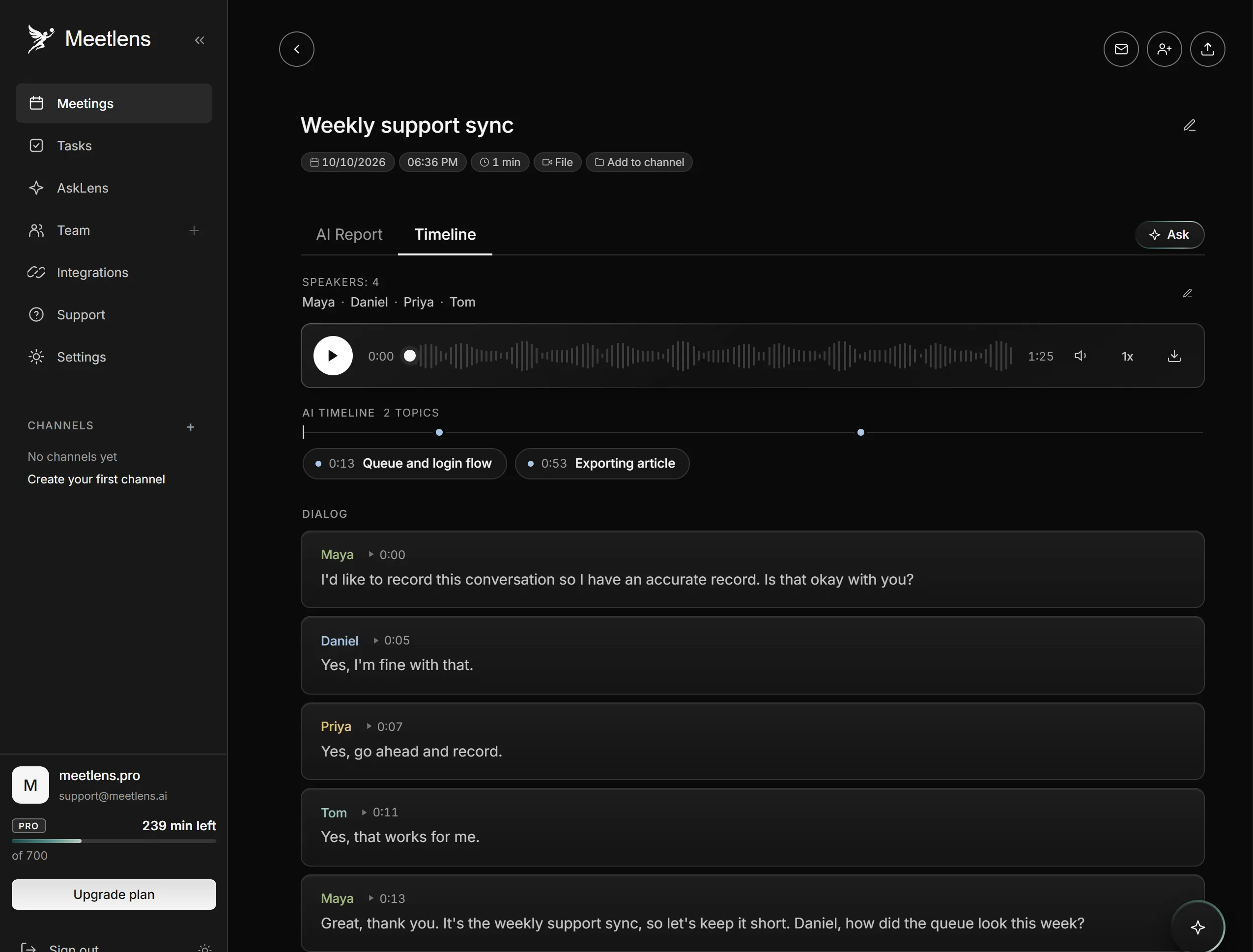
For browser meetings in Google Meet, Zoom Web, Microsoft Teams Web or Webex, Meetlens, a Chrome extension, records the meeting audio from the browser tab, plus your microphone if you allow access, without a bot joining the call. Participants get no recording notice from Meetlens, so the announcement is up to you. Allow microphone access so your own announcement is recorded too, then press Start recording and announce: the consent exchange stays at the top of the transcript, with speaker labels and timestamps; ask each person to answer in a full sentence ("Yes, I agree to the recording") so every consent gets its own line. See how the browser meeting recorder works.
One state in detail: Florida
Is Florida a one-party consent state? No: it requires everyone's consent, and one table row can't show its exceptions. Besides the parent exception, a child under 18 may record an in-person conversation they're part of to capture statements about sexual abuse or violence against them (§ 934.03(2)(k)).
Change log: October 9, 2026: statutes for all 50 states and DC checked.