Is It Illegal to Record Someone Without Their Permission? Federal and State Rules
 Meetlens Editorial9 min read
Last reviewed: October 9, 2026. Fact-checked against the statute texts linked in this article.
On this page
- Is it illegal to record someone without their permission?
- Is it illegal to record a conversation without the other person knowing?
- Is it illegal to record a phone call?
- Can you record someone in public or on video?
- Can you record conversations at work?
- What happens if you record someone illegally?
- Can you sue someone for recording you without permission?
- How do you record a conversation legally?
- Recording meetings and video calls
Recording someone without their permission is legal in most of the US if you are part of the conversation, and generally illegal if you are not and no one in it agreed — but a minority of states require everyone's consent. Whether it is illegal to record someone without their permission also turns on where everyone is. Below: secret recording, calls, public places, work, penalties, recording legally.
Is it illegal to record someone without their permission?
Under federal law and in most states, it is legal to record a conversation without the other person's permission as long as you're a participant; this is called one-party consent. Recording a call or private conversation you're not part of, with no one's consent, is illegal wiretapping or eavesdropping.
Wiretapping means tapping a phone line; eavesdropping means secretly listening to or recording a conversation. Three questions settle most cases:
- Are you a participant, or did one agree? If not, recording is illegal, unless it's an in-person talk that isn't private.
- Is anyone in an all-party consent state? Then get everyone's consent to record; if not, yours is enough.
- For an in-person talk: could the people talking expect privacy? If not, wiretap laws generally don't apply, except in a few states, such as Massachusetts, Montana and Oregon, whose bans don't depend on privacy. Phone calls are protected either way.
Three checks before you record
-
Are you a participant, or did one agree?
- YesGo to check 2
- NoIllegal, unless it’s an in-person talk that isn’t private
-
Is anyone in an all-party consent state?
- YesGet everyone’s consent
- NoYour consent is enough
-
In person: could they expect privacy?
in-person talks only- YesChecks 1 and 2 apply
- NoWiretap laws generally don’t apply, except in a few states, such as Massachusetts, Montana and Oregon. Phone calls are always covered.
What federal law says
Federal law allows one-party consent recording unless it is made to commit a crime or a tort. The Wiretap Act of 1968, now Title I of the Electronic Communications Privacy Act (ECPA), lets you "intercept" a call, message or conversation you take part in, or one a participant consented to (18 U.S.C. § 2511(2)(d)). To intercept is the statute's word for acquiring the contents with a device (§ 2510(4)). The exception fails if the recording is made "for the purpose of committing any criminal or tortious act." States can add stricter rules.
One-party vs. all-party consent states
Most states follow the one-party consent rule; all-party consent states require everyone in a private conversation to agree. These states require every participant's consent; in Massachusetts, Montana and Illinois the ban covers only secret recording, so everyone's knowledge can be enough: California, Florida, Illinois, Maryland, Massachusetts, Montana, New Hampshire, Pennsylvania and Washington State. Connecticut, Nevada and Oregon (ORS 165.540; video calls follow the in-person rule there, ORS 165.535) use different rules for phone calls and in-person conversations, and courts and guides disagree about Michigan and Delaware. Each state's rule is in our list of one party consent states.
What makes a conversation "private"
A conversation is private when the people in it reasonably expect no one is listening in or recording: the reasonable expectation of privacy test. Federal law protects an in-person "oral communication" only under that expectation (§ 2510(2)); calls and electronic communications, such as email, are covered regardless. California Penal Code § 632 protects a "confidential communication" and likewise excludes talk where people may reasonably expect to be overheard or recorded.
Is it illegal to record a conversation without the other person knowing?
In one-party consent states you can record a conversation you're part of without telling anyone; in all-party states the others must agree, and in some, like Massachusetts, the law targets secret recording specifically. Knowledge and consent are different tests:
- Massachusetts defines interception as to "secretly hear, secretly record" a conversation without everyone's prior authority, so a hidden recording can be illegal there even in public (except of police on duty in public; see below).
- Washington State counts consent to record as obtained once a participant announces to everyone that the conversation "is about to be recorded," and the announcement is itself recorded (RCW 9.73.030(3)).
- Illinois bans recording a private conversation "in a surreptitious manner," meaning "obtained or made by stealth or deception, or executed through secrecy or concealment" (720 ILCS 5/14-1), without the consent of all other parties to the conversation.
Do you have to tell someone you are recording them? Only in all-party states, but announcing it and stopping if anyone objects is the simplest way to stay legal everywhere.
Is it illegal to record a phone call?
Recording a phone call you are on is legal under federal law and in one-party states; if anyone on the call is in an all-party state, you generally need everyone's consent. In federal terms, a telephone call is a "wire communication," carried at least partly by wire, cable or a similar connection (§ 2510(1)).
For interstate calls, courts disagree whose jurisdiction governs, the recorder's state or the other person's, according to the Reporters Committee for Freedom of the Press (RCFP). Follow the strictest state on the call. In Kearney v. Salomon Smith Barney (2006), the California Supreme Court held that California law governs calls that a brokerage's office in Atlanta, Georgia, was accused of recording with California clients without their knowledge, but applied it only going forward: it declined to impose damages for calls recorded before the ruling. California's full rules are on our page answering is california a one party consent state.
- Washington State: recording only your own side is still illegal, says the legal aid site Washington Law Help.
- Call centers: "This call may be recorded" works as implied consent: people warned of a recording who keep talking are generally presumed to agree (RCFP), though California's high court hasn't settled this for cell phone calls. Connecticut also accepts a recorded notice or a beep about every 15 seconds.
- Texas is a one-party state under Penal Code § 16.02.
Can you record someone in public or on video?
You can usually record people in public places where no one expects privacy, and silent video falls outside wiretap laws, but recording sound turns it into an audio recording, and filming in bathrooms, changing rooms or homes is restricted.
- Public space: loud talk on a street usually isn't private, but a quiet conversation can be: courts weigh where you are, what's said and how loudly (RCFP).
- Video: a camera without sound generally falls outside wiretap laws; with sound, the audio follows the state's recording law (RCFP). Every state and Washington, D.C. has a hidden camera law. The federal video voyeurism law, 18 U.S.C. § 1801, covers only special federal jurisdiction, such as military bases.
- Home and stores: cameras in your own home are generally allowed, but recording guests' conversations brings in wiretap laws; a store can ban recording on its property.
Recording police and public officials
Several federal appeals courts hold that the First Amendment protects recording police doing their jobs in public. In Glik v. Cunniffe (1st Cir. 2011), filming an arrest on Boston Common was "unambiguously" protected, and because it was open, it wasn't a secret recording under Massachusetts law. In 2020 the same court held, in Project Veritas Action Fund v. Rollins, that Massachusetts can't apply its ban to secretly recording police officers doing their jobs in public. Each ruling binds only its own circuit.
Can you record conversations at work?
State consent law decides whether a workplace recording is a crime, but your employer can still have a no-recording policy and discipline you for breaking it.
Can I record my boss yelling at me? In a one-party state, yes, if you're in the conversation; in an all-party state, only with consent.
For most private-sector employees, Section 7 of the National Labor Relations Act (NLRA) protects "concerted activities for the purpose of collective bargaining or other mutual aid or protection" (29 U.S.C. § 157). The NLRB's test for when a no-recording rule chills that protected concerted activity keeps changing: the Board's current test comes from Stericycle (2023), and the agency's general counsel is asking the Board to overturn it in pending cases. As of October 2026, the Board had not ruled.
Before using a recording as evidence of harassment, talk to an employment lawyer. For work calls, see is it legal to record a meeting.
What happens if you record someone illegally?
Illegal recording can be a felony, can make you liable for civil damages, and usually can't be used as evidence. Criminal cases bring prison and fines; civil damages go to the person recorded.
| Law | Criminal penalty | Civil remedy |
|---|---|---|
| Federal: 18 U.S.C. § 2511(4), § 2520 | Fine, up to 5 years in prison, or both | A court may award actual damages plus the violator's profits, or statutory damages of $100 a day or $10,000, whichever is greater; punitive damages; attorney's fees |
| California: Penal Code § 632(a), § 637.2 | Fine up to $2,500 per violation, up to 1 year in county jail or a state prison term, or both; up to $10,000 per violation after a prior conviction | $5,000 per violation or 3 times actual damages, whichever is greater |
| Florida: Fla. Stat. § 934.03(4)(a), § 934.10 | Third-degree felony: up to 5 years (§ 775.082) and $5,000 (§ 775.083) | Actual damages, at least $100 a day or $1,000, whichever is higher; punitive damages; attorney's fees |
| Illinois: 720 ILCS 5/14-4, 5/14-6 | Class 4 felony: up to 3 years (1 to 3 if imprisoned; 730 ILCS 5/5-4.5-45) and up to $25,000 (5/5-4.5-50); Class 3 for a repeat offense | Injunction; actual and punitive damages |
| Maryland: Cts. & Jud. Proc. § 10-402(b), § 10-410 | Felony: up to 5 years, $10,000, or both | Actual damages, at least $100 a day or $1,000, whichever is higher; punitive damages; attorney's fees |
| Pennsylvania: 18 Pa.C.S. § 5703, § 5725 | Third-degree felony: up to 7 years (§ 1103) and $15,000 (§ 1101) | Actual damages, at least $100 a day or $1,000, whichever is higher; punitive damages; attorney's fees |
| Washington State: RCW 9.73.080, 9.73.060 | Gross misdemeanor: up to 364 days, $5,000, or both (RCW 9.92.020) | Actual damages, or $100 a day up to $1,000; attorney's fees |
In Washington, the $1,000 is a cap; in Florida, Maryland and Pennsylvania, it's a floor.
Can you use a recording as evidence?
A lawful recording can be evidence in court once authenticated, for example by a witness who knows the voices (Federal Rule of Evidence 901); an illegally intercepted one usually can't. 18 U.S.C. § 2515 bars illegally intercepted calls and conversations from any trial or hearing, and Washington's RCW 9.73.050 does the same in state courts. Recording for evidence follows the same consent rules.
Can you sue someone for recording you without permission?
Yes. If the recording broke federal or state law, you can sue for damages; under federal law, within two years of when you first had a reasonable chance to discover it (§ 2520(e)). That statute of limitations is federal; state deadlines differ. The lawsuit claims a privacy violation; remedies are in the table above.
If someone is secretly recording you:
- Note the facts: date, place, who was there.
- Object: say "I don't consent to being recorded," and leave if recording continues; staying after a warning can count as consent.
- Keep evidence that mentions or contains the recording.
- Get help: a lawyer, or law enforcement if the recording is used for threats or blackmail.
- Don't record back in secret in an all-party state.
How do you record a conversation legally?
Announce the recording at the start, get a clear yes on the recording, and stop if anyone objects; that keeps you legal in every state.
- Confirm you're a participant.
- Check where everyone is and follow the strictest state.
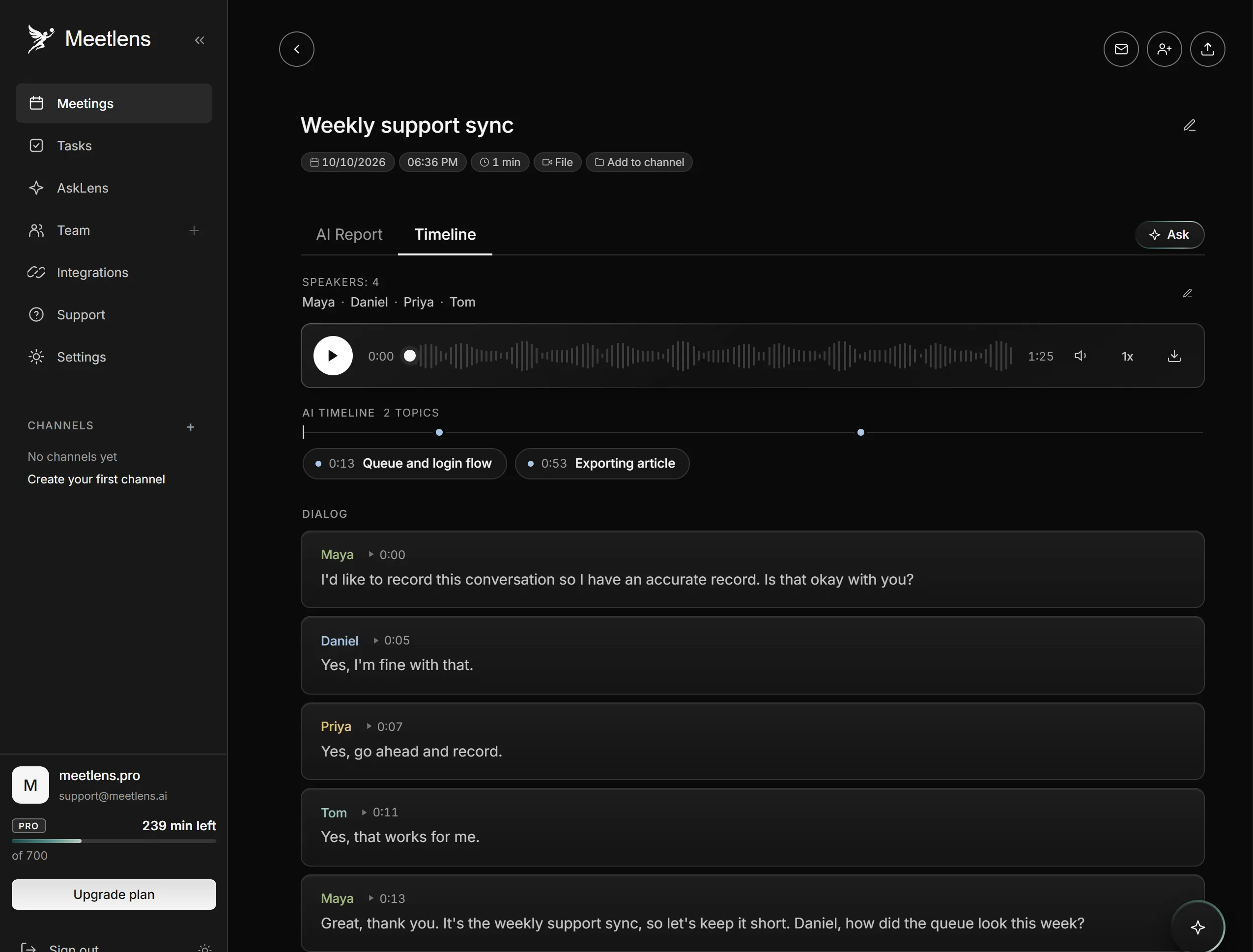
- Start the recorder, then announce: "I'd like to record this conversation so I have an accurate record. Is that OK with you?"
- Get each yes and offer an opt out; ask each person to answer in a full sentence, such as "Yes, I agree to the recording," and stop if anyone declines.
- Store the file securely.
For browser meetings in Google Meet, Zoom Web, Microsoft Teams Web or Webex, Meetlens can be the recorder; it's one of several bot-free ways to record a meeting. The Chrome extension records the meeting audio, plus your microphone if you allow access, without a bot joining the call, and produces a transcript with speaker labels and timestamps. Participants get no recording notice from Meetlens, so announcing is up to you. Allow microphone access so your own announcement is recorded too, then press Start recording and announce: when each person answers in a full sentence ("Yes, I agree to the recording"), every consent appears at the top of the transcript as its own timestamped line. See how the bot-free meeting recorder works.
Recent changes we track:
- California: SB 690, signed September 30, 2026 and effective January 1, 2027, ends private lawsuits over website and app tracking under Penal Code § 638.51; the recording rules in §§ 631 and 632 and the damages above don't change.
- Florida: a 2024 law (ch. 2024-131) added § 934.03(2)(l), letting a parent record a child's conversation to capture evidence of abuse against the child.
- Pennsylvania: Act 53 of 2023 added § 5704(19) for recording telemarketing calls and robocalls.
What about recording a video meeting with people in several states?
Recording meetings and video calls
Recording a video meeting follows the same consent rules, plus three questions: whether a platform's recording notice counts as consent, how AI note-takers fit, and how to handle attendees in several states. The meeting guide linked in the work section covers all three.