What Is Transcription? Meaning, Types and How It Works
 Meetlens Editorial7 min readUpdated October 17, 2026
On this page
Transcription is turning speech from audio or video into written text — the sample transcripts you have seen, from interview notes to court records, are its output. This guide covers how transcription differs from a transcript, its main types, how manual and AI transcription work, how it compares with translation, captions and dictation, what a transcriptionist does, and when to choose a human or automatic transcript.
In biology and music the word has other meanings; this article is about turning speech into text.
What is a transcription?
Transcription is the process of converting spoken language from an audio or video recording into written text, usually with speaker names and timestamps. The source can be an audio file from a phone or a recorder, a video recording of a webinar, or a call captured in the browser. Once transcribed, the spoken content becomes text you can search, quote and skim without replaying the audio.
Spoken language is messy: people restart, interrupt and trail off, so every transcription involves choices about what to keep. The word comes from the Latin transcribere, from trans- and scribere, "to write," according to Merriam-Webster; English has used "transcribe" since the 1550s.
Illustrative example: two spoken lines and the same lines in a written transcript.
What the recording says:
  "Um, so I think we— we ship on Friday?"
  "Uh, Friday works if, um, if QA signs off."

What the transcript says:
  [12:04] Dana: So I think we ship on Friday?
  [12:08] Luis: Friday works if QA signs off.
What is the difference between transcription and a transcript?
Transcription is the process of writing down recorded speech; a transcript is the written document that process produces. You do transcription; you share, file and search a transcript.
A finished transcript usually opens with a header: title, date, participants and recording length. Below it, each speaker turn starts on a new line with a label and, often, a timestamp. In everyday use, people also call that document "a transcription," as in "send me the transcription of the call."
What are the types of transcription?
There are four main types of transcription for recorded speech: verbatim, clean (intelligent) verbatim, edited and phonetic. They differ in how much of the spoken line survives on the page. Illustrative example, one line in all four:
| Type | The same spoken line on the page |
|---|---|
| Verbatim | So, um, me and Sam, we— we moved it to, uh, March. [laughs] |
| Clean verbatim | So me and Sam, we moved it to March. |
| Edited | Sam and I moved it to March. |
| Phonetic | /ˈmuvd ɪt tə ˈmɑrtʃ/ for "moved it to March," in General American |
Verbatim transcription
Verbatim (word-for-word) transcription keeps everything said, and how: filler words, false starts, repeats, stuttering, laughter and long pauses. Verbatim transcription suits conversation analysis, which studies pauses and overlaps, and legal work where a hesitation could change a statement's meaning. Style guides set how much detail to keep, such as timed pauses.
Clean verbatim (intelligent verbatim)
Clean verbatim, also called intelligent verbatim, drops filler words, stutters and false starts but keeps the speaker's words and grammar. It's the usual choice for meetings and for interviews where what was said matters more than how: easy to read, still accurate to quote.
Edited transcription
Edited transcription fixes grammar, trims repetition and splits long answers, so the text can be published as an article or a Q&A. Don't quote an edited transcript as someone's exact words.
Phonetic transcription
Phonetic transcription records sounds instead of words, in the symbols of the International Phonetic Alphabet (IPA). The International Phonetic Association provides the IPA as "a notational standard for the phonetic representation of all languages." Researchers in linguistics and phonetics, and speech-language pathologists, use it; business meetings don't need it. The other three types are orthographic transcription: speech written in ordinary spelling.
Fields add their own rules on top of these types:
| Legal | Medical | Academic | Meetings | |
|---|---|---|---|---|
| Who uses it | Courts, law firms | Hospitals, clinics | Researchers | Managers, recruiters, sales |
| Usual type | Verbatim or close to it | Edited into formal reports | Clean verbatim, or verbatim when pauses and overlaps are data | Clean verbatim |
| What matters most | Exact wording, certification | Medical terms, privacy | Exact quotes, anonymized interview data | Names, numbers, decisions |
How does transcription work?
In transcription, a person or a speech recognition model listens to the recording, writes down what is said, marks who said it and when, and then someone checks the result.
Manual transcription
Manual transcription is a loop of listening, typing and checking:
- Play a few seconds of audio, pause, and type what you heard in Microsoft Word or Google Docs.
- Start a new line at every change of speaker, with a label and a timestamp.
- Replay unclear spots, and mark words you can't make out as [inaudible] with the time.
- Proofread the full text against the audio.
Automatic (AI) transcription
Automatic transcription tools run the same loop in software:
- Speech recognition. An automatic speech recognition (ASR) model converts the audio into words.
- Speaker diarization. The model splits the audio by voice to answer "who spoke when" and labels the turns Speaker A, Speaker B. It doesn't know names; you rename the speakers.
- Timestamps and punctuation. Each turn gets a start time, and the model adds punctuation and capital letters.
Review stays human: check names, numbers and jargon against the audio. If the recording is a video file, the same steps run on its audio track.
Automatic transcription, step by step
-
Audio
-
Speech recognition (ASR)
so i think we ship on friday friday works if qa signs off
-
Speaker diarization
Speaker A so i think we ship on friday
Speaker B friday works if qa signs off
-
Timestamps and punctuation
[00:12] Speaker A: So I think we ship on Friday?
[00:16] Speaker B: Friday works if QA signs off.
Human review: names, numbers, jargon
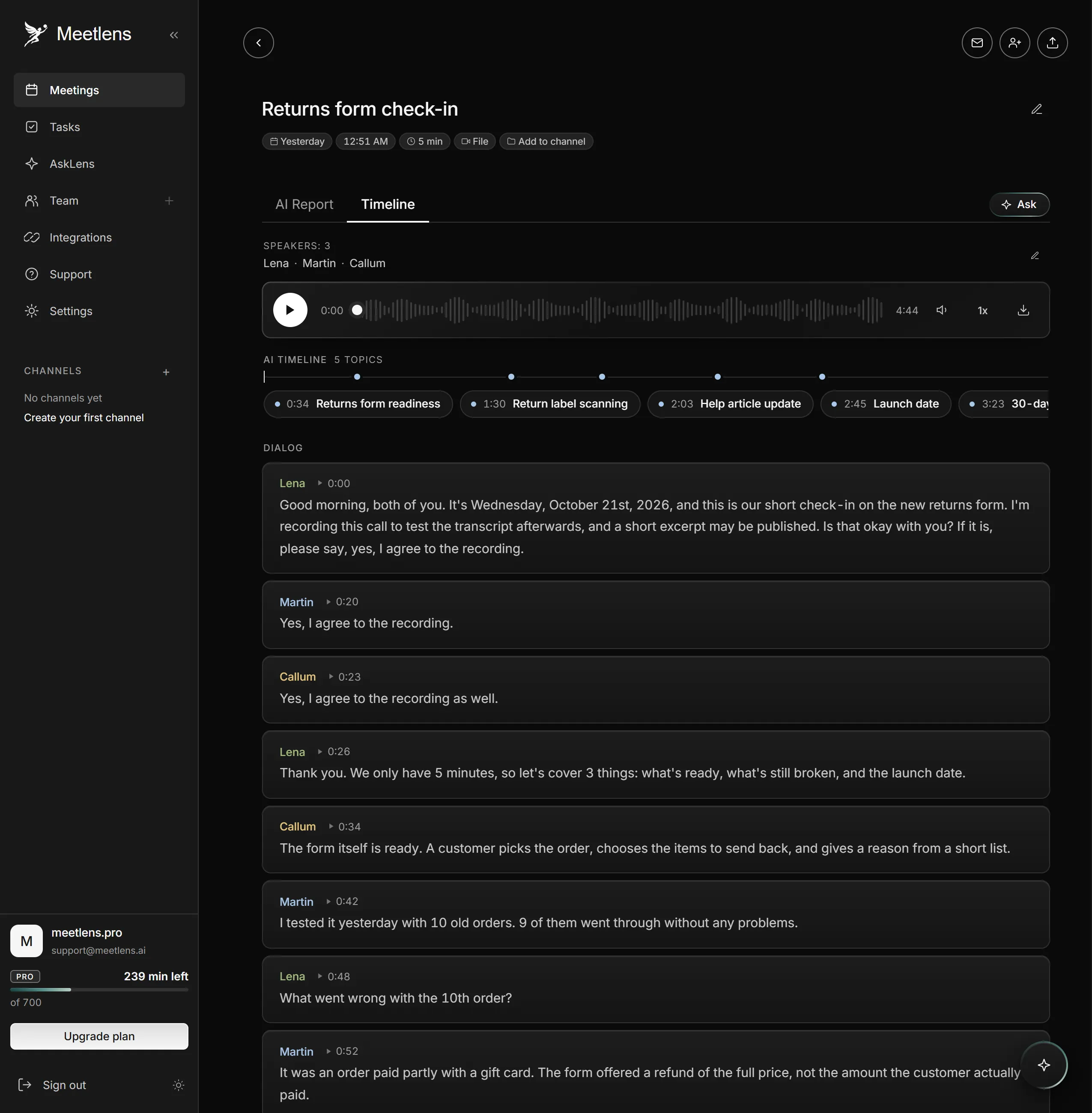
Meetlens runs this pipeline on browser meetings: after the recording ends, it transcribes the call in 99+ languages, with automatic language detection, speaker labels and MM:SS timestamps. Diarization has edge cases: a reply of three words or fewer between two turns of one person can be credited to that person, so a bare "Yes" may not get its own line.
Transcription vs. translation, captions and dictation
Transcription writes speech down in the language it was spoken; translation changes the language; captions are timed text shown on screen; dictation is speaking so that someone writes it down.
| Input | Output | Who does it | Example | |
|---|---|---|---|---|
| Transcription | Audio or video recording | Text in the same language | Transcriptionist or ASR | A team call transcript |
| Translation | Text or speech | Text in another language | Translator | A Spanish interview published in English |
| Captions | Video with sound | Timed on-screen text | Captioner or ASR | Closed captions on a training video |
| Dictation | Speech meant for the record | Written text | Typist or speech-to-text | A doctor's notes for a patient report |
Captions, in the words of the W3C Web Accessibility Initiative, are "a text version of the speech and non-speech audio information needed to understand the content," so they also show sounds like [applause]. Closed captions can be turned on and off; open captions are always on screen. Captions serve accessibility; subtitles translate the speech for viewers who can hear it but don't know the language.
To translate a recording, you usually transcribe it first, then translate the transcript. Transliteration changes only the alphabet: Russian "спасибо" in Latin letters is "spasibo," still Russian.
What does a transcriptionist do?
A transcriptionist does transcription for a living: they listen to recordings, turn the speech into accurate written records, and today often review and edit drafts produced by speech recognition software.
General transcriptionists work on interviews, podcasts, focus groups and business meetings. Legal transcriptionists transcribe court proceedings, depositions and attorney dictation. Medical transcription turns doctors' dictation into patient reports. The Bureau of Labor Statistics profiles medical transcriptionists, also called healthcare documentation specialists, and lists among their duties: "Review and edit drafts prepared by speech recognition software." Its figures for medical transcriptionists:
- Median pay: $40,410 per year, or $19.43 per hour, in 2025.
- Jobs: 42,000 in 2025.
- Outlook: employment projected to decline 4% from 2025 to 2035, about 1,900 fewer jobs.
A transcriptionist's job is hard mostly because of the audio, not the typing. Noise, strong accents and crosstalk slow the work down most. The same BLS page lists five important qualities (listening, writing, critical-thinking, time-management and computer skills) and notes that transcriptionists may work under tight deadlines. Medical and legal work add their own terminology. Typing speed gets a draft down, but proofreading against the audio is what makes the record accurate.
Human or automatic transcription: which do you need?
Use automatic transcription for meeting and interview recordings you will review yourself; use a human or human-checked transcript when the text becomes a legal, medical or published record.
| Task | Best fit | Why |
|---|---|---|
| Team meetings and calls | Automatic transcription software such as Meetlens, then your own review | You were in the call and can fix names fast |
| Research interviews | Automatic draft, proofread against the audio | Quotes must match the recording |
| Podcast or video published as text | Human-edited transcript | Readers notice every misheard name |
| Medical reports | Medical transcriptionist editing an ASR draft | Errors can affect patient care |
| Depositions and court records | Certified court reporter | The record must be certified |
The trade-off is turnaround, cost, how closely the text matches what was said, and who answers for it. A human transcription service takes longer and usually charges by the length of the audio, but the transcriptionist answers for the text. Automated transcription is ready soon after the recording ends and costs less, but the review is yours. Depositions need a certified record: in federal civil cases, Rule 30(f)(1) of the Federal Rules of Civil Procedure requires the officer to certify in writing that the deposition "accurately records the witness's testimony."
Meetlens records the audio of browser calls in Google Meet, Zoom Web, Microsoft Teams Web or Webex without a bot joining. Its transcription page calls the result "an AI-generated working transcript, not a certified or professional record" and names overlapping speech, distant microphones, heavy noise and unfamiliar terminology as sources of errors. That fits the first two rows of the table, not the last two.
Once you have a transcript, the next question is what to do with it. A long transcript is rarely read end to end; a transcription summary keeps the decisions, action items and key quotes. Keep the full transcription of the recording as the source: if someone disputes a summary line, the transcript's timestamps lead back to the exact words.