Transcript Examples: 7 Samples for Meetings, Interviews and More
 Meetlens Editorial10 min readUpdated October 17, 2026
On this page
- What does a transcript look like?
- Meeting transcript example
- Interview transcript example
- Verbatim vs. clean verbatim transcript example
- Transcript with timestamps example
- Legal transcript example
- AI transcript example: before and after review
- What are the four types of transcription?
- From transcript to summary, video and other languages
A transcript is the written record of a recording: who spoke, when, and what they said. Below are seven transcription examples to copy: the transcript format, a team meeting, a research interview, verbatim vs. clean verbatim, timestamps, a legal page, and raw AI transcription before and after review. Each transcript example comes with its rule; the four types of transcription close the list.
Looking for a school or college transcript? This page covers transcripts of audio and video.
What does a transcript look like?
A transcript of a recording has a header (title, date, participants, recording length), speaker labels at every turn, optional timestamps, and bracketed notes for anything that isn't speech. Each turn starts a new paragraph with normal punctuation, so the page reads like a script. Illustrative example transcript:
Customer onboarding review
Thursday, October 8, 2026 · Length 00:32:10
Participants: Dana (host), Luis, Mei

[00:04:12] Dana: Let's look at the setup checklist. Luis, where are we?
[00:04:18] Luis: Three of the five steps are done. Single sign-on is [inaudible 00:04:21].
[00:04:24] Mei: [crosstalk] Sorry, go ahead.
[00:04:26] Luis: Single sign-on is waiting on their IT team.
Anatomy of a transcript
Customer onboarding review
- Transcript title
- Date and length
- Participants with roles
[00:04:12] Dana: Let's look at the setup checklist. Luis, where are we?
- Per-turn timestamp
- Speaker label
[00:04:18] Luis: Three of the five steps are done. Single sign-on is [inaudible 00:04:21].
- Unclear words, timed
[00:04:24] Mei: [crosstalk] Sorry, go ahead.
- Overlapping speech
[00:04:26] Luis: Single sign-on is waiting on their IT team.
To format a transcript, follow six rules; the same transcript format works for meetings and interviews:
- Start with a header: title, date, recording length, and participants with roles.
- Start each speaker turn on a new line with the same label every time. A long answer can run to several paragraphs under one label.
- Pick one timestamp style: [00:04:12] counts hours, minutes and seconds from the start; MM:SS works for recordings under an hour.
- Tag unclear words as [inaudible 00:04:21] only after replaying the spot. The federal judiciary's format rules for court transcripts (Guide to Judiciary Policy, Vol. 6) allow "inaudible" only "when it is impossible to transcribe the record."
- Use [crosstalk] when overlapping speech can't be made out. If both speakers are clear, skip the tag and transcribe both turns; Reduct's transcription guidelines say there's "no need to write [crosstalk]" then.
- Replace real names with participant codes in research transcripts before you share the file.
Type the transcript in Microsoft Word or Google Docs, and keep a DOCX copy for anyone who edits it.
Meeting transcript example
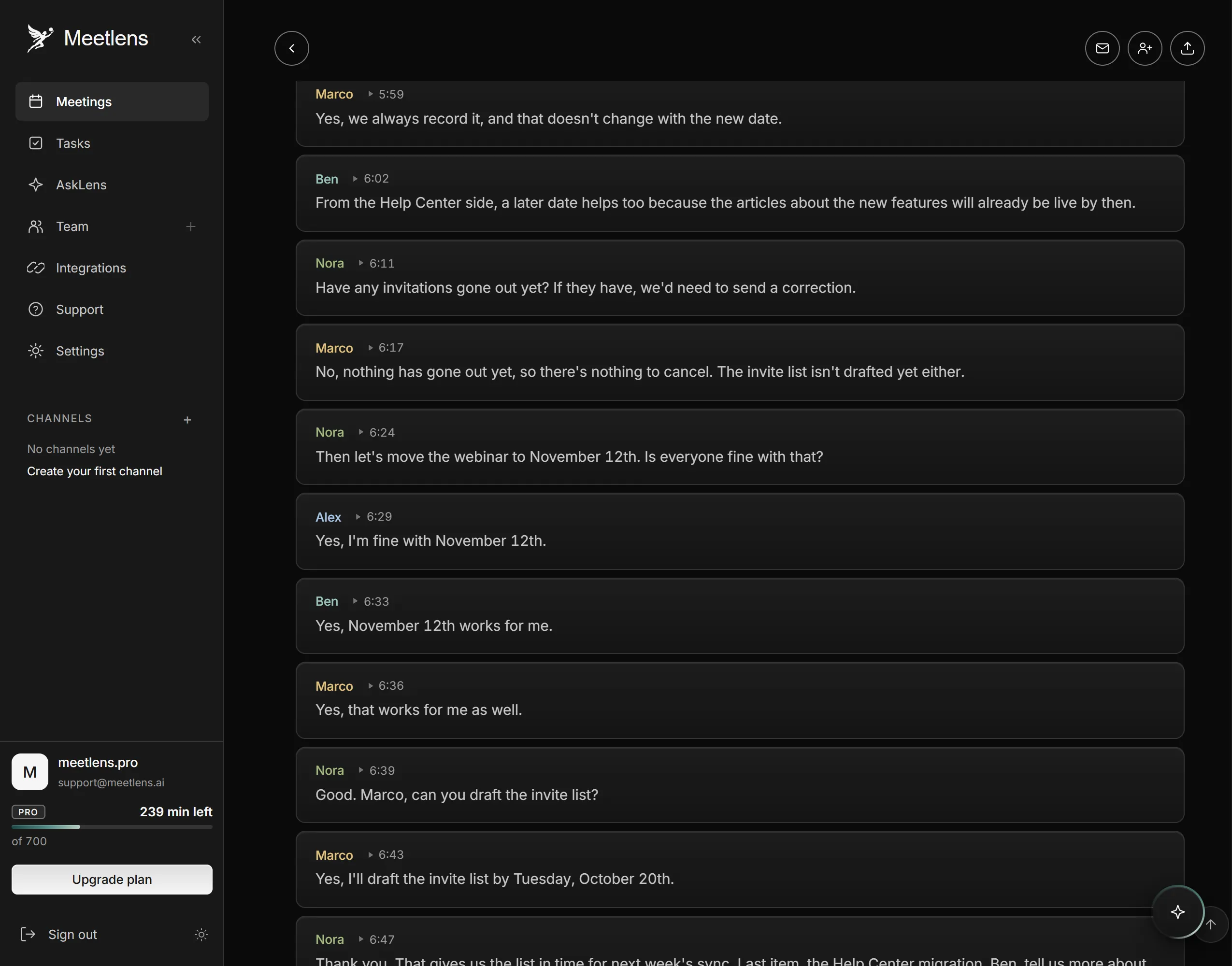
Here is a meeting transcript excerpt from a 4-person team sync, transcribed automatically with speaker labels and timestamps. This sample meeting transcript comes from a 10-minute staged test meeting (scripted conversation, synthetic voices), uploaded to Meetlens as an audio file and exported as TXT. The text is unedited; only the speaker names were set in the workspace.
[6:11] Nora
Have any invitations gone out yet? If they have, we'd need to send a correction.

[6:17] Marco
No, nothing has gone out yet, so there's nothing to cancel. The invite list isn't drafted yet either.

[6:24] Nora
Then let's move the webinar to November 12th. Is everyone fine with that?

[6:29] Alex
Yes, I'm fine with November 12th.

[6:33] Ben
Yes, November 12th works for me.

[6:36] Marco
Yes, that works for me as well.

[6:39] Nora
Good. Marco, can you draft the invite list?

[6:43] Marco
Yes, I'll draft the invite list by Tuesday, October 20th.
In about half a minute, the participants check that no invitations have gone out, make a decision (move the webinar to November 12), and agree on an action item with an owner and a date.
This conversation transcript example came out of AI meeting transcription in Meetlens, a Chrome extension that records browser meetings in Google Meet, Zoom Web, Microsoft Teams Web or Webex without a bot joining the call. Recordings of in-person meetings or desktop-app calls can be uploaded as audio or MP4 files. Transcription covers 99+ languages, and the Pro and Business plans export transcripts as TXT, Markdown or PDF.
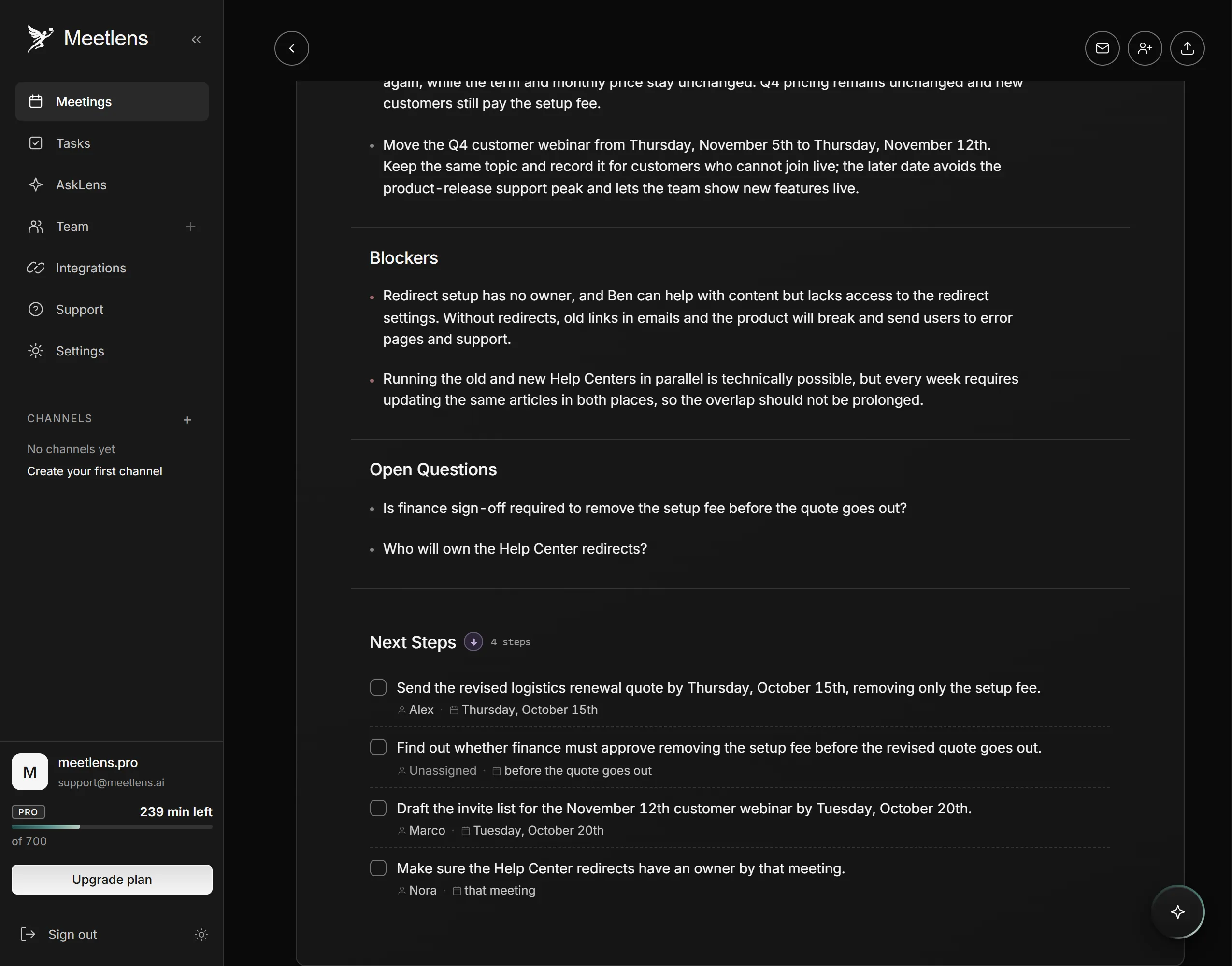
The Meetlens Team Sync report built from the same call turned this excerpt into a decision (move the Q4 customer webinar from November 5 to November 12) and a task for Marco due October 20.
How to write a transcript of a meeting
Meeting transcription takes four steps: record with consent, transcribe, fix names and terms, then add the header.
- Record with consent. Ask each person for a full-sentence yes ("Yes, I agree to the recording"); a bare "yes" can merge into a neighboring speaker's line. In a room, a voice recorder or a phone works. For privacy, tell people who will see the file.
- Transcribe the audio with an AI speech-to-text tool or a human service.
- Fix names and terms by replaying every spot you doubt.
- Add the header. Meetlens's TXT export starts with the title, date and duration; you add the participants and check that the date is the day of the meeting.
Interview transcript example
Interview transcripts use a Q&A layout — I: for the interviewer, R: or a participant code for the respondent — so answers can be coded line by line. In qualitative research, interview transcription puts one turn on each line, because each answer gets tagged with codes during analysis. Illustrative UX research interview with participant code P07:
Study: Meeting follow-up habits · Session P07 · October 6, 2026 · 00:41:20
I = interviewer · P07 = participant 7 (operations manager)

[00:03:10] I: Walk me through what happens after your weekly ops call.
[00:03:15] P07: I write the notes up in a doc, usually that evening.
[00:03:21] I: Who reads them?
[00:03:23] P07: My two shift leads, and [manager 1] if something's late.
[00:03:30] I: What goes missing from the notes?
[00:03:33] P07: Usually an owner or a date. [laughs]
The bracketed [manager 1] replaces a real name, so the text stays anonymized. For confidentiality, the UK Data Service advises one consistent replacement across transcripts and a log of every change, and warns that "removing names alone is rarely sufficient." Full-length interview transcript samples and dissertation templates are a separate topic, built on the same Q&A format.
Verbatim vs. clean verbatim transcript example
Verbatim transcription keeps every um, repeat and false start; clean verbatim transcription removes them but keeps the meaning and wording. Here is the same illustrative answer both ways:
| Verbatim | Clean verbatim |
|---|---|
| So, um, we— we looked at the, uh, the renewal numbers, and I— I think the, like, the price is, um, is the only thing they really, you know, pushed back on. [laughs] Yeah. | So we looked at the renewal numbers, and I think the price is the only thing they really pushed back on. |
The verbatim version keeps filler words and interjections ("um," "uh"), verbal habits ("like," "you know"), and stutters and false starts ("we— we"). Clean verbatim drops them for readability but doesn't fix grammar or reword.
Choose a verbatim transcript when every hesitation matters — in conversation research, or in legal work where a pause could change a statement's meaning. Even federal court transcripts, under the same format rules, leave out "false starts, stutters, uhms and ahs" unless "their exclusion could change a statement's meaning." Meetings and most interviews read better in clean verbatim.
Transcript with timestamps example
Timestamps go either at every speaker change or at fixed intervals, such as every 30 or 60 seconds; per-turn stamps make a conversation easy to scan, and interval stamps suit raw video footage. Speechpad's transcription timestamp guide calls periodic stamps "a popular choice for raw video footage" and says speaker-change stamps are "more commonly used for depositions, interviews, panel discussions, and conversational material." The same illustrative documentary interview, both ways:
Per-turn timestamps:
[00:00:21] Interviewer: Tell me about the first winter on the farm.
[00:00:25] Farmer: We had no heat in the barn that year, so all six of us slept in the kitchen, and my father kept the stove going all night.
[00:00:33] Interviewer: How old were you?
[00:00:35] Farmer: Nine.
Interval timecodes, every 30 seconds:
Interviewer: Tell me about the first winter on the farm.
Farmer: We had no heat in the barn that year, so all six of us [00:00:30] slept in the kitchen, and my father kept the stove going all night.
Interviewer: How old were you?
Farmer: Nine.
The meeting example above uses per-turn stamps in minutes and seconds. In documentary production, interval timecodes let an editor find a moment inside a long answer.
Legal transcript example
Legal transcription numbers every line and page and uses Q./A. for questions and answers, so lawyers can cite an answer by page and line. The federal format rules linked above set 25 lines of text per page, a number on each line, the page number in the top right corner, and "Q" and "A" at the left margin. Other speakers appear in capitals with a colon, as in the MR. HALE line below.
Illustrative example, not a real case: page 12 of a deposition.
                                                          12
 1  Q.  When did you first see the revised delivery
 2  schedule?
 3  A.  On March 3rd, in an email from the warehouse
 4  manager.
 5  Q.  Did you reply to that email?
 6  A.  Yes, the same day.
 7  Q.  What did your reply say?
 8            MR. HALE:  Objection to form.
 9  A.  That we couldn't meet the new date.
10  Q.  Who else received your reply?
To quote the witness's answer about the email, a lawyer cites page 12, lines 3–4.
Page 12 of a deposition
- Page number
1Q. When did you first see the revised delivery
2schedule?
- Line numbers
3A. On March 3rd, in an email from the warehouse
- Q. and A. at margin
4manager.
- Cited lines 3–4
5Q. Did you reply to that email?
6A. Yes, the same day.
7Q. What did your reply say?
8MR. HALE: Objection to form.
- Objection, indented
9A. That we couldn't meet the new date.
10Q. Who else received your reply?
Certified transcripts come from a court reporter. In federal court, the reporter or transcriber signs a certification on the last page of each volume. For depositions, Rule 30(f)(1) of the Federal Rules of Civil Procedure requires the officer to certify in writing that the witness was duly sworn and that the deposition accurately records the testimony. Many states accept the National Court Reporters Association's Registered Professional Reporter (RPR) credential in place of their own exam.
AI transcription doesn't replace that record in legal proceedings: Meetlens's transcription page, linked above, calls its output "an AI-generated working transcript, not a certified or professional record." If testimony may become evidence in court, book a certified court reporter.
AI transcript example: before and after review
AI transcription delivers text within minutes, but the raw output needs a review pass before you quote it: names, numbers and jargon first, then small words and sentence breaks. The same Meetlens page says the finished text "usually appears in your workspace within minutes" and that "overlapping speech, distant microphones, heavy noise, and unfamiliar terminology can increase errors." Speech-to-text output reads fluently, so a wrong word in transcribed audio is easy to miss. Four kinds of slips to look for, raw and reviewed:
Illustrative example: typical speech recognition slips, not output from a specific tool; names and details are invented.
| Raw output | Reviewed | Problem |
|---|---|---|
| "Thanks, May. Can you send it to Louise?" | "Thanks, Mei. Can you send it to Luis?" | Misheard names |
| "We have fifty seats left for the webinar." | "We have fifteen seats left for the webinar." | Sound-alike number |
| "It's waiting on the cue A sign-off." | "It's waiting on the QA sign-off." | Jargon heard as common words |
| "We ship Friday. If QA signs off, we tell the client." | "We ship Friday if QA signs off. We tell the client." | Wrong sentence break changes the meaning |
Some slips leave no trace on the page: a dropped word, or an extra one, shows only in the audio. Misheard words are real words, not typos, so spell-check proofreading misses them. Real calls add noise, crosstalk and jargon: replay the audio wherever a number, date or decision sits.
Human transcription services include this pass; with AI transcription, it's yours. In Meetlens, you correct the text and rename speakers in the meeting workspace. Results depend on the audio, so the next question is usually how accurate is AI transcription on real meetings.
What are the four types of transcription?
The four common types of transcription, the ways of turning recorded speech into a written transcript, are verbatim, intelligent (clean) verbatim, edited and phonetic.
- Verbatim: every word and sound, including filler words and false starts.
- Intelligent verbatim (clean verbatim): the same words without fillers and repeats; grammar stays as spoken.
- Edited transcription: corrects grammar and tightens sentences for publication.
- Phonetic transcription: symbols of the International Phonetic Alphabet show how each word sounds.
The examples of transcription above use the first two types.
Labels vary: TAUS, for example, uses "clean verbatim" as another name for edited transcription. Specialized formats such as legal and medical transcription sit on top of these types; medical transcriptionists "convert voice recordings from physicians and other healthcare workers into formal reports," in the words of the Bureau of Labor Statistics. For a wider look at what transcription is — its meaning, types and how it works — see the full explainer.
From transcript to summary, video and other languages
A transcript is raw material: most people next summarize it, transcribe a video file, or need transcription that handles two languages.
- To pull out decisions and action items, summarize a transcript with AI and check the result against the text.
- If the recording is a video file, here is how to transcribe a video in five ways.
- Calls where people switch languages mid-sentence need multilingual meeting transcription that handles code switching.
A translated transcript is a different thing: the finished text recreated in another language. Keep the original speaker labels and timestamps on each turn so a bilingual reader can check it against the recording.