Interview Transcript Examples: What a Good Transcript Looks Like
 Meetlens Editorial10 min readUpdated October 17, 2026
On this page
- What is an interview transcript?
- What does an interview transcript look like?
- Example 1: a qualitative research interview (intelligent verbatim)
- Example 2: the same excerpt in full verbatim
- Example 3: a job interview transcript
- Example 4: an anonymized, coded transcript
- Interview transcript template you can copy
- How do you type up an interview transcript?
- Before you transcribe: the recording and the guide
A good interview transcript is a word-for-word written record with a header, a labeled turn for every speaker, timestamps and consistent tags for unclear speech. If you're still learning how to transcribe an interview, finished interview transcripts side by side are the fastest way to get the format right. Below: the definition and parts, research, hiring and coded examples, a template, and how to type up your own.
What is an interview transcript?
An interview transcript is a written, word-for-word record of an interview that shows who spoke, what they said and when. It is the product of transcription, which turns recorded speech into written text. Researchers code it, journalists quote it, and anyone can check a claim in it against the audio recording. A transcript of an interview keeps the exact words of the interviewer and the interviewee; notes summarize, and minutes record decisions.
What does an interview transcript look like?
A usable interview transcript has a header, labeled speaker turns, timestamps and consistent tags for anything that isn't clear speech. Line numbers are optional.
- Header: metadata fields such as project, participant code, interviewer, date, style and consent.
- Speaker labels: I: for the interviewer, P07: for the participant. Transcription software assigns them through speaker diarization, so check every change of speaker.
- Timestamps: the HH:MM:SS position in the recording at each turn, so a quote leads straight to the audio.
- Line numbers: for citing or coding passages by line. In Word, choose Layout > Line Numbers > Continuous (Microsoft Support); in Google Docs, Tools > Line numbers, in pages format only (Google Docs Editors Help).
- Tags: notes in square brackets for what isn't clear speech, such as [inaudible 00:15:31], [laughs] or [overlap] for two people talking at once (some transcribers write [crosstalk]).
The parts of an interview transcript on one page
- Project:
- Post-call notes in remote teams
- Participant:
- P07 (operations manager, remote team of 9)
- Interviewer:
- I
- Date:
- 2026-03-12Duration: 00:41:18
- Style:
- intelligent verbatim
- Consent:
- written, confirmed on the recording at 00:00:20
- Transcribed:
- AI draft, proofread against the audio by the interviewer on 2026-03-14
- Excerpt:
- 00:14:02–00:15:55
- 110
[00:14:02] I: Walk me through what happens right after a client call ends.
- 111
[00:14:06] P07: Usually nothing for an hour. I have calls until noon, so the notes just wait.
- 112
And by then half of what I typed is fragments.
- 113
[00:14:19] I: What do the fragments look like?
- 114
[00:14:22] P07: Things like "Corinne, pricing, Friday." It meant something at ten.
- 115
By lunch I'm guessing whether Friday was her deadline or ours.
Lines 116–122 not shown
- 123
[00:15:15] P07: Nothing official. Some of us record the Tallowmere Freight calls now, because they change scope a lot.
- 124
Honestly, [inaudible 00:15:31] the recordings pile up.
- Header fieldsProject, participant code, interviewer, date, style and consent.
- Line numbersFor citing or coding passages by line.
- TimestampsThe HH:MM:SS position in the recording at each turn, so a quote leads straight to the audio.
- Speaker labelsI: for the interviewer, P07: for the participant.
- Inaudible tagA note in square brackets for what isn't clear speech, with its time.
Example 1: a qualitative research interview (intelligent verbatim)
This is a 2-minute excerpt from a semi-structured research interview, transcribed in intelligent verbatim. The study is qualitative research on how remote teams handle notes after client calls. In a semi-structured interview, the interviewer follows a guide but asks follow-ups freely. The Consent line records the participant's informed consent.
Illustrative example. The study, people and companies are fictional.
Project:      Post-call notes in remote teams
Participant:  P07 (operations manager, remote team of 9)
Interviewer:  I
Date:         2026-03-12          Duration: 00:41:18
Style:        intelligent verbatim
Consent:      written, confirmed on the recording at 00:00:20
Transcribed:  AI draft, proofread against the audio by the interviewer on 2026-03-14
Excerpt:      00:14:02–00:15:55

[00:14:02] I: Walk me through what happens right after a client call ends.
[00:14:06] P07: Usually nothing for an hour. I have calls until noon, so the notes just wait. And by then half of what I typed is fragments.
[00:14:19] I: What do the fragments look like?
[00:14:22] P07: Things like "Corinne, pricing, Friday." It meant something at ten. By lunch I'm guessing whether Friday was her deadline or ours.
[00:14:36] I: How do you settle that?
[00:14:38] P07: I message Corinne or I search the client's email thread. That's about ten minutes per call.
[00:14:50] I: Have you tried a different way of taking notes?
[00:14:53] P07: Yeah. Last spring the whole Tucson office switched to a shared doc for every call. It lasted three weeks. Nobody wanted to type while the client was talking.
[00:15:12] I: What replaced it?
[00:15:15] P07: Nothing official. Some of us record the Tallowmere Freight calls now, because they change scope a lot. Honestly, [inaudible 00:15:31] the recordings pile up.
[00:15:36] I: What would make the recordings useful?
[00:15:41] P07: Someone writing the decision down while it's fresh. I don't need the whole hour, just the two minutes where we agreed on Friday.
Interview transcript example: a research interview in intelligent verbatim
- Project:
- Post-call notes in remote teams
- Participant:
- P07 (operations manager, remote team of 9)
- Interviewer:
- I
- Date:
- 2026-03-12Duration: 00:41:18
- Style:
- intelligent verbatim
- Consent:
- written, confirmed on the recording at 00:00:20
- Transcribed:
- AI draft, proofread against the audio by the interviewer on 2026-03-14
- Excerpt:
- 00:14:02–00:15:55
[00:14:02] I: Walk me through what happens right after a client call ends.
[00:14:06] P07: Usually nothing for an hour. I have calls until noon, so the notes just wait. And by then half of what I typed is fragments.
[00:14:19] I: What do the fragments look like?
[00:14:22] P07: Things like "Corinne, pricing, Friday." It meant something at ten. By lunch I'm guessing whether Friday was her deadline or ours.
[00:14:36] I: How do you settle that?
[00:14:38] P07: I message Corinne or I search the client's email thread. That's about ten minutes per call.
[00:14:50] I: Have you tried a different way of taking notes?
[00:14:53] P07: Yeah. Last spring the whole Tucson office switched to a shared doc for every call. It lasted three weeks. Nobody wanted to type while the client was talking.
[00:15:12] I: What replaced it?
[00:15:15] P07: Nothing official. Some of us record the Tallowmere Freight calls now, because they change scope a lot. Honestly, [inaudible 00:15:31] the recordings pile up.
[00:15:36] I: What would make the recordings useful?
[00:15:41] P07: Someone writing the decision down while it's fresh. I don't need the whole hour, just the two minutes where we agreed on Friday.
In this interview transcript, intelligent verbatim, also called clean verbatim, drops ums, restarts and repeated words but leaves grammar as spoken. It keeps the participant's own wording and the [inaudible] tag; overlaps, laughter and pauses appear only in full verbatim.
Example 2: the same excerpt in full verbatim
Full verbatim keeps every um, restart, pause and overlap, so the same two minutes run noticeably longer. Here are the first six turns of the P07 interview transcript in full verbatim.
Illustrative example, same fictional interview.
[00:14:02] I: So, um, walk me through what happens right after a client call ends.
[00:14:06] P07: Usually? Usually nothing for, like, an hour. I have back-to-back— I have calls until noon, so the notes just wait. (2s) And by then, um, half of what I typed is fragments.
[00:14:19] I: What do the— what do the fragments look like?
[00:14:22] P07: Things like, uh, "Corinne, pricing, Friday." [laughs] It meant something at ten. By lunch I'm, I'm guessing whether Friday was her deadline or ours.
[00:14:36] I: Mm-hmm. And how do you settle that? [overlap]
[00:14:38] P07: [overlap] I just— sorry. I message Corinne or I, um, I search the client's email thread. That's, uh, about ten minutes? Per call.
These six turns run to 105 words against Example 1's 84, or 25% longer, not counting labels, timestamps or tags. The timestamps stay the same in both styles.
Full verbatim transcription adds filler words (um, uh, like), false starts (a form of speech disfluency), pauses such as (2s), [overlap] for overlapping speech and non-verbal cues such as [laughs], since laughter can change how a sentence reads. Use it when how something is said matters to the analysis. Conversation analysts use Jefferson notation instead, the transcription system Gail Jefferson developed (Jefferson, 2004): (0.5) is a pause timed in tenths of a second, (.) a micropause, and a left square bracket the start of overlapping talk.
The same six turns in intelligent and full verbatim
- Fillers
- False starts and repeats
- Pause, overlap, laughter
| Turn | Intelligent verbatimExample 1 | Full verbatimExample 2 |
|---|---|---|
| [00:14:02] I: | Walk me through what happens right after a client call ends. | So, um, walk me through what happens right after a client call ends. |
| [00:14:06] P07: | Usually nothing for an hour. I have calls until noon, so the notes just wait. And by then half of what I typed is fragments. | Usually? Usually nothing for, like, an hour. I have back-to-back— I have calls until noon, so the notes just wait. (2s) And by then, um, half of what I typed is fragments. |
| [00:14:19] I: | What do the fragments look like? | What do the— what do the fragments look like? |
| [00:14:22] P07: | Things like "Corinne, pricing, Friday." It meant something at ten. By lunch I'm guessing whether Friday was her deadline or ours. | Things like, uh, "Corinne, pricing, Friday." [laughs] It meant something at ten. By lunch I'm, I'm guessing whether Friday was her deadline or ours. |
| [00:14:36] I: | How do you settle that? | Mm-hmm. And how do you settle that? [overlap] |
| [00:14:38] P07: | I message Corinne or I search the client's email thread. That's about ten minutes per call. | [overlap] I just— sorry. I message Corinne or I, um, I search the client's email thread. That's, uh, about ten minutes? Per call. |
| Words | 84 wordsIntelligent verbatim | 105 wordsFull verbatim, 25% longer |
Example 3: a job interview transcript
A job interview transcript is a written record of a recorded hiring interview that lets the interview panel compare candidates on what they actually said. This excerpt is one answer to a behavioral question, which asks a candidate to describe a real past situation.
Staged test interview: the three roles were voiced with synthetic voices, the audio file was imported into Meetlens and the report built in the HR Interview format. Below is the Meetlens transcript of the answer, with speaker codes and HH:MM:SS times added; no words were corrected. The role, candidate and employer are fictional.
Role:               Customer support team lead
Candidate:          C3 (name kept in the hiring file)
Interviewers:       HM = hiring manager, R = recruiter
Date:               2026-09-15
Recording consent:  agreed by email, confirmed on the recording at 00:00:57
Excerpt:            00:01:48–00:02:35

[00:01:48] HM: Thank you. That's a helpful start. Let's go straight to the main question. Tell me about a time a customer escalation went wrong. What did you do?
[00:01:58] C3: I led a night shift team of 6. A customer's payroll run failed 2 nights in a row, and they escalated to our vice president.
[00:02:07] HM: What was your part in it?
[00:02:09] C3: The first night, I approved closing the ticket after a workaround. Nobody checked the next run. That was my mistake.
[00:02:17] R: And what did you change?
[00:02:19] C3: I called the customer the next morning and stayed on until engineering found the bug. Now payroll tickets stay open until the next successful run.
[00:02:28] HM: Did it work in the end?
[00:02:30] C3: No repeat payroll escalations in 6 months, and the customer renewed.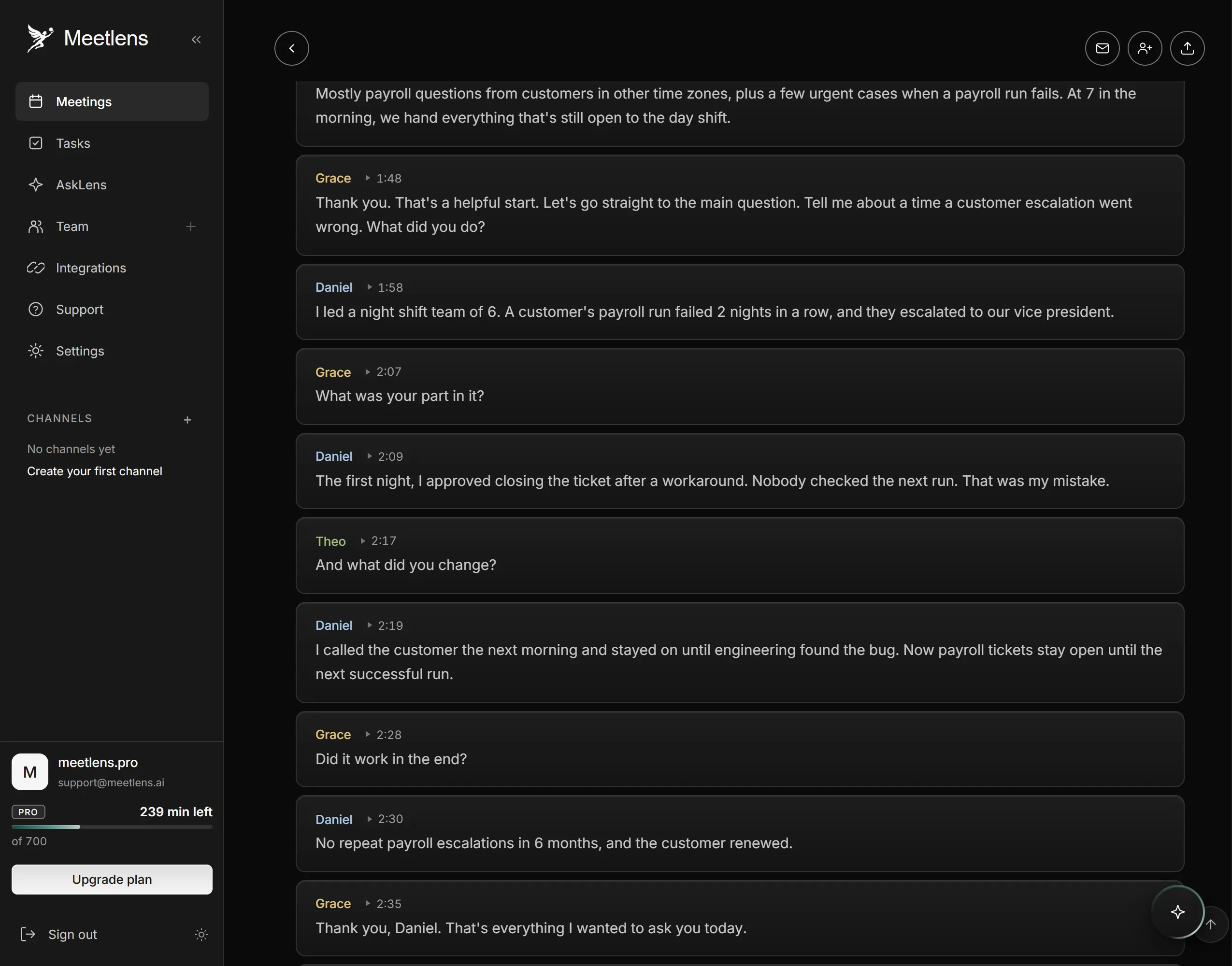
A hiring panel reads a job interview transcript for the situation, the candidate's own action and a checkable result; when every candidate gets the same behavioral questions, the transcripts compare line by line. In Meetlens, pick HR Interview in the format drop-down above Start recording to get a candidate assessment and brief along with the transcript.
Example 4: an anonymized, coded transcript
Before analysis, researchers replace names with codes and add qualitative codes in a margin column. Here are six lines of the P07 interview transcript from Example 1 after data anonymization and a first pass of qualitative coding. Corinne became [Person A], Tucson became [City] and Tallowmere Freight became [Company A].
Illustrative example, same fictional interview.
| Line | Transcript (de-identified) | Code |
|---|---|---|
| 114 | P07: Things like "[Person A], pricing, Friday." It meant something at ten. | FRAGMENTED NOTES |
| 117 | P07: I message [Person A] or I search the client's email thread. | WORKAROUND |
| 118 | That's about ten minutes per call. | TIME COST |
| 120 | P07: Yeah. Last spring the whole [City] office switched to a shared doc for every call. | TOOL SWITCHING |
| 123 | P07: Nothing official. Some of us record the [Company A] calls now, because they change scope a lot. | WORKAROUND |
| 124 | Honestly, [inaudible 00:15:31] the recordings pile up. | RECORDING BACKLOG |
A de-identified transcript with codes in the margin
- Line 114
P07: Things like "[Person A], pricing, Friday." It meant something at ten.
Code: FRAGMENTED NOTES - Line 117
P07: I message [Person A] or I search the client's email thread.
Code: WORKAROUND - Line 118
That's about ten minutes per call.
Code: TIME COST - Line 120
P07: Yeah. Last spring the whole [City] office switched to a shared doc for every call.
Code: TOOL SWITCHING - Line 123
P07: Nothing official. Some of us record the [Company A] calls now, because they change scope a lot.
Code: WORKAROUND - Line 124
Honestly, [inaudible 00:15:31] the recordings pile up.
Code: RECORDING BACKLOG
Two rules keep a coded interview transcript safe and consistent:
- Store the key apart from the data. The key links P07 and [Person A] to real people. Pacific University's IRB, for example, says data "must be stored separately from the master code key" (Pacific University IRB). The UK Data Service adds: mark replacements clearly, apply them consistently and log every change (UK Data Service).
- Take every code from a codebook, which defines each code once (WORKAROUND: an informal fix for a gap in the process), so everyone who codes the transcripts applies the same meaning.
A pseudonym, an invented first name, can replace P07 if it never changes. In thematic analysis (Braun and Clarke, 2006), codes roll up into themes: WORKAROUND and TIME COST might form "notes break down after back-to-back calls."
Interview transcript template you can copy
Copy this template, keep the header fields the same for every interview, and pick one style for the whole project. It has three parts: the header, the body pattern and a tag glossary that tells readers what each bracket means.
Project:      [study name]
Participant:  [code, e.g. P01] ([role or segment, never a real name])
Interviewer:  [I or initials]
Date:         [YYYY-MM-DD]        Duration: [HH:MM:SS]
Style:        [intelligent verbatim / full verbatim]
Consent:      [written / verbal], confirmed on the recording at [HH:MM:SS]
Transcribed:  [AI draft / by hand], proofread against the audio by [name] on [YYYY-MM-DD]

[HH:MM:SS] I: [question]
[HH:MM:SS] P01: [answer]

Tag glossary
[inaudible HH:MM:SS]              words you can't make out
[overlap]                         two people talking at once (full verbatim only)
[laughs]                          laughter (full verbatim only)
(2s)                              pause in seconds (full verbatim only)
[Person A], [Company A], [City] replaced identifiersIn a dissertation or thesis, interview transcripts your committee asks for go in an appendix; refer to it by label the first time you quote from it. APA Style labels a single appendix "Appendix" and several "Appendix A," "Appendix B" in order of first mention (APA Style).
How do you type up an interview transcript?
To type up an interview transcript, get a first draft from automatic transcription, then correct it against the audio line by line. That review pass is where accuracy comes from: play each turn, fix the words, check the label and timestamp, and add tags. The guide linked at the top covers the full process.
What an AI draft looks like before cleanup
Before an AI draft becomes a usable interview transcript, check it for four things: names and jargon, speaker labels, short replies and tags.
- Names and jargon can come out spelled by sound.
- Speaker labels can swap between similar voices, so check the first words of every turn.
- Short replies can vanish into a neighboring turn: a "yes" between two turns of the same speaker can end up inside that speaker's turn, so ask for full-sentence answers.
- Tags follow your own glossary, which no AI draft knows, so add them yourself.
Meetlens is a Chrome extension that records the audio of a browser call (Google Meet, Zoom Web, Microsoft Teams Web or Webex) without a bot joining, then produces a speaker-labeled transcription with timestamps in 99+ languages. For an in-person interview, import the recording instead: audio file formats MP3, WAV, M4A and OGG, or WebM and MP4, up to an hour per file on Free, an hour and a half on Pro and two hours on Business. On Pro and Business, you can download the transcript as TXT, Markdown or PDF, ready to proofread in your editor. No bot means no recording notice from Meetlens, so tell the interviewee yourself.
A transcript is only as good as the recording and the questions behind it.
Before you transcribe: the recording and the guide
Two decisions made before the first question shape every interview transcript: consent to record and the interview guide. Ask for consent before you press record, then again on the recording, so the Consent field can cite a timestamp:
I'd like to record this conversation so the transcript is accurate. Do you agree? Please answer in a full sentence, like "Yes, I agree to the recording."
Then ask every participant the same core questions from one guide, tied to your research question, so the transcripts line up when you compare them.