How to Transcribe an Interview in 7 Steps (Manual and AI)
 Meetlens Editorial9 min read
Last reviewed: October 13, 2026, against the guides and help pages linked below. Disclosure: we build Meetlens, one of the options in step 2.
On this page
- What does it mean to transcribe an interview?
- How long does it take to transcribe an interview?
- Which transcription style should you use?
- How to transcribe an interview step by step
- Manual, AI or a transcription service: which is easiest?
- How do you cite an interview transcript in APA?
- What to do with the interview transcript next
To transcribe an interview, you turn the recording into an interview transcript: a written record of who said what and when, checked against the audio. Here is how to transcribe an interview when it's a qualitative research interview you will code and quote: what transcription involves, how long it takes, which style to pick, 7 steps, manual vs AI vs a service, and APA quoting.
What does it mean to transcribe an interview?
Interview transcription is converting a recorded interview into text with speaker labels and timestamps, so it can be read, coded and quoted without replaying the audio. The interview transcript is the written record your interview analysis works from: you search it, tag passages and show reviewers the evidence behind each finding. In journalism, reporters transcribe interviews for the same reason: exact quotes.
A transcript of an interview differs from interview notes: notes keep what you judged important, the transcript keeps the whole conversation, in order.
How long does it take to transcribe an interview?
Transcribing an interview by hand takes about 4 to 8 hours for every hour of audio, and longer for full verbatim or conversation analysis. Three research sources set that range:
- A 2010 toolkit from the UK's National Centre for Research Methods (NCRM): four to seven hours per recorded hour for thematic content analysis, depending on typing speed, recording quality and interview complexity.
- The National Park Service: 6 to 8 hours on average.
- LSU's oral history center: 6 to 12 hours for word-for-word transcription, plus 2 hours for a second listener's check.
A foot pedal and transcription software cut manual transcription time by a third to a half, NCRM adds. Still, at NCRM's rate, transcribing interviews for a study of ten one-hour sessions means 40 to 70 hours of typing.
Which transcription style should you use?
Choose the style by what you will analyze: intelligent verbatim for most qualitative research, full verbatim when hesitations matter, and Jefferson notation only for conversation analysis. Here is one participant reply written into an interview transcript four ways (illustrative):
| Style | What it keeps | Use it for | The same reply |
|---|---|---|---|
| Full verbatim | Every word: filler words, false starts, repetitions, non-verbal cues such as [laughs] | Hesitation, emotion, how something was said | Um, so we— we tried the, uh, the shared spreadsheet first [laughs], and it just— honestly, it didn't stick. |
| Intelligent verbatim | The participant's words without fillers and false starts; grammar as spoken | Thematic analysis, most interview studies | We tried the shared spreadsheet first, and honestly, it didn't stick. |
| Edited transcription | The meaning, with grammar and punctuation corrected | Reports, publications, oral history archives | We tried a shared spreadsheet first, but it didn't stick. |
| Jefferson notation | Pauses, overlaps, stretched sounds, breaths and laughter, as symbols | Conversation analysis | u:m (0.6) so we- we tried the (.) uh the shared spreadsheet first heh heh .hhh an' it just- (0.4) honestly it didn't stick. |
Intelligent verbatim trades the detail of full verbatim transcription for readability: it drops filler words, false starts and other signs of speech disfluency, usually along with nonverbal communication such as [laughs]. Clean verbatim is another name for intelligent verbatim. Edited transcription goes further: its editing fixes grammar and punctuation, so a quote from it is no longer word for word.
Jefferson symbols come from Gail Jefferson's glossary: (0.6) is a pause of six tenths of a second, (.) a micropause, colons stretch a sound. Methods writers call the two ends of this range naturalism, which captures every utterance in as much detail as possible, and denaturalism, which corrects grammar and strips out pauses and other interview noise (a 2005 Social Forces article on interview transcription). Whichever style you pick, name it in the header (step 6).
How to transcribe an interview step by step
Prepare the recording, create a first draft by hand or with AI, add speaker labels and timestamps, proofread against the audio, anonymize the transcript, format it, and export it for analysis. The same steps answer how to write an interview transcript by hand.
1. Prepare the recording and your tools
Check the audio recording first: play the opening and closing minutes to judge audio quality. Then set up noise-cancelling headphones and a transcription player with hotkeys and a slower playback speed; a foot pedal keeps both hands on the keyboard. If you haven't recorded yet, see how to record interview audio that transcribes cleanly.
2. Create a first draft by hand or with AI
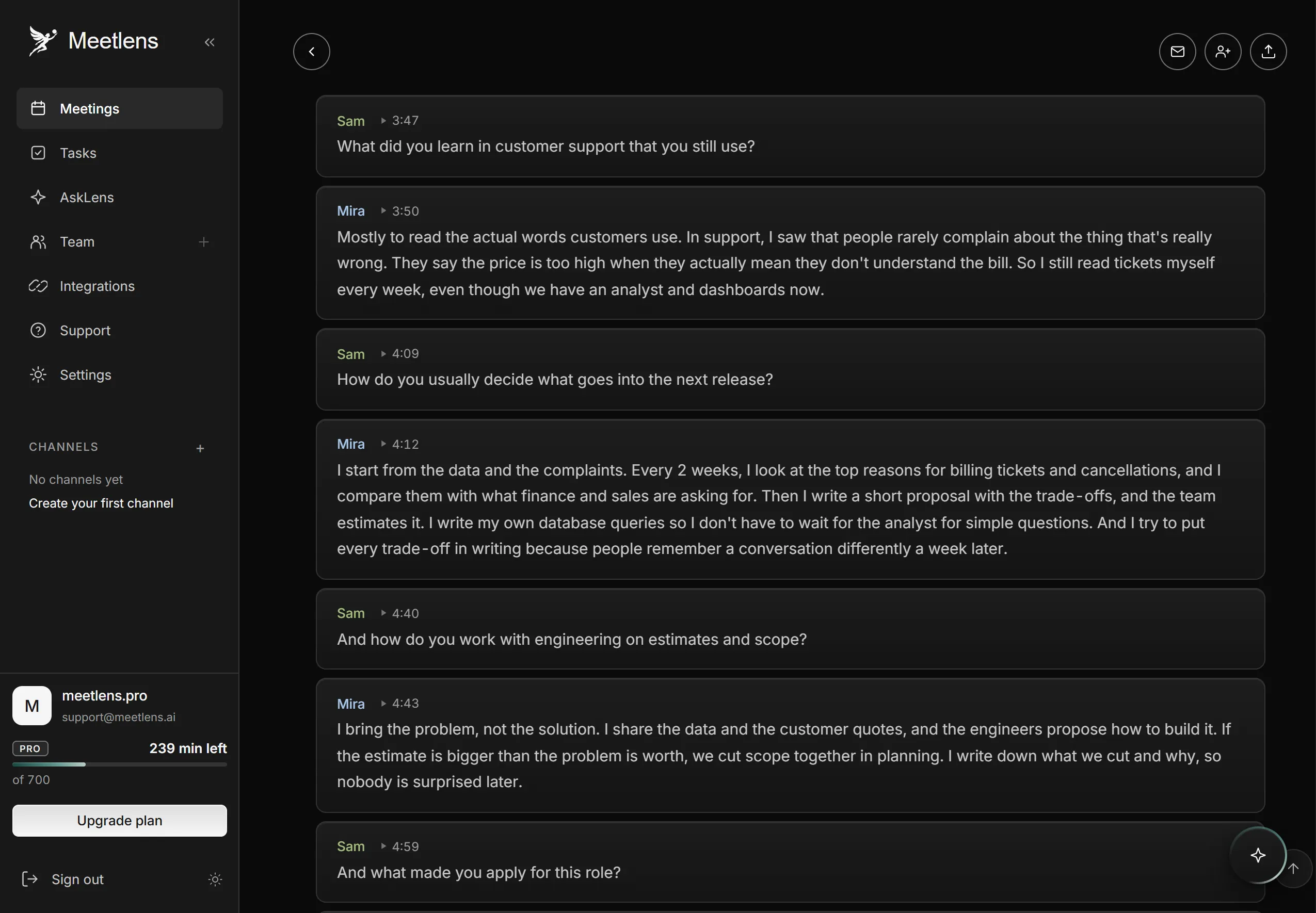
Type the interview audio into text yourself, or let automatic transcription draft it. By hand, play a few seconds, pause, type in Google Docs or Microsoft Word, and repeat. With AI, automatic speech recognition (ASR) drafts the text, and you check instead of typing.
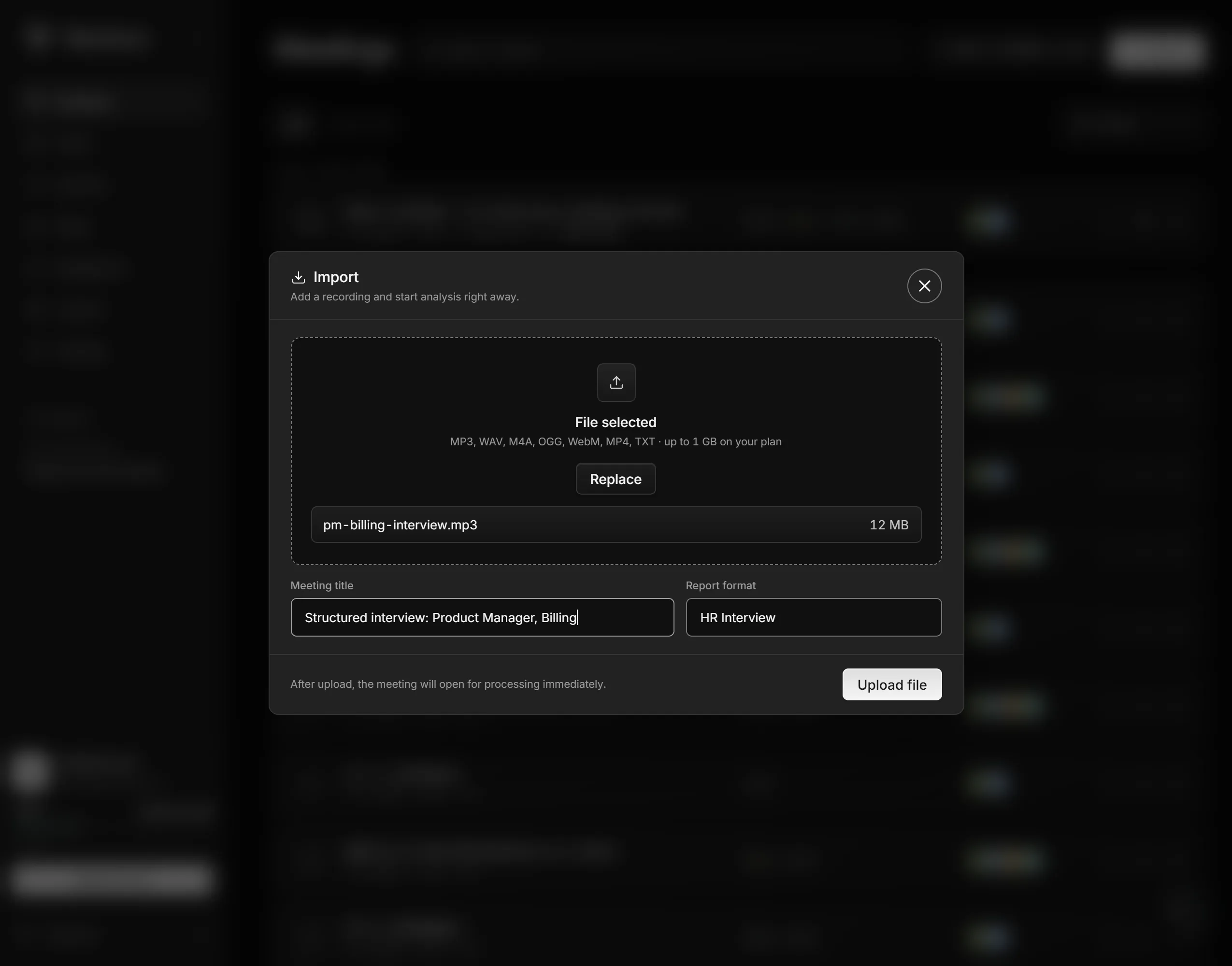
To get an AI draft, import an interview recording into Meetlens, including one from a voice recorder. It accepts common audio file formats (MP3, WAV, M4A, OGG, WebM) and MP4 video, up to 1 GB per file (3 GB on Business). A file can run 60 minutes on Free, 90 on Pro and 120 on Business; a longer one won't upload as a single file. Meetlens transcribes it in 99+ languages with speaker labels and timestamps and doesn't train its AI on your recordings. Remote interviews in Zoom Web, Google Meet, Microsoft Teams Web or Webex can instead be recorded with the Meetlens Chrome extension (not the desktop apps); no bot joins, so the platform shows participants no notice and telling them is up to you.
Can ChatGPT transcribe an interview? On paid plans, yes: OpenAI's help page allows audio files up to 512 MB but warns that the text may contain errors and that telling speakers apart may be unreliable. Use AI transcription on participant audio only if your ethics approval and data management plan allow it.
3. Add speaker labels and timestamps
Label every turn and add a timestamp at each change of speaker. Use I: for the interviewer and a code such as P07: for the participant. Transcription software adds speaker labels through speaker diarization (speaker identification in Meetlens), but check each one: a short "yes" can be merged into the neighboring speaker's turn.
Four lines of a research transcript, part by part
Participant: P07 (pseudonym "Dana")Interviewer: IStyle: intelligent verbatim
- 1
[00:00:05] I: Can you walk me through the last time your team planned a project?
- 2
[00:00:14] P07: We tried the shared spreadsheet first, and honestly, it didn't stick.
- 3
[00:00:21] I: What made it not stick?
- 4
[00:00:23] P07: Nobody owned it. [Company] had [inaudible 00:00:25] at the time.
- Speaker codesI: for the interviewer and a code such as P07: for the participant, on every turn.
- Time at a change of speakerA timestamp each time the speaker changes, here when P07 answers.
- Anonymization placeholder[Company] replaces an identifying name (step 5).
- Inaudible tagMarks words you can't hear, with their time in the recording (step 4).
4. Proofread against the audio
Proofread the whole interview transcript while listening, AI drafts included. The National Park Service guide says to "always review transcripts generated by voice recognition software for accuracy." Fix names and jargon, then mark what stays unclear with tags: [inaudible 00:12:31] for words you can't hear, [overlap] where people talk over each other.
5. Anonymize the transcript
Replace names and identifying details with a pseudonym or a placeholder such as [Company], as each participant's informed consent requires. Data anonymization goes beyond names: the UK Data Service guide warns that "removing names alone is rarely sufficient," because a rare occupation in a small community or a detailed timeline can still point to one person. Keep the key to real names in a separate, secured file. Check every replacement by eye: in the NCRM toolkit's example, swapping Tom for Mike with Find and Replace turned "tomorrow" into "mikeorrow."
6. Format the transcript
Start the file with a header of metadata, then turn on line numbers so you can cite passages by line. A minimal version (illustrative); for complete layouts, see a full interview transcript with examples:
Project: Team planning tools study
Participant: P07 (pseudonym "Dana")
Interviewer: I
Date: 2026-10-02 | Length: 00:42:18
Style: intelligent verbatim
Transcribed by: [initials] | Proofread by: [initials]

1  [00:00:05] I: Can you walk me through the last time your team planned a project?
2  [00:00:14] P07: We tried the shared spreadsheet first, and honestly, it didn't stick.
3  [00:00:21] I: What made it not stick?
4  [00:00:23] P07: Nobody owned it. [Company] had [inaudible 00:00:25] at the time.
7. Export it for analysis
Export the interview transcript in a format your analysis software reads, so qualitative coding — tagging passages with themes — can start. Computer-assisted qualitative data analysis software (CAQDAS), such as NVivo and MAXQDA, can also sync the text to its audio:
- NVivo 15 syncs a transcript to audio already in the project: on Windows, Word or RTF paragraphs that start with an hh:mm:ss timestamp (help); on Mac, TXT only, with a colon and a space after each speaker name (help).
- MAXQDA recommends DOCX and reads timestamps such as [hh:mm:ss] at the end of each paragraph (Import > Transcripts > Transcript with Timestamps), then asks for the audio file (manual).
Meetlens exports TXT, Markdown or PDF on Pro and Business. In the TXT file, each turn starts with a timestamp and speaker label, such as [12:31] Speaker B, and the words follow on the next line. Neither program documents that layout, so import the TXT as a plain document for coding. We haven't tested a synced import of a Meetlens transcript in NVivo or MAXQDA: if you need one, reformat a single transcript to your program's format and test it in your own setup before you convert the rest.
Manual, AI or a transcription service: which is easiest?
AI transcription with a human proofread is the easiest route for most interviews; manual transcription is the slowest but keeps the data on your computer; a human service costs the most per audio hour. The three transcription methods trade time, cost, accuracy and privacy:
| Manual | AI draft + your proofread | Human transcription service | |
|---|---|---|---|
| Time per audio hour | Longest: you type every word | Shortest: you check instead of typing | The service's turnaround, then your check |
| Cost | Your time | A free tier or a monthly plan | Highest; priced by audio length |
| Accuracy risk | Typos and skipped words when you tire | Misheard names and jargon, wrong speaker labels | Unfamiliar terms; the transcriber wasn't there |
| Privacy / IRB | Audio stays on your computer | Audio usually goes to a cloud service | A third person hears the audio |
| Best for | Sensitive data, conversation analysis | Most qualitative research | Large batches with a budget |
Accuracy in every column depends on the recording, so no method skips the proofread. Most AI services run on cloud computing, so the interview audio leaves your computer: confirm that your institutional review board (IRB) approved the service and, for participants in the EU, that processing meets the GDPR. A transcription service needs the same approval plus a confidentiality agreement.
How do you cite an interview transcript in APA?
APA Style has no required layout for an interview transcript; what it regulates is how you quote participants. Under APA's guidance on quoting research participants (Publication Manual, 7th edition, Section 8.36), their quotations are part of your original research, so they need no citations or reference list entry and aren't personal communications.
- Fewer than 40 words: quotation marks within your sentence.
- 40 words or more: a block quotation, indented below the text.
- Attribution: say the words come from participants; use a pseudonym or code.
Example (illustrative): "Dana" (P07) said the team's spreadsheet "didn't stick" because "nobody owned it."
If your thesis or dissertation committee wants full transcripts and your consent form allows it, put each one in an appendix at the end of the thesis (Section 2.14), labeled Appendix A, B and so on.
What to do with the interview transcript next
A clean interview transcript is raw data, not a finding, so the next step is analysis. To turn a set of interview transcripts into themes and quotes, see how to summarize an interview. If a word-for-word record is more than a project needs, learn how to take interview notes instead. For the next round, start from a user research interview template, so every session covers the same core questions and the answers compare cleanly.