How to Take Interview Notes as an Interviewer (Template and Example)
 Meetlens Editorial13 min readUpdated October 17, 2026
On this page
- What are interview notes?
- Why should interviewers take notes?
- How to take interview notes: before, during and after
- What to write in interview notes
- Interview notes template
- Interview notes example
- What not to write: legal limits on interview notes
- Should you record the interview instead of taking notes?
- From notes to a summary — and a note for candidates
To take interview notes as an interviewer, set up one block per question before the call, capture evidence and short verbatim quotes while the candidate talks, and finish and score your notes the same day. Even with a transcript of an interview on file, your job interview notes decide what the panel remembers at the debrief. Below: how to take interview notes, what to write, a template, an example, legal limits and recording.
What are interview notes?
Interview notes are the interviewer's record of what a candidate said and did in a job interview, written against the questions and criteria for the role. They feed the evaluation but are not the evaluation itself: you rate the candidate after the interview, from the notes. Three documents often get mixed up:
| Document | What it holds | Who writes it, and when |
|---|---|---|
| Interview notes | Answers, examples and short quotes, question by question | The interviewer, during the interview and the same day |
| Interview summary | A rating for each criterion and a hire or no-hire recommendation | The interviewer, after scoring |
| Transcript | Every word, in order, with speaker labels | A person or software, from the recording |
Why should interviewers take notes?
Interview notes let you compare candidates on evidence instead of memory, defend the hiring decision later and give a useful debrief. Four reasons:
- Comparison. Notes organized by question line up across candidates, so you compare answer 3 with answer 3.
- Memory. Memory keeps the impression and drops the details: the number, the tool, who made the call.
- Debrief. In the debriefing after a panel interview, each interviewer reports evidence for each criterion. Without notes, you report a feeling.
- Record. Interview notes document the hiring decision, and federal rules set how long you keep them (see the legal section below).
How to take interview notes: before, during and after
Prepare a page per question before the job interview, write down evidence and short quotes during it, and finish and score your interview notes the same day. Good note-taking starts before the call: the less you decide while the candidate talks, the more you hear.
Before the interview
- Get the interview guide and the criteria, and know which criterion each question tests.
- Give each question its own page. Jacob Kaplan-Moss, who writes about hiring engineers, recommends printing the interview guide "one question per page" and taking notes directly on the printout.
- Pre-write follow-up questions under each question ("What did you do next?"), so you don't compose them while listening.
During the interview
Taking notes during an interview as the interviewer means capturing evidence, not judging it. "During the interview, be more like a stenographer," Kaplan-Moss writes; judgment comes after.
- Tell the candidate you'll take notes. It keeps rapport when you look down at the page:
I'll be taking notes as we talk, so I can review your answers fairly later. If I pause, I'm just catching up.
- Jot down facts, not sentences. Use shorthand: a dash per fact, an arrow for a result, "?" for a gap. Put key phrases in quotation marks, word for word.
- Mark the STAR method beside each story. Write S, T, A and R (Situation, Task, Action, Result) next to the lines that cover each part. An empty letter is your next follow-up question.
- Pause when you need to. "Don't be afraid of 10-15 seconds of silence," Kaplan-Moss advises.
- Keep eye contact. Write in short bursts and look up between sentences; active listening, such as a nod or a short paraphrase, shows you're following.
- Choose paper over a laptop. Typing can feel rude in person, and on a video call the candidate hears the clicks, so Kaplan-Moss recommends writing by hand.
What is the 80/20 talking rule in interviewing?
The 80/20 talking rule in interviewing is a rule of thumb: the candidate talks about 80% of the time and the interviewer about 20%. It is a habit from interviewing practice, not a research finding. The less you talk, the more time you have to take notes.
After the interview
- Finish your notes the same day. Expand the shorthand, fill in the STAR fields and mark doubts with "?" instead of guessing. Kaplan-Moss draws his conclusions "immediately after the interview, if possible, and within 24 hours at the most."
- Match evidence to criteria. A note that fits no criterion is usually an impression.
- Score each criterion separately, then add up. In Thinking, Fast and Slow (chapter 21, "Intuitions vs. Formulas"), Daniel Kahneman advises collecting information "on one trait at a time" and scoring each trait before the next to avoid halo effects, then adding up the scores.
- Score before you see other interviewers' ratings. In the U.S. Office of Personnel Management's guidance on structured interviews, each panel member "rates applicant responses individually and then participates in a group discussion."
What to write in interview notes
In interview notes, write what the candidate did and said — examples, numbers, decisions, exact phrases — and leave out how they made you feel. OPM sets the same rule for federal interviewers: notes "should describe the applicant's answers to the questions and not their personal traits or the interviewer's perception of the individual" (OPM FAQ).
Here is one illustrative answer to "Tell me about a process you improved":
"New support hires took three weeks before they worked the queue alone. I rewrote the onboarding checklist and recorded videos for the ten most common request types. My manager wanted to keep the shadowing week, so I tested the change with two hires first. Onboarding dropped to nine days, and we rolled it out to the team."
The same answer, noted five ways:
| Weak note | Evidence-based note | What changed |
|---|---|---|
| Seemed sharp | Cut onboarding for new support hires from 3 weeks to 9 days | A result, with numbers |
| Strong leader | "I rewrote the onboarding checklist"; videos for the top 10 request types | Own actions, in the candidate's words |
| Good with stakeholders | Manager wanted to keep the shadowing week → tested with 2 hires first | A decision and how it was made |
| Seemed nervous at first | (nothing) | An impression, not a job criterion |
| Gut feeling: strong yes | Rating left blank until after the interview | Judgment moves to scoring |
Verbatim quotes are your strongest evidence; keep each to a phrase. Note what's missing, too: "no result given" is evidence. Record nonverbal communication only when the job calls for it, such as client presentations, and describe the behavior instead of reading into it: "read from slides for most of the demo," not "lacks confidence." "Great culture fit" or "reminds me of myself" records the interviewer's bias, not the candidate's answer.
Interview notes template
An interview notes template needs a header filled in before the interview and one block per question with STAR fields, a quote line and a rating. Copy it, paste in the questions from your guide, and print one block per page if you write by hand:
INTERVIEW NOTES
Candidate:                    Role:
Interviewer:                  Panel role:
Date:                         Format: video call / in person
Recording: no / yes, consent at [mm:ss]
Criteria for this interview: [criterion 1] · [criterion 2] · [criterion 3]

Q[n]. [Question, word for word from the guide]
Criterion: [what this question tests]
Follow-ups ready: [1] [2]
S  Situation:
T  Task:
A  Action (what they did, "I" or "we"):
R  Result (numbers, outcome):
Quote: "[exact words]"
Timestamp: [mm:ss, if recorded]
Gaps / follow-up asked:
Rating (after the interview):  1   2   3   4
Evidence for the rating:

[Repeat the block for each question]

AFTER THE INTERVIEW
Written up on: [date]
Rating by criterion: [criterion 1] _ · [criterion 2] _ · [criterion 3] _
One question block of the interview notes template, ready to print
Interview notes
- Candidate:
- Role:
- Interviewer:
- Panel role:
- Date:
- Format:
- video call / in person
- Recording:
- no / yes, consent at [mm:ss]
- Criteria for this interview:
- [criterion 1] · [criterion 2] · [criterion 3]
Q[n]. [Question, word for word from the guide]
Criterion: [what this question tests]
Follow-ups ready: [1] [2]
Situation:
Task:
Action (what they did, “I” or “we”):
Result (numbers, outcome):
Quote:“[exact words]”
Timestamp:[mm:ss, if recorded]
Gaps / follow-up asked:
Rating (after the interview):1234
Evidence for the rating:
[Repeat the block for each question]
Give every score a description. A 1–4 rating scale has no middle score to hide in; Kaplan-Moss uses four points too, +1, +0, −0 and −1. A 1–3 scale suits short screening calls. Scales where each number describes observable behavior are called behaviorally anchored rating scales (BARS); in the same OPM guidance, the most structured interviews are "scored according to benchmarks of proficiency." A scoring rubric for one criterion (illustrative):
| Rating | Stakeholder management: what the evidence shows |
|---|---|
| 1 | No example, or the candidate avoided the disagreement |
| 2 | Raised the disagreement, but gave no data or alternative |
| 3 | Disagreed with data, offered an alternative and reached an agreement |
| 4 | All of 3, plus an example of the stakeholder backing the approach later |
If your company uses an applicant tracking system (ATS), copy the ratings and evidence lines into its scorecard the same day.
Interview notes example
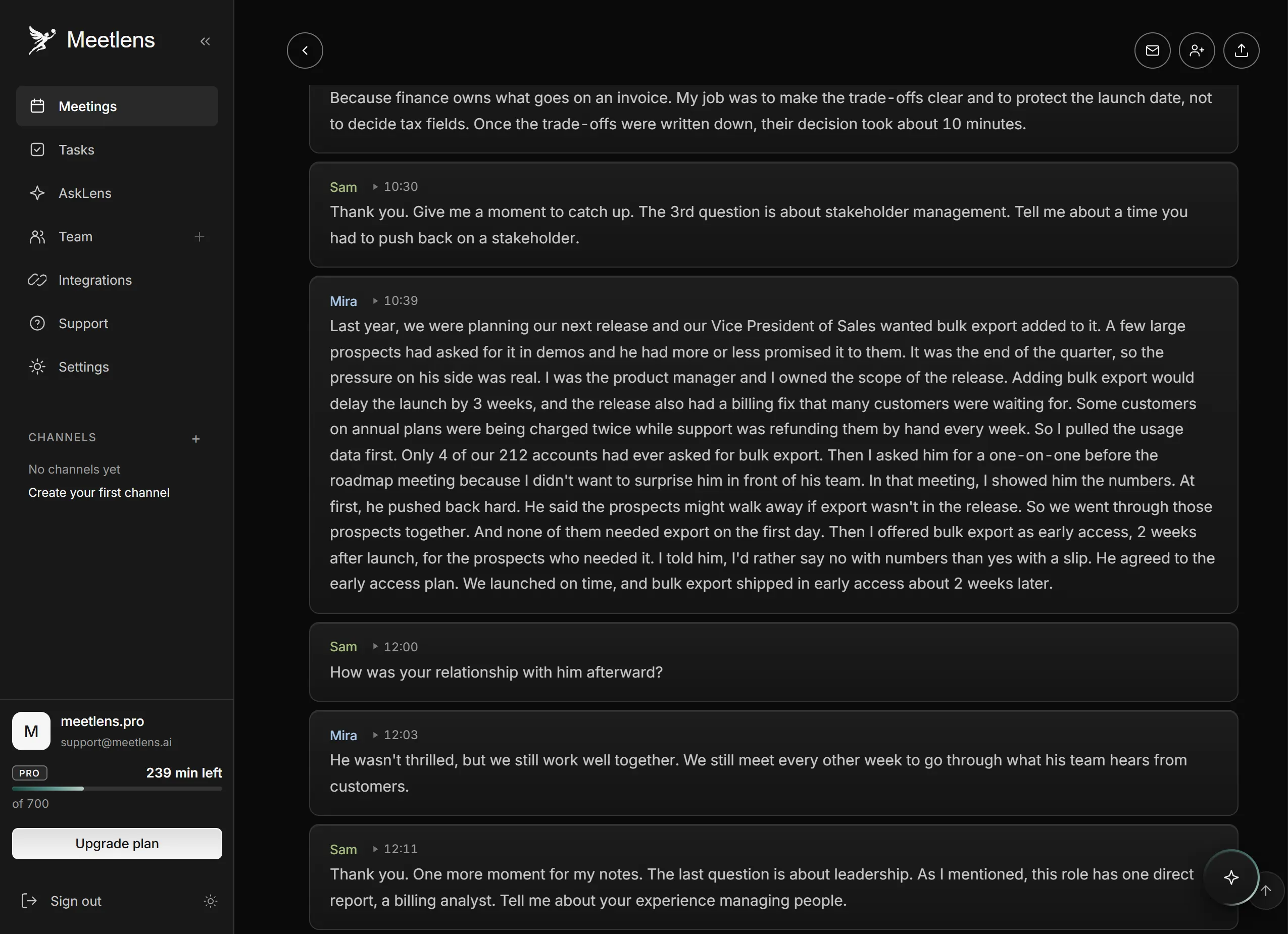
This interview notes example shows one behavioral job interview question twice: as shorthand written during the call, and as the template block finished after it. The question is "Tell me about a time you had to push back on a stakeholder"; the criterion is stakeholder management. The answer comes from a staged test interview (synthetic voices, audio file imported into Meetlens); both versions of the notes are illustrative, written for this article, and their quotes match the Meetlens transcript.
Version 1: during the interview, by hand.
Q3 push back on stakeholder        crit: stakeholders
S  next release; sales VP wants bulk export added
T  cand = prod. mgr, owns scope; export = +3 wks to launch
A  - pulled usage data: 4 of 212 accts asked for export
   - 1:1 w/ VP before roadmap mtg
   - offered export as early access 2 wks after launch
   - "I'd rather say no with numbers than yes with a slip"
R  VP agreed to early-access plan; launched on time; export ~2 wks later
?  relationship after? → ASKED
   "He wasn't thrilled, but we still work well together"
In version 1, "?" marks a gap in the story, and "→ ASKED" shows the gap was closed during the interview.
Version 2: after the interview, in the template.
Q3. Tell me about a time you had to push back on a stakeholder.
Criterion: Stakeholder management
S  Situation: Next release; the sales VP wanted bulk export added.
T  Task: Candidate was the product manager who owned scope;
   bulk export would delay the launch by 3 weeks.
A  Action: Pulled usage data (4 of 212 accounts had asked for bulk
   export). Met the VP 1:1 before the roadmap meeting. Offered bulk
   export as early access 2 weeks after launch.
R  Result: VP agreed to the early-access plan. Launched on time; bulk
   export shipped in early access about 2 weeks later.
Quote: "I'd rather say no with numbers than yes with a slip."
Gaps / follow-up asked: Relationship afterward? "He wasn't thrilled,
   but we still work well together."
Rating (after the interview): 3
Evidence for the rating: Disagreed with data, offered an alternative,
   agreement reached. Not a 4: no example of the VP backing the
   approach later.
Version 2 adds no new facts. It expands the shorthand, sorts each line under its STAR field and adds a rating with its evidence, measured against the scale in the template section.
What not to write: legal limits on interview notes
Keep interview notes strictly job-related: comments on age, family, health, religion, national origin or other protected characteristics can become evidence of discrimination. The EEOC lists the protected characteristics, also called protected classes, as race, color, religion, sex (including transgender status, sexual orientation and pregnancy), national origin, age (40 or older), disability and genetic information. They come from four of the federal laws the EEOC enforces: Title VII of the Civil Rights Act of 1964, the Age Discrimination in Employment Act (ADEA), the Americans with Disabilities Act (ADA) and the Genetic Information Nondiscrimination Act (GINA). Most employers with at least 15 employees are covered, or 20 in age cases (EEOC overview).
Leave these out, even when the candidate brings them up:
- age or generation ("young and energetic", "close to retirement");
- children, pregnancy, marriage plans or childcare;
- health and disability: employers are "explicitly prohibited from making pre-offer inquiries about disability," says the first EEOC page above;
- illnesses or medical conditions in the candidate's family, which GINA treats as genetic information;
- religion, gender, race or where the candidate's family comes from.
Retention. Treat interview notes as hiring records and keep them for the minimum set in the Code of Federal Regulations (CFR):
| Who | How long | Rule |
|---|---|---|
| Employers | 1 year from the date the record was made or the hiring decision, whichever is later | 29 CFR 1602.14, which covers "records having to do with hiring" |
| Federal contractors with 150+ employees and a government contract of at least $150,000 | 2 years; 1 year if either threshold isn't met | 41 CFR 60-741.80, the Rehabilitation Act Section 503 rule, which lists "interview notes" by name |
| An employer facing a discrimination charge | All relevant records until the charge or lawsuit is finally resolved | 29 CFR 1602.14 |
A parallel two-year rule for federal contractors under Executive Order 11246, 41 CFR 60-1.12, is rescinded effective October 26, 2026 (Federal Register). When a retention period ends, delete the notes under your company's data retention policy.
Write as if a lawyer will read every line. Interview notes are documentation of the hiring process, and if a hiring decision is challenged, they "may be reviewed during litigation (i.e., be discoverable)," the same OPM FAQ says.
Should you record the interview instead of taking notes?
Record when you can get consent to record, and keep light interview notes anyway: timestamps of the strongest answers and your follow-up questions. A recording keeps exact quotes and lets a hiring manager who wasn't there check an answer; weighing the evidence against criteria stays with you. Light notes with timestamps show where to find each answer in the recording before the debrief (illustrative):
Recorded: yes, consent at 00:40
04:15  Q1 strong example, has numbers
12:30  Q3 quote on pushback, check exact wording
21:05  ? start date, confirm with recruiter
33:50  Q5 weak, no result given
Ask before you press record: federal law requires one party's consent, but several states, including California, Florida, Illinois, Maryland, Massachusetts, Pennsylvania and Washington State, require everyone on the call to agree (RCFP). Record a job interview with your meeting platform's recorder or a browser recorder, then confirm consent on the recording:
I'd like to record this interview so I can listen to you instead of writing everything down. Only the hiring team for this role will use the recording. An AI notetaker will transcribe it and draft notes for the team; people make the hiring decision. If that's okay with you, please say "Yes, I agree to the recording."
AI rules. Don't paste interview notes or candidate details into an AI tool your company hasn't approved, such as a personal ChatGPT account. If you use AI to analyze or rate candidates, state and city laws can add duties, for example:
- Illinois. The Illinois Artificial Intelligence Video Interview Act covers employers that ask applicants to record video interviews and use AI to analyze them, for positions based in the state. Before the interview, the employer must tell each applicant that AI may be used, explain how it works and what general types of characteristics it evaluates, and get consent. Since January 1, 2026, the Illinois Human Rights Act also bars AI with a discriminatory effect in hiring and requires employers to give notice when they use AI in recruitment or hiring (Public Act 103-0804). Its definition of AI includes generative AI, and the law leaves how and when to give notice to rules from the Illinois Department of Human Rights.
- New York City. NYC Local Law 144 covers automated employment decision tools (AEDTs) that substantially assist or replace discretionary decision-making in hiring for jobs in the city. Per the city's AEDT FAQ, it requires a bias audit within the past year, a public summary of the results, and notice to candidates who live in the city 10 business days before use.
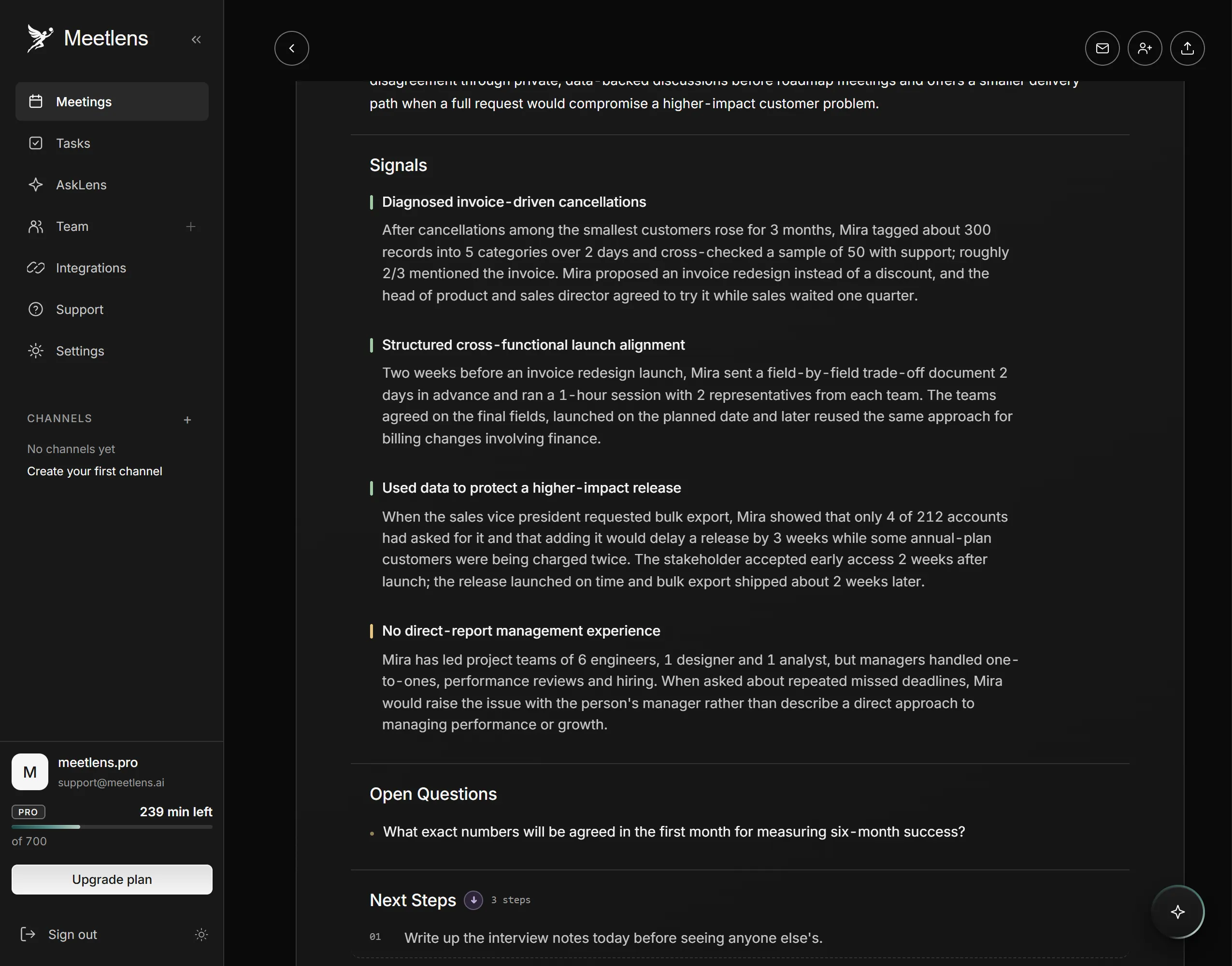
An AI notetaker can take over the writing on browser calls. Meetlens is a Chrome extension that records the audio of a browser meeting — Google Meet, Zoom Web, Microsoft Teams Web or Webex — without a bot joining the call. Pick HR Interview in the format drop-down above Start recording and allow microphone access, so your own questions are recorded too. After the call, you get a transcript with speaker labels and timestamps and an HR Interview report: AI interview notes to use as a draft, while the rating and the hiring decision stay with you.
No bot means the platform shows the candidate no recording notice, so the consent request is yours; ask for a full sentence, because a one-word "yes" may not get its own transcript line. To check a quote before the debrief, add the interview to the AI chat with Add context and ask "What did the candidate say about team size?"; answers link to moments in the recording, so check each one there. A recording runs up to an hour on Free, 90 minutes on Pro and two hours on the Business plan. Meetlens records audio only and doesn't capture video, the desktop Zoom or Teams apps, or phone screening calls; for an in-person interview, upload a recording made with consent. Meetlens doesn't train its AI on your recordings.
From notes to a summary — and a note for candidates
Interview notes become an interview summary when you turn the evidence for each criterion into a rating and add a hire or no-hire recommendation. Notes are input; the decision comes from what you do with them. Write the summary from the finished template blocks, one piece of evidence per rating, before the debrief.
Can candidates take notes in an interview?
Yes, candidates can take notes in a job interview: a few key points about their own examples and a list of questions for the interviewer. Ask first ("Do you mind if I take a few notes?") and glance at the page; don't read prepared answers from it. At the end, write down the interviewers' names and the next steps for your thank-you email.