How to Summarize an Interview: Template and Examples for Hiring Teams
 Meetlens Editorial10 min readUpdated October 17, 2026
On this page
- What is an interview summary?
- What should an interview summary include?
- How to write an interview summary in 6 steps
- Interview summary template
- Interview summary examples
- Narrative or Q&A: which interview report format should you use?
- How to check an AI-generated interview summary
- Summarizing a research or customer interview instead
To summarize an interview, sort the evidence from your notes or recording by hiring criterion, rate each criterion, and end with a clear recommendation, written the same day. A job interview summary rests on evidence: your notes, the recording, or a word-for-word record if you know how to write a transcript of an interview. Here's how to summarize an interview in steps, with a template, examples and an AI check.
What is an interview summary?
An interview summary is a one-page record of what a candidate showed in a job interview, organized by hiring criteria and ending in a clear recommendation. The recruiter and the hiring manager read it to compare candidates and choose the next step without replaying the call. Hiring teams also call it an interview report, an interview write-up or a scorecard summary.
The interview summary is built from two rawer records:
| Record | What it holds | Order |
|---|---|---|
| Interview notes | Short phrases you wrote during the call | As things were said |
| Transcript | Every word of the recording, with speaker labels | As things were said |
| Interview summary | Evidence, a rating per criterion and a recommendation | By criterion |
What should an interview summary include?
Include the context, evidence for each criterion, strengths, concerns, open questions and a recommendation — and nothing about the candidate's personal life. Seven fields cover it:
- Context: candidate, role, stage, interviewer, date and the evidence source: notes, recording or transcript.
- Criteria: the competencies this interview tested, the same for every candidate.
- Evidence and rating per criterion: what the candidate said or did, where it sits in your notes or the recording, and your rating.
- Strengths: two or three points the evidence supports.
- Concerns and risks: gaps, vague answers or missing experience, each tied to evidence.
- Open questions: what you couldn't test, for the next interviewer to probe.
- Recommendation: advance, hold or decline, with a one-line reason.
Leave out the candidate's personal life and anything you didn't observe. Privacy matters because a job interview summary travels to people who never met the candidate. It can also resurface: the structured interview training from the U.S. Office of Personnel Management (OPM) notes that interview notes can be reviewed in an appeal and may decide whether a rating stands.
How to write an interview summary in 6 steps
Set the criteria before the job interview, capture evidence during it, then sort that evidence by criterion, rate it, write the recommendation and send it the same day. The same six steps answer how to write an interview report, whatever your team calls the document.
1. Set the criteria from the job description
Pick 4–6 competencies from the job description before the first job interview, the typical range in the OPM training, and ask every candidate the same questions in the same order. That makes it a structured interview: the same questions, the same rating scale and detailed notes for every candidate.
Structure pays off. In a 2022 Journal of Applied Psychology review of personnel selection research, Sackett and colleagues found that structured interviews had the highest mean validity of the selection methods they examined, .42, well ahead of unstructured interviews. Validity here is the correlation with job performance; 1.0 would be a perfect prediction.
2. Capture evidence during the interview
Write down what the candidate said or did in the job interview, not your opinion of it, and note the minute of each strong or weak answer. Behavioral evidence, a specific past situation and the candidate's own actions in it, outweighs claims such as "I'm a strong communicator"; OPM's behavioral questions rest on the premise that past behavior in similar circumstances best predicts future behavior on the job. An audio recording, made with the candidate's consent, keeps the exact words, and your time marks become its index.
3. Sort the evidence by criterion, not by time
Tag each key point in your notes with the criterion it supports. An answer about a conflict with another team goes under teamwork, even if it came up during the leadership question. Points that support no criterion stay out of the interview summary.
4. Rate each criterion on an interview scorecard
Rate each criterion separately on your interview scorecard, the scoring rubric your team agreed on for the role. OPM recommends one rating scale for all competencies, typically 3 to 7 levels, with behavioral examples written for each level; scales built this way are called behaviorally anchored rating scales. Anchors for problem-solving on a 4-level scale might read:
- 1, weak: restates the problem; no plan.
- 2, mixed: proposes a fix without checking the cause.
- 3, meets: finds the cause with data, then proposes a fix.
- 4, strong: does all of 3 and names the result that would prove the fix wrong.
Candidate evaluation one criterion at a time guards against the halo effect: one strong answer lifting every other rating. OPM's training lists it with rater bias among the rating errors to avoid.
5. Write the recommendation, concerns and open questions
End with advance, hold or decline and a one-line reason that points to the ratings. Your recommendation feeds the hiring decision; the panel makes it. Add the concerns that could change the call and the follow-up questions the next round should ask.
6. Send it before the debrief
Submit your interview summary the same day, before you read anyone else's ratings, so yours stay independent. In OPM's process, each interviewer rates individually first; the panel then compares ratings, and where they differ, each interviewer explains theirs from notes until the panel reaches consensus.
Interview summary template
Copy this template into your ATS note or a doc; keep the same headings for every candidate and every interviewer on the panel. Ratings use the scale from step 4; swap in your team's scale if it differs.
INTERVIEW SUMMARY
Candidate:      [Full name]
Role:           [Job title]
Stage:          [Phone screen / Structured interview / Final round]
Interviewer:    [Your name]
Date:           [Month D, YYYY]
Evidence from:  [Notes / Recording / Transcript]

CRITERIA (1 weak · 2 mixed · 3 meets · 4 strong)
1. [Criterion]: [rating]/4
   - [What the candidate said or did] [mm:ss]
   - [Second piece of evidence] [mm:ss]
2. [Criterion]: [rating]/4
   - [Evidence] [mm:ss]
3. [Criterion]: [rating]/4
   - [Evidence] [mm:ss]

STRENGTHS
- [Strength backed by evidence above]

CONCERNS
- [Gap or risk, with evidence]

OPEN QUESTIONS FOR THE NEXT ROUND
- [What the next interviewer should probe]

RECOMMENDATION: [Advance / Hold / Decline]
Reason: [one line that points to the ratings]
Keep each line to one sentence. Pasted into the applicant tracking system (ATS), the summary stays with the candidate's record, and the [mm:ss] times point back to the recording.
Interview summary template on one page
Interview summary
- Candidate
- [Full name]
- Role
- [Job title]
- Stage
- [Phone screen / Structured interview / Final round]
- Interviewer
- [Your name]
- Date
- [Month D, YYYY]
- Evidence from
- [Notes / Recording / Transcript]
Criteria1 weak · 2 mixed · 3 meets · 4 strong
-
1.
[Criterion]
Rating: [rating]/4
- [What the candidate said or did] [mm:ss]
- [Second piece of evidence] [mm:ss]
-
2.
[Criterion]
Rating: [rating]/4
- [Evidence] [mm:ss]
-
3.
[Criterion]
Rating: [rating]/4
- [Evidence] [mm:ss]
- [Strength backed by evidence above]
- [Gap or risk, with evidence]
- [What the next interviewer should probe]
Interview summary examples
Below are two filled-in summaries: a full structured interview and a short phone screen. They follow one candidate through two job interview stages for the same role.
Example 1 comes from a staged test interview: the script was voiced with synthetic voices and the audio file imported into Meetlens with the HR Interview format. Example 2 is illustrative. Names are fictional.
Example 1: structured interview summary (product manager)
Each evidence line ends with timestamps from the job interview recording, so anyone on the panel can jump to the answer. The teamwork evidence follows the STAR method: situation, task, action, result.
INTERVIEW SUMMARY
Candidate:      Mira Halvorsen
Role:           Product Manager, Billing
Stage:          Structured interview (round 2 of 3)
Interviewer:    Sam Whitfield
Date:           October 6, 2026
Evidence from:  Recording and transcript

CRITERIA (1 weak · 2 mixed · 3 meets · 4 strong)
1. Problem-solving: 3/4
   - Diagnosed churn before proposing a fix: "I pulled the
     cancellation reasons first, and most were about the invoice."
     [05:47]
   - Asked how she'd know the fix failed, she said: "We'd watch
     whether churn goes down." Named only company-wide churn,
     with no threshold or time frame. [08:13]
2. Teamwork: 4/4
   - STAR. S: design and finance disagreed on invoice fields two
     weeks before launch. T: she owned the launch date. A: she
     wrote the trade-offs in a shared doc, then ran one session
     with both teams; finance chose. R: launched on the planned
     date. [08:31]
   - Asked why finance made the final call: "Because finance
     owns what goes on an invoice." [10:13]
3. Stakeholder management: 3/4
   - Pushed back on the sales VP with usage data (4 of 212
     accounts had asked for bulk export); offered early access
     2 weeks after launch: "I'd rather say no with numbers than
     yes with a slip." [10:35]
   - On the relationship afterward: "He wasn't thrilled, but we
     still work well together." [12:01]
4. Leadership: 2/4
   - "I've led project teams, but I've never had direct reports."
     [12:20]
   - On an engineer missing deadlines: "I'd raise it with their
     manager." No steps of her own. [13:03]

STRENGTHS
- Finds the cause with data before proposing a fix [05:47].
- Settles disagreements between teams in writing [08:31].

CONCERNS
- No people-management experience [12:20]; the role has one
  direct report.

OPEN QUESTIONS FOR THE NEXT ROUND
- "Tell me about a time you gave hard feedback to a peer."

RECOMMENDATION: Advance
Reason: Problem-solving 3, teamwork 4 and stakeholder
        management 3 meet the bar; leadership 2 is the risk
        to probe in round 3.
Example 1 as a one-page interview summary
Interview summary
- Candidate
- Mira Halvorsen
- Role
- Product Manager, Billing
- Stage
- Structured interview (round 2 of 3)
- Interviewer
- Sam Whitfield
- Date
- October 6, 2026
- Evidence from
- Recording and transcript
Criteria1 weak · 2 mixed · 3 meets · 4 strong
-
1.
Problem-solving
Rating: 3/4
- Diagnosed churn before proposing a fix: “I pulled the cancellation reasons first, and most were about the invoice.” 12:40
- Asked how she’d know the fix failed, she said: “We’d watch whether churn goes down.” Named no signal or threshold. 15:05
-
2.
Teamwork
Rating: 4/4
- STAR. S: design and finance disagreed on invoice fields two weeks before launch. T: she owned the launch date. A: she ran one session with both teams and wrote the trade-offs in a shared doc; finance chose. R: launched on the planned date. 21:30
-
3.
Leadership
Rating: 2/4
- “I’ve led project teams, but I’ve never had direct reports.” 33:10
- On an engineer missing deadlines: “I’d raise it with their manager.” No steps of her own. 35:45
- Finds the cause with data before proposing a fix 12:40
- Settles disagreements between teams in writing 21:30
- No people-management experience 33:10; the role has one direct report.
- “Tell me about a time you gave hard feedback to a peer.”
Example 2: short phone screen summary
A phone screen summary answers one question: whether the candidate moves on. Five lines do it:
PHONE SCREEN · Mira Halvorsen · Product Manager, Billing · Oct 2, 2026 · from notes
Must-haves: 4 years in B2B product; owns the billing roadmap in her current role. Met.
Availability: can start in 4 weeks; salary expectation within the posted range.
Concern: no people-management experience; the role has one direct report.
Next: advance to the structured interview; probe leadership there.
This one comes from notes, so it has no timestamps. The concern it flagged became the leadership question in Example 1.
Narrative or Q&A: which interview report format should you use?
Use a criteria-based format for hiring decisions, a Q&A format when readers need the exact questions and answers, and a narrative only for a single job interview written for people outside the panel. Whichever interview report format you pick, keep the recommendation line.
| Format | Use it when | Plus | Minus |
|---|---|---|---|
| Criteria-based (the template above) | A panel compares candidates for one role | Candidates compare line by line, criterion by criterion | Needs criteria set before the interview |
| Q&A format | Readers need what was asked and answered, such as a technical screen or a hiring manager who missed the call | Shows the exact questions; easy to check | Long; the recommendation sits at the end |
| Narrative | One job interview, summarized for people outside the panel | Readability: it reads as a short story | Hard to compare across candidates; opinions slip in |
How to check an AI-generated interview summary
Treat an AI summary as a draft: check every claim against the recording, delete adjectives without evidence, and remove anything about protected characteristics. Run six checks before the AI draft of a job interview reaches the panel:
- Quotes match the recording. Open each time reference and compare the words.
- No conclusions the candidate didn't state. An AI hallucination is a confident line, such as "has managed a team," that nobody said; find its source or delete it.
- Facts vs opinions are separate. "Communicates clearly" is an opinion; "explained the invoice redesign in three steps [18:05]" is evidence. Delete adjectives without evidence.
- No "culture-fit" verdicts without observed behavior. An unexplained "good fit" or "not a fit" can hide the "similar to me" error, rating people who seem like you higher than they earned, which is on the same OPM list of rating errors as rater bias.
- Nothing about protected characteristics. Remove age, family, health, religion and similar details, even if the candidate raised them. Federal law bars discrimination against a job applicant because of race, color, religion, sex, national origin, age, disability or genetic information, and the U.S. Equal Employment Opportunity Commission (EEOC) warns that hiring questions about these traits may be used as evidence of intent to discriminate.
- A person writes the rating and the recommendation. Save the AI-generated draft next to your final version, so the audit trail shows what you changed.
Six checks for an AI-generated interview summary
Check the AI draftbefore it reaches the panel
-
1.
Quotes match the recording
Open each time reference and compare the words.
-
2.
No conclusions the candidate didn’t state
An AI hallucination is a confident line nobody said, such as
has managed a team
: find its source or delete it. -
3.
Facts and opinions separated, adjectives without evidence deleted
opinionCommunicates clearly
evidenceexplained the invoice redesign in three steps 18:05
-
4.
No culture-fit verdicts without observed behavior
An unexplained
good fit
ornot a fit
can hide thesimilar to me
error: rating people who seem like you higher than they earned. -
5.
Nothing about protected characteristics
Remove age, family, health, religion and similar details, even if the candidate raised them.
-
6.
A person writes the rating and the recommendation, and the AI draft is kept next to the final version
Save the AI-generated draft next to your final version, so the audit trail shows what you changed.
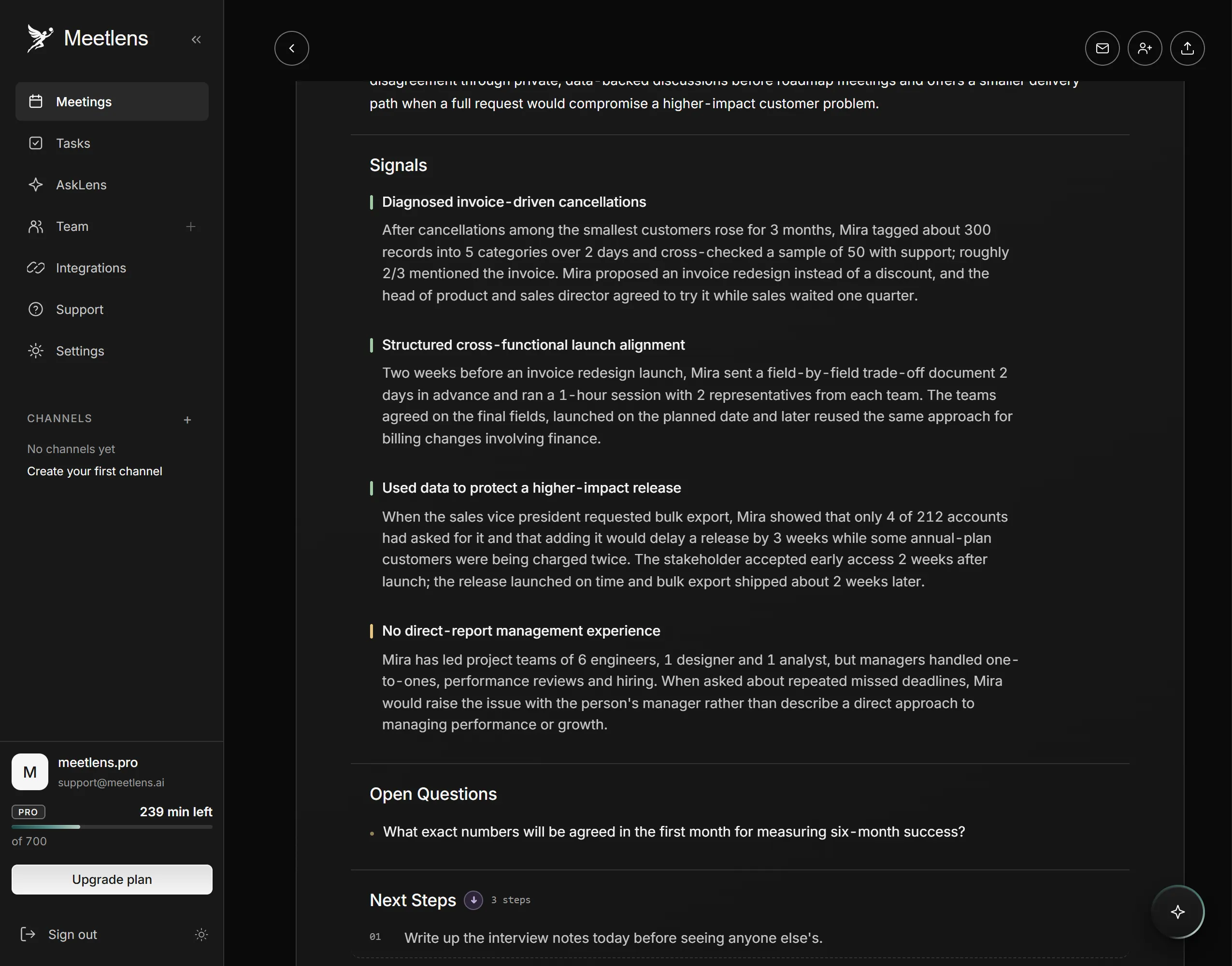
Meetlens can produce that first draft. It's a Chrome extension that records the audio of a browser meeting — Google Meet, Zoom Web, Microsoft Teams Web or Webex — without a bot joining the call, so the platform shows no recording notice: tell the candidate and ask for a full-sentence yes. Choose HR Interview in the format drop-down above Start recording; after the job interview, you get a transcript with speaker labels and timestamps and an AI interview summary: structured draft notes on the candidate. The rating and the recommendation stay yours to write.
To run check 1, add the interview to the AI chat with Add context and ask, for example, "Where did the candidate talk about direct reports?"; answers link to the moment in the recording and often quote the exact words. Meetlens doesn't record phone calls or the desktop Zoom and Teams apps; for a desktop-app call, import the recording file instead.
We ran the six checks on the HR Interview draft from our staged interview: all 31 statements (every sentence, signal heading and next step) had support in the recording, the draft held no culture-fit verdicts, nothing about protected characteristics and no rating or recommendation, so there were no adjectives or fit-type phrases to delete.
Not every interview ends in a hiring decision.
Summarizing a research or customer interview instead
A research or customer interview summary is organized by themes, not criteria: what the participant does, the quotes that show it and what it means for the product. A research interview ends without a rating or a recommendation. Write it in the 15 minutes after the session, in four parts:
- Themes: two or three patterns in what the participant described.
- Quotes: the participant's exact words, with the time in the recording.
- Behavior: what they actually do now, such as workarounds; it outweighs what they say they would do.
- Takeaways for the product: what to build, change or test next.
Insights come from comparing sessions, so use one discussion guide for every participant.