What Is a Discovery Call? How to Run One (Agenda, Questions and Notes)
 Meetlens Editorial12 min readUpdated October 17, 2026
On this page
- What is a discovery call?
- What is the purpose of a discovery call?
- Discovery call vs. cold call vs. demo
- What happens on a discovery call: a 30-minute agenda
- What questions should you ask on a discovery call?
- How to take discovery call notes
- What should you do after a discovery call?
- What do notes and follow-ups look like for other sales calls?
A discovery call is the first real conversation in a sales cycle: the seller asks, listens and decides with the prospect whether a next step makes sense. It is also the call most worth recording: if you transcribe sales calls, start with discovery, because everything later depends on what the buyer says here. Below: definition, purpose, cold call and product demonstration differences, meeting agenda, questions, notes, follow-through.
What is a discovery call?
A discovery call is the first scheduled conversation between a seller and a prospect, used to understand the prospect's problem and decide together whether a next step makes sense. It sits early in the sales process: after outreach or an inbound request, such as a demo request or a referral, and before the product demonstration.
In business-to-business (B2B) sales, sales professionals such as a sales development rep (SDR) or an account executive (AE) usually run it; at an early-stage company, the founder often does. Salesforce's sales blog sizes a discovery call at 20 to 30 minutes for a simple transactional sale and says complex enterprise deals can need up to an hour across several calls.
Outside software sales, the term shifts slightly:
- Coaching and freelancing: a short introductory call, often free, where both sides check whether they are a good fit before any paid work.
- Law firms: some firms use it for the first consultation with a potential client.
Not to be confused with discovery in litigation, the pre-trial exchange of evidence between the parties to a lawsuit (Cornell LII). This guide uses the sales meaning, but the agenda and notes below work for a coaching discovery call too.
What is the purpose of a discovery call?
The purpose of a discovery call is to learn enough about the prospect's problem, priorities and buying process to decide whether you can help — not to pitch. A good call has four goals:
- Understand the pain point and its cost. Get the problem in the prospect's words, plus what it costs them in time, money or missed goals.
- Check fit against your ideal customer profile (ICP). Company size, use case and urgency should match the customers your solution serves well.
- Learn the buying process. Find out who signs, who else is involved and by when.
- Agree on a next step with a date, or agree openly that there isn't one.
That is what it means to qualify a prospect. A "no fit" is a valid result: it saves both sides a product demonstration that goes nowhere.
A discovery call is not where you close, and two things don't belong on it. A product presentation belongs in the next meeting. Pricing before you understand the problem turns the talk to cost before anyone agrees on value; if asked, explain how pricing works and promise a number once you know the scope.
Discovery call vs. cold call vs. demo
A cold call is unannounced outreach, a discovery call is a scheduled conversation the prospect agreed to, and a product demonstration comes after discovery to show how the product solves what you learned. Cold calling earns the meeting; the discovery call decides whether the next meeting is worth anyone's time. The cold call length in the table comes from Highspot's guide to discovery calls.
| Cold call | Discovery call | Product demonstration | |
|---|---|---|---|
| Who starts it | The seller, unannounced | Both sides, after outreach or an inbound request | Both sides, at the end of the discovery call |
| What the prospect expects | Nothing | Questions about their problem | The product, shown against what they said |
| Goal | Earn a meeting | Understand the problem and qualify | Show how the product solves that problem |
| Length | 1–5 minutes | One booked slot (ranges above) | One booked slot, sized to what you'll show |
| Result | A booked discovery call, or a no | A dated next step, or an agreed no-fit | A proposal, a free trial or a meeting with whoever signs off |
Is a discovery call an interview?
Yes, but a two-way one: the salesperson asks most of the questions, while the prospect decides whether the seller understands the problem well enough to earn a second meeting. In coaching and freelancing, the discovery call is openly a mutual fit check. If you're the buyer, bring the problem in one sentence, your deadline and the names of others who will weigh in.
Other names for a discovery call
A discovery call also goes by discovery meeting, intro call, qualification call, exploratory call or needs analysis call; in professional services, it is often just a consultation.
What happens on a discovery call: a 30-minute agenda
A good discovery call follows a simple agenda: agree on the plan, let the prospect describe their situation, dig into the problem and its impact, map how they decide, and end with a dated next step. Put the meeting agenda in the invitation so the prospect knows what's coming.
Before the call, spend a few minutes on research: the company's website, the person's LinkedIn profile and whatever they wrote in the inbound form. That background lets you skip questions the website already answers.
Copy this discovery call agenda for a 30-minute slot. The time boxes are our recommendation, not a standard:
Discovery call agenda (30 minutes)
0–3    Introductions, plan for the call, start recording, ask for consent
3–8    Their context: team, role, how the work is done today
8–18   The problem and its impact: what breaks, how often, what it costs
18–24  Current workaround, who decides, timeline, budget signal
24–28  Short answer: where you can help (no pitch)
28–30  Next step with a date, spoken recap
Keep the first block short. Rapport comes from questions that show you did the research, not from long small talk. If the problem block runs over, cut the 24–28 slot, never the next step.
Press record, then open with a short script:
Here's my plan for the call: you tell me how things work today and what made you reach out, I'll ask some questions, and in the last few minutes we'll decide together whether a next step makes sense. I'd like to record this call so I can listen instead of typing. Is that OK? If it is, please say "Yes, I agree to the recording."
Starting the recording before you ask puts the yes on the recording, and a full sentence is easier to find in a transcript than a one-word reply. If anyone objects, stop recording and take notes by hand. Consent is also a legal matter: California's Penal Code § 632, for example, bars recording a confidential communication without the consent of all parties.
What questions should you ask on a discovery call?
Ask open questions in four blocks — situation, problem, impact, and decision — and spend most of the call on the middle two. Most open-ended questions start with "how," "what" or "walk me through," so the prospect talks and you listen. The table maps each question to the SPIN stage or BANT letter it covers; both frameworks are explained below.
| Block | Question | Covers |
|---|---|---|
| Situation | 1. "Walk me through how your team handles [process] today." | SPIN: Situation |
| Situation | 2. "Which numbers do you track for it?" | SPIN: Situation |
| Situation | 3. "What made this a priority now?" | BANT: Need, Timeline |
| Problem | 4. "Where does the current process break down?" | SPIN: Problem; BANT: Need |
| Problem | 5. "When did that last happen?" | SPIN: Problem |
| Problem | 6. "What have you tried so far?" | SPIN: Problem |
| Impact | 7. "What does it cost you today, in hours or money?" | SPIN: Implication |
| Impact | 8. "What happens if it's still unsolved next quarter?" | SPIN: Implication; BANT: Timeline |
| Impact | 9. "If this were solved, how would you measure the result?" | SPIN: Need-payoff |
| Decision | 10. "How does your company usually decide on a purchase like this?" | BANT: Authority |
| Decision | 11. "Who else will weigh in before a decision?" | BANT: Authority |
| Decision | 12. "Is budget already set aside, or would this need a new approval?" | BANT: Budget |
Question 2 surfaces the KPIs (key performance indicators) the prospect reports on, question 7 prices the opportunity cost of leaving the problem unsolved, and question 9 shows the return on investment they expect. The decision block maps the prospect's decision-making: who has the final say, which approvals a purchase needs, and whether there is a gatekeeper, such as procurement or IT security, who can slow or block the deal without deciding it.
Two habits of active listening make the questions work:
- Ask one question at a time and let the answer finish.
- Follow up in the prospect's words. "You said the handoff 'falls apart on Fridays.' What happens then?" Repeating their phrase shows empathy and gets you a concrete example.
Question 12 is a deliberate either/or: it asks for a budget signal, not a number, so you learn whether money exists without forcing a figure on the first call.
BANT, SPIN or MEDDIC?
Use BANT to qualify a simple, fast sale, SPIN to order your questions, and MEDDIC for a complex deal with a buying committee.
- BANT checks budget, authority, need and timeline. IBM used it as a gate for partners: its 2012 partner BANT form counts an opportunity as validated only after "at least one sales call" where you know the customer's "Budget, Authority, Need and Timeframe."
- SPIN stands for Situation, Problem, Implication and Need-payoff questions. It comes from Neil Rackham's book SPIN Selling (McGraw-Hill, 1988); his team studied more than 35,000 sales calls made by 10,000 salespeople in 23 countries over 12 years, according to Routledge's description of the book.
- MEDDIC covers Metrics, Economic buyer, Decision criteria, Decision process, Identify pain and Champion. It was developed at PTC in 1996; accounts of who created it differ.
How to take discovery call notes
Take discovery call notes in the prospect's own words and in fixed fields — problem, impact, current workaround, stakeholders, timeline, budget signal, next step — so anyone on your team can pick up the deal. Fixed fields show at a glance what you forgot to ask. The prospect's words keep your summary from drifting into your own pitch.
Copy this template and fill in one per call:
Discovery call notes
Company / contact / date:
Problem (their words):
Impact (what it costs, how they'd measure a fix):
Current workaround:
Stakeholders (who decides, who weighs in, who can block):
Timeline (the date and what drives it):
Budget signal:
Next step (what, who, date):
Quotes worth keeping:
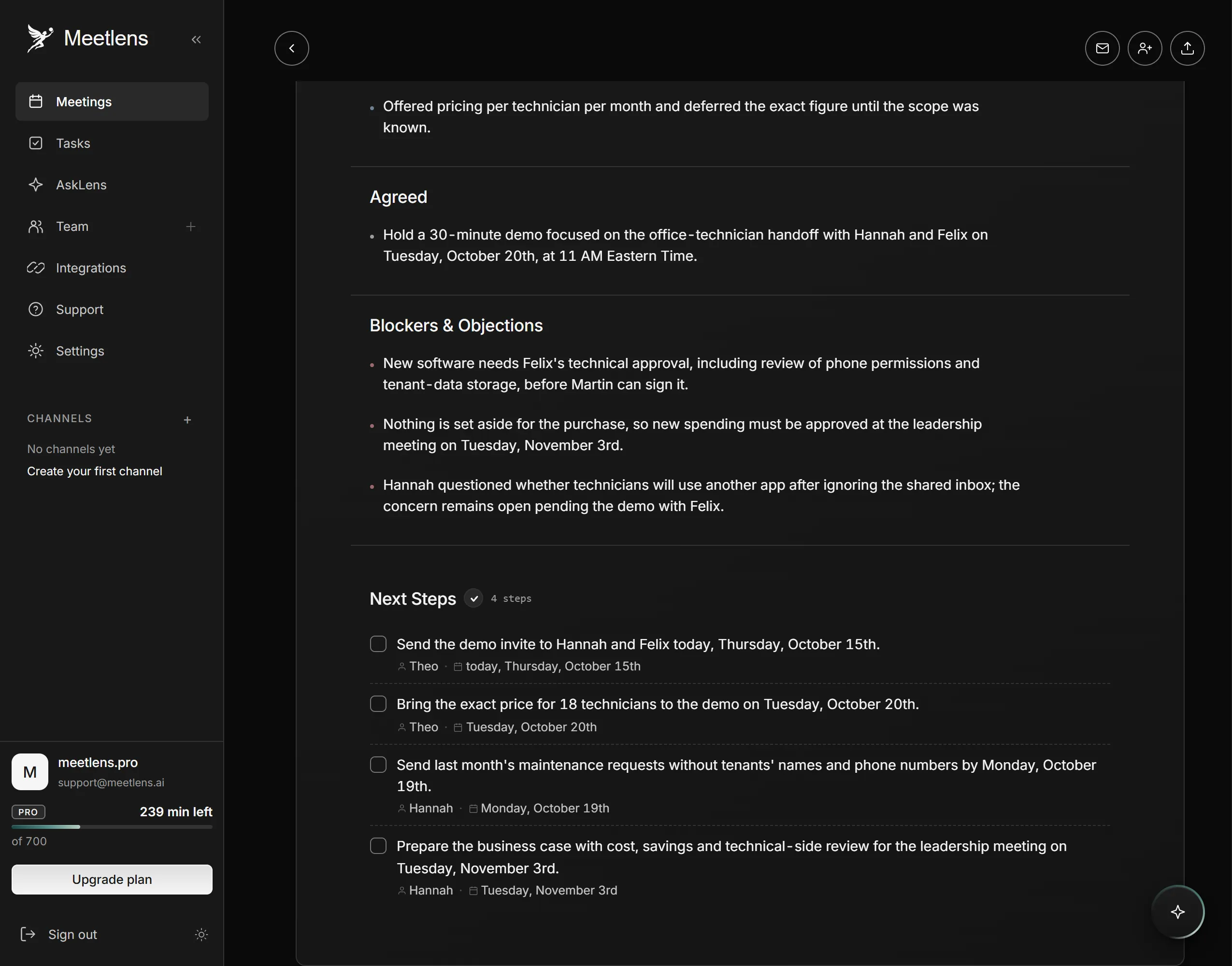
Illustrative: notes from a staged discovery call, voiced with synthetic voices and imported into Meetlens as a recording; the company and people are invented.
Discovery call notes
Company / contact / date: Harlow Bend Properties / Hannah, director of
maintenance / Oct 15, 2026
Problem (their words): "Nobody knows which list is the real one."
Requests go into a shared spreadsheet, each of the 18 technicians gets
the day's jobs by text message at 7, and "by the afternoon they don't
match anymore."
Impact (what it costs, how they'd measure a fix): her 3 coordinators
"spend about 10 hours a week together chasing technicians by phone";
last quarter "about $6,000 for water damage that a faster repair would
have prevented." A fix: the average time from request to repair goes
"from about 4 days to under 2 days, and no urgent repair waits more
than 24 hours."
Current workaround: the shared spreadsheet and a morning text to each
technician; the coordinators "call every technician after lunch to
check the list against what was actually done." Tried before: a shared
email inbox ("The inbox lasted 2 months.") and a whiteboard in the
office. Looked at the work order module in their property management
software: "On a phone, it's so clumsy that my technicians would never
use it."
Stakeholders (who decides, who weighs in, who can block): Hannah picks
the tool and writes a short business case; Martin (Chief Operating
Officer) signs: "Martin signs any new software, whatever the price."
Felix (information technology manager) approves any app on the
technicians' phones and can stop it: "If Felix says no, it's dead."
He'll ask about phone permissions and where tenants' data is stored.
Her 3 coordinators weigh in.
Timeline (the date and what drives it): "We need it running before
January 1st, when the 2 new buildings start." The new owners' contract
says urgent repairs within 24 hours.
Budget signal: "It would need a new approval. Nothing is set aside this
year." Martin approves new spending at the monthly leadership meeting;
the next one is on Tuesday, November 3rd. The business case "has to
include a price," and she needs it "well before November 3rd."
Next step (what, who, date): a 30-minute demo focused on the handoff
between the office and the technicians, with Felix joining — Tuesday,
October 20th, at 11 AM Eastern Time. Theo sends the invite to Hannah
and Felix today, Thursday, October 15th, and brings the exact price
for 18 technicians to the demo. Hannah sends last month's maintenance
requests, without tenants' names and phone numbers, by Monday,
October 19th.
Quotes worth keeping: "Nobody knows which list is the real one." /
"If we miss the 24 hours, we lose the contract." / "If Felix says no,
it's dead."
Typing while you listen splits your attention; recording the call frees it. When the discovery call runs on a video conferencing platform in the browser — Google Meet, Zoom Web, Microsoft Teams Web or Webex — Meetlens, a Chrome extension, records the tab's audio, plus your microphone once you allow access, without a bot joining the call. Choose Client Meeting in the format drop-down above Start recording. After you stop, you get a transcript with speaker labels and timestamps, plus a report with sections such as About the Client & Project, What the Client Needs (with the client's quotes), Agreed, Blockers & Objections, and Next Steps with owners and dates.
Treat the report from automated note taking as the first draft of your notes. Check each field against the transcript, then copy it into your CRM (customer relationship management) system by hand: Meetlens has no CRM integration. It records audio only, from desktop Chrome: no phone calls, no Zoom or Teams desktop apps. The platform shows no recording notice for it, so your announcement from the agenda is the consent step.
What should you do after a discovery call?
Within the same day, send a short recap in the prospect's words, confirm the next meeting in the calendar, and share your notes with whoever joins the deal next. Four steps close out a discovery call:
- Send the recap: the problem as they described it, what you agreed, the next step with its date. Ask them to correct anything you got wrong.
- Send the calendar invite for the next step, such as a product demonstration or a technical session.
- Hand over the notes to whoever joins next, such as a sales engineer or your manager, with the transcript or the recording attached.
- Do a self-review. Replay the problem block of your recording and write down one thing to change next time: a skipped question, an answer you cut off, a pitch that came too early.
From our staged call: at 4:30, the seller cut in with a feature pitch ("That's exactly what our tool fixes") while the buyer was starting a new point ("And that's not even the worst of it, because on weekends, the…"); she lost her thread, and the call never came back to weekends.
If the call showed no fit, say so in the recap. A clear no keeps the relationship open for later.
What do notes and follow-ups look like for other sales calls?
The fixed fields and the same-day follow-up from a discovery call carry over to every later call in the deal.
A notes template for every call
The discovery call notes template above fits a renewal, an upsell or a check-in with an existing customer. Keep the field order, and your call notes stay comparable across the sales cycle.
The follow-up after a discovery call
The follow-up email after a discovery call sets the order for later ones: what you heard, what was agreed, the date of the next step. Keep it, and the prospect always finds the next step in the same place.