Meeting Minutes vs. Notes: Key Differences and When to Use Each
 Meetlens Editorial9 min readUpdated October 9, 2026
On this page
- What is the difference between meeting minutes and meeting notes?
- What do Robert's Rules say about meeting minutes?
- One meeting, two documents: a side-by-side example
- When do you need formal meeting minutes?
- When are meeting notes enough?
- Why are meeting notes called minutes?
- Can AI meeting notes replace meeting minutes?
Minutes vs notes comes down to approval: meeting minutes are a group's official record of decisions, approved at the next meeting, while meeting notes are an informal summary nobody votes on. If you're still asking "what are meeting minutes," that approval is the short answer, and the rest follows. Below: the key differences, Robert's Rules, one meeting written both ways, when to use each, the word's origin, and where AI fits.
What is the difference between meeting minutes and meeting notes?
Meeting minutes are the formal, approved record of what a group decided; meeting notes are an informal summary that anyone can take for themselves or their team, and nobody votes to approve them. Minutes are an official document of the organization. Notes belong to whoever wrote them.
So minutes are not the same as notes. Both terms are correct, but they name two different documents. In the strict sense, "minutes" is a record the group will approve; the informal minutes many teams send the same day work like notes. A recorded call adds a third document: a speech-to-text transcript, often with an AI summary on top. The table compares all three.
| Meeting minutes | Meeting notes | AI transcript or summary | |
|---|---|---|---|
| Purpose | Official record of decisions; creates accountability for who owes what | Help you or your team keep the context and follow up | Capture everything said, so nobody types during the call |
| Who writes it | A designated secretary or clerk | Any participant, for personal use or for the team | Software, from the recording |
| Audience | Members, the board, stakeholders, auditors, sometimes the public | You and your team | Whoever can open the recording |
| Structure | Structured: follows the meeting agenda item by item | Flexible: bullets, shorthand, any order | Transcript in time order; summary in the tool's format |
| Content focus | Decisions, votes, action items | Context, ideas, who said what, to-dos | Verbatim text, then a machine-picked summary |
| Approval | Approved by the group, usually at the next meeting | None | None; a person reviews it, then the group approves it as minutes |
| Legal weight | The organization's approved account of what it decided; can be examined as evidence | One person's unofficial account | An unreviewed source, not an approved record |
| How long it's kept | Filed in the organization's archive under its records policy | As long as they're useful | Under the tool's or the company's retention settings |
Minutes, notes or a transcript: how they compare
| Meeting minutes | Meeting notes | AI transcript or summary | |
|---|---|---|---|
| Purpose | Official record of decisions; creates accountability for who owes what | Help you or your team keep the context and follow up | Capture everything said, so nobody types during the call |
| Who writes it | A designated secretary or clerk | Any participant, for personal use or for the team | Software, from the recording |
| Audience | Members, the board, stakeholders, auditors, sometimes the public | You and your team | Whoever can open the recording |
| Structure | Structured: follows the meeting agenda item by item | Flexible: bullets, shorthand, any order | Transcript in time order; summary in the tool’s format |
| Content focus | Decisions, votes, action items | Context, ideas, who said what, to-dos | Verbatim text, then a machine-picked summary |
| Approval | Approved by the group, usually at the next meeting | None | None; a person reviews it, then the group approves it as minutes |
| Legal weight | The organization’s approved account of what it decided; can be examined as evidence | One person’s unofficial account | An unreviewed source, not an approved record |
| How long it’s kept | Filed in the organization’s archive under its records policy | As long as they’re useful | Under the tool’s or the company’s retention settings |
Legal weight is where the two documents split hardest. Board minutes are a contemporaneous record that stockholder plaintiffs scrutinize when they pursue claims, lawyers at Skadden write on the Harvard Law School Forum on Corporate Governance. A page of personal meeting notes was never approved by anyone, so it speaks only for its author.
Short answer: if anyone will later judge what was decided by this document, write meeting minutes. If it only helps people remember and act, meeting notes are enough.
What do Robert's Rules say about meeting minutes?
Robert's Rules of Order says meeting minutes are "a record of what was done at a meeting, not a record of what was said," and that line is exactly what separates them from meeting notes. The official FAQ (question 15, citing RONR, 12th edition, 48:2) adds that summarizing the discussion in the minutes is improper. Minutes keep the proposal, the result and the follow-up, and leave the debate out.
Approval is what makes minutes an accurate record. When members spot errors in the draft, the corrections go into the text, and the next meeting's minutes say only that the previous ones were "approved as corrected," without describing the change (question 16 on the same page). Once approved, the minutes can be changed only by a new vote of the group.
Meeting notes have no such standard. No rulebook says what goes into them, nobody corrects them by vote, and their author decides the form.
One meeting, two documents: a side-by-side example
Below is the same 30-minute team meeting written up twice: once as meeting minutes and once as meeting notes. Four people attended. The meeting made 2 decisions and assigned 3 action items, and both versions contain them, but only one is a record the team can approve.
Illustrative example.
The meeting minutes version
Marketing team meeting: minutes (DRAFT) October 13, 2026, 10:00–10:30 a.m., video call Present: D. Kim (chair), L. Ortega, P. Halloran, S. Reed (secretary)
- Pricing page launch. P. Halloran reported that legal review of the new pricing page would not be finished by October 27. Decision: the team agreed to move the launch to November 3.
- Webinar platform. The team discussed switching webinar platforms before the November webinar. Decision: the team agreed to keep the November webinar on the current platform and to reconsider a switch in Q1.
Action items
- P. Halloran to get a review date from legal by October 16.
- L. Ortega to open registration for the November webinar by October 20.
- S. Reed to draft the launch announcement email by October 23.
Next meeting: October 20, 2026. Status: draft, for approval at that meeting.
The meeting notes version
Mktg sync 10/13 (Luis's notes)
- Pricing page: legal still has it, no way by 10/27 → push to 11/3. Pia frustrated, copy was ready 2 wks ago
- Dana: legal usually takes ~1 wk per page
- Webinar tool: I think switching mid-quarter = risk. Sam wants the new one for analytics → stay on current for Nov, revisit Q1
- Idea (Sam): comparison table on pricing page? Parked
- Legal checklist: shared drive > Legal > Web copy
- TODO: Pia → get legal review date by 10/16 · me → webinar registration live by 10/20 · Sam → launch email draft by 10/23
One team meeting, written up twice
The meeting minutes version
Marketing team meeting: minutes (DRAFT)
October 13, 2026, 10:00–10:30 a.m., video call
Present: D. Kim (chair), L. Ortega, P. Halloran, S. Reed (secretary)
1. Pricing page launch. P. Halloran reported that legal review of the new pricing page would not be finished by October 27. Decision: the team agreed to move the launch to November 3.
2. Webinar platform. The team discussed switching webinar platforms before the November webinar. Decision: the team agreed to keep the November webinar on the current platform and to reconsider a switch in Q1.
Action items
- P. Halloran to get a review date from legal by October 16.
- L. Ortega to open registration for the November webinar by October 20.
- S. Reed to draft the launch announcement email by October 23.
Next meeting: October 20, 2026. Status: draft, for approval at that meeting.
The meeting notes version
Mktg sync 10/13 (Luis’s notes)
- Pricing page: legal still has it, no way by 10/27 → push to 11/3. Pia frustrated, copy was ready 2 wks ago
- Dana: legal usually takes ~1 wk per page
- Webinar tool: I think switching mid-quarter = risk. Sam wants the new one for analytics → stay on current for Nov, revisit Q1
- Idea (Sam): comparison table on pricing page? Parked
- Legal checklist: shared drive > Legal > Web copy
- TODO: Pia → get legal review date by 10/16 · me → webinar registration live by 10/20 · Sam → launch email draft by 10/23
What changed between the two versions
- Tone. The minutes use full, neutral, past-tense sentences. The notes use shorthand ("→ push to 11/3") and keep "Pia frustrated." An emotional word in a record reads as bias, so minutes drop it.
- Who said what. The notes record that Luis saw risk and Sam wanted better analytics. The minutes record only the outcome.
- Decisions vs ideas. The minutes hold decisions and action items; Sam's comparison-table idea stays in the notes, because no decision-making happened on it.
- Who approves. The minutes carry a DRAFT label and go to the next meeting for approval. Nobody approves Luis's notes; they are accurate if Luis says so.
When do you need formal meeting minutes?
You need formal meeting minutes when a group makes decisions on behalf of an organization and may later have to prove them: boards of directors, committees with authority, shareholder and member meetings, public bodies, and the boards of associations and homeowner associations. Each of these is a governing body acting for people who weren't in the room. Minutes give those people transparency: they can see what was decided and how, and check the group's governance without attending.
Take meeting minutes, not just meeting notes, if any of these six signs applies:
- The decision binds the organization, not only your team: a contract, a policy, a public commitment.
- The group has bylaws or a charter that sets how it meets and decides.
- There is a vote. Someone puts forward a parliamentary motion, a formal proposal put to a vote, and the group decides it by voting.
- An outsider could ask. An external auditor, a regulator or the IRS may review the decision during an audit or a regulatory compliance check.
- The participants aren't one team. Members, outside directors or several departments need the same version of what was agreed.
- The decision concerns money or people: spending, hiring, pay, or removing someone from a role.
For a corporation, a nonprofit organization or a homeowner association, state law or the bylaws often make keeping minutes a duty; the guide to what meeting minutes are, linked above, covers the legal side. If you need minutes, start from a minutes template built on your agenda. Meeting notes need no template at all.
When are meeting notes enough?
Meeting notes are enough, without formal meeting minutes, for internal working meetings where decisions are easy to revisit and nobody has to approve them: stand-ups, one-on-ones, brainstorms, client calls, and planning sessions. Enough doesn't mean optional. Hermann Ebbinghaus's forgetting curve describes how memory of new information declines over time, so a few lines written during or right after the call outlast everyone's recall. That note-taking can live in a shared Google Docs file, the calendar invite or your notes app; for the method itself, see how to take good meeting notes.
| Meeting type | Minutes or notes | Why |
|---|---|---|
| Board meeting | Minutes | Votes bind the organization |
| Committee meeting with a vote | Minutes | The full body relies on the record |
| Weekly team meeting | Notes | Decisions stay inside the team |
| Daily stand-up meeting | Notes | Status updates, nothing to approve |
| One-on-one | Notes | Private between two people |
| Brainstorming session | Notes | Ideas, not decisions |
| Client call | Notes | Internal follow-up; send the client a recap |
| Project planning meeting | Notes | Plans change from week to week |
One exception: if an informal meeting decides something about money or people, record that decision separately, with the date and the name of whoever approved it, and file it with your formal records.
Why are meeting notes called minutes?
The "minutes" in meeting minutes have nothing to do with time: the word comes from Medieval Latin minūta, "note," so minutes literally means "notes," not sixtieths of an hour. Wikipedia's article on minutes gives the same reading, citing Merriam-Webster.
The word's etymology runs from Medieval Latin minūta through Old French into Middle English, according to Wiktionary. In late Middle English, a minute in the singular was a written "note or memorandum." Oxford Learner's Dictionaries trace that sense to the notion of "a rough copy in 'small writing' (Latin scriptura minuta) as distinct from the fair copy in book hand."
In other words, minutes started out as the rough draft: the working notes a clerk took before the clean copy was made. Today the name covers the approved version, which is why "minutes" and "notes" sound like synonyms but name different documents.
Can an AI note-taker's output count as minutes?
Can AI meeting notes replace meeting minutes?
AI meeting notes and transcripts are raw material for meeting minutes: they become minutes only after a person checks them and the group approves them. Speech-to-text transcription turns the call into text, and generative AI condenses that text into a summary. This kind of automatic summarization reports what was said; it can't confirm which proposal the group meant to adopt, whether a quorum was present or who voted which way.
For an internal meeting, an AI summary can serve as informal minutes after a human review that fixes the decisions and owners. For a board, a committee vote or anything on the checklist above, it can't: minutes need the group's approval, and an unreviewed summary has none. To take meeting notes electronically without typing during the call, record it and edit the summary afterward.
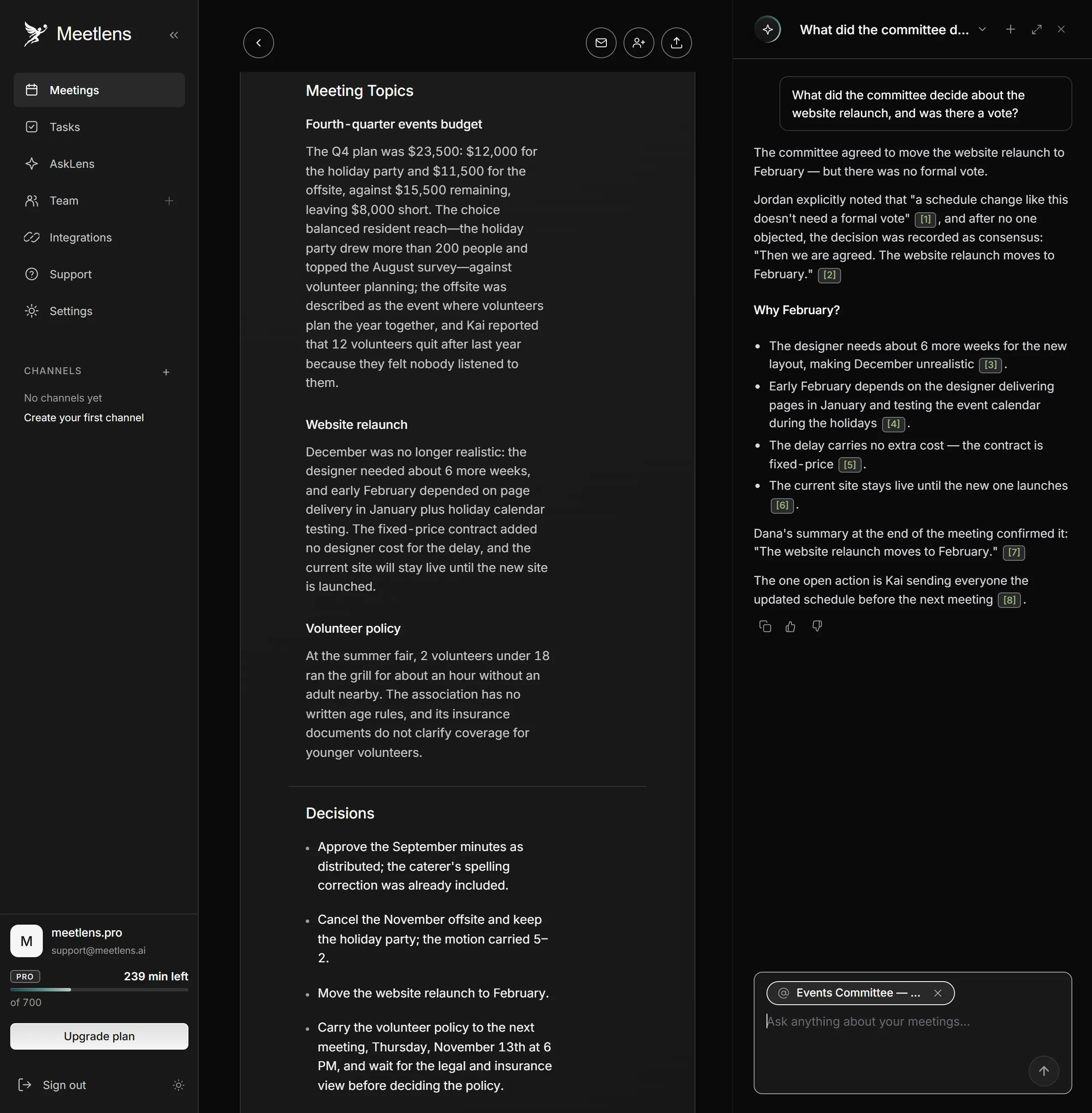
Meetlens is a Chrome extension that records the audio of a browser meeting in Google Meet, Zoom Web, Microsoft Teams Web or Webex without a bot joining the call, then produces a transcript with speaker labels and an AI report. General Meeting, the default report format, has Brief, Meeting Topics, Decisions, Tasks and Open Questions: that is the notes version. For minutes, Meetlens drafts the record: decisions, open questions and action items with owners and dates, and its timeline links each decision and task to its moment in the recording. You add attendance, quorum, motions and votes, and the signature.
For those additions, ask the meeting chat after the call, for example "What did the committee decide about the website relaunch, and was there a vote?" Pick the meeting with Add context so the chat looks only at it; the answer links to the moments in the recording it draws on and often quotes the exact words; play them back before you write the entry. What you get is draft minutes and notes, which the product page calls an "editable AI draft, not formally approved minutes." No bot joins, so the platform shows no recording notice for Meetlens: start recording, announce it, get each participant's yes, and stop if anyone objects.
To turn meeting notes into minutes, keep only the decisions, motions and action items, rewrite them as neutral past-tense entries, and send the draft to the group for approval.