Board Meeting Minutes Template, Example, and Rules for Motions and Executive Sessions
 Meetlens Editorial12 min read
Last reviewed: October 9, 2026. Fact-checked against the statute texts linked in this article.
On this page
- Board meeting minutes template (free download)
- Board meeting minutes example
- What should board minutes include — and leave out?
- How do you write a motion in board minutes?
- How do you take board minutes in a closed (executive) session?
- Are board meeting minutes legally required?
- How do you take and approve board minutes?
- Can you record a board meeting and use AI for the board minutes?
- Board meeting notes vs. board minutes
A board meeting minutes template records the board's order of business — quorum, approval of prior minutes, reports, the exact wording and vote on every parliamentary motion, and any executive session — and you can copy or download ours below, along with a filled example. If your first question was "what is meeting minutes", you already know the basics; board minutes add motions and votes, executive sessions, and legal weight.
Board meeting minutes template (free download)
Board meeting minutes follow the order of business: call to order and quorum, approval of the agenda and prior minutes, reports, old and new business with each motion and its result, executive session, and adjournment. That is the standard board minutes format for a regular, special or annual meeting of a Board of Directors. The board secretary (the corporate or company secretary), the officer responsible for the minutes, fills in the brackets and deletes the lines that didn't happen.
[Organization] — Minutes of the [Regular / Special / Annual] Meeting of the Board of Directors
Date: [ ]   Time: [ ]   Location / video link: [ ]
Presiding: [name, title]          Recording secretary: [name]
Directors present: [ ]            Directors absent: [ ]
Also present: [staff, counsel, guests — name and role]
Quorum: [present / not present] ([n] of [n] directors)

1. Call to order — [time], [presiding officer]
2. Conflict-of-interest disclosures — [none / name, item, recusal]
3. Approval of agenda — [approved / amended]
4. Approval of minutes of [date] — [approved / approved as corrected]
5. Reports
   5.1 [CEO / Executive Director] — [one-line summary]; report received
   5.2 Treasurer — [one-line summary]; financial statements for [period] [received / accepted]
   5.3 [Committee] — [summary; any recommendation]
6. Unfinished (old) business
7. New business
   [Materials received: document, date. Questions to management: one line each.]
   MOTION: [Director] moved that the board [exact wording].
   VOTE: [for]–[against]–[abstain]. Motion [carried / failed].
   [Roll call, if taken: names by vote. Dissent recorded at a director's request: name.]
8. Executive session — entered [time], exited [time]. Purpose: [general category]. Action taken: [none / see separate minutes].
9. Action items — [task] — [owner] — [due date]
10. Next meeting — [date]
11. Adjournment — [time]

Respectfully submitted, [name], Secretary        Approved by the board on: [date]
Board meeting minutes template on one page
[Organization] — Minutes of the [Regular / Special / Annual] Meeting of the Board of Directors
Date: [ ] Time: [ ] Location / video link: [ ]
Presiding: [name, title] Recording secretary: [name]
Directors present: [ ] Directors absent: [ ]
Also present: [staff, counsel, guests — name and role]
Quorum: [present / not present] ([n] of [n] directors)
1.Call to order — [time], [presiding officer]
2.Conflict-of-interest disclosures — [none / name, item, recusal]
3.Approval of agenda — [approved / amended]
4.Approval of minutes of [date] — [approved / approved as corrected]
5.Reports
5.1[CEO / Executive Director] — [one-line summary]; report received
5.2Treasurer — [one-line summary]; financial statements for [period] [received / accepted]
5.3[Committee] — [summary; any recommendation]
6.Unfinished (old) business
7.New business
[Materials received: document, date. Questions to management: one line each.]
MOTION: [Director] moved that the board [exact wording].
VOTE: [for]–[against]–[abstain]. Motion [carried / failed].
[Roll call, if taken: names by vote. Dissent recorded at a director’s request: name.]
8.Executive session — entered [time], exited [time]. Purpose: [general category]. Action taken: [none / see separate minutes].
9.Action items — [task] — [owner] — [due date]
10.Next meeting — [date]
11.Adjournment — [time]
Respectfully submitted, [name], Secretary Approved by the board on: [date]
Seven lines need care:
- Quorum: directors present out of the total, not just "present." Your bylaws set the number needed.
- Conflict-of-interest disclosures: director, item, recusal. The IRS sample policy in Appendix A of the Form 1023 instructions asks minutes to name who disclosed a financial interest, its nature, and the board's decision on whether a conflict existed.
- Prior minutes: whether the board approved the previous meeting's minutes as distributed or as corrected.
- Reports: a one-line summary, then "report received." Financial statements and committee recommendations go in the attachments.
- Votes: for–against–abstain. Abstentions get their own number, separate from votes against.
- Action items: task, owner, due date. This line creates accountability between meetings.
- Adjournment: the time the chair closed the meeting.
Download this board of directors meeting minutes template for Google Docs or Microsoft Word, or as a PDF; no email required. It comes in two more variants: a nonprofit board meeting minutes template for a nonprofit organization, with the approval-date line that the IRS question below depends on, and a corporate meeting minutes template for annual meetings.
Board meeting minutes example
Below is the board meeting minutes template filled in for a one-hour nonprofit board meeting with two motions and a short executive session. The organization and names are invented: this is an illustrative example.
Harbor Lane Literacy Center — Minutes of the Regular Meeting of the Board of Directors
Date: October 15, 2026   Time: 6:00 pm   Location: office and video link
Presiding: L. Grant, Chair          Recording secretary: M. Reyes, Secretary
Directors present: L. Grant, D. Okafor, M. Reyes, T. Brooks, A. Lindqvist, P. Hughes, S. Ito
Directors absent: R. Dunn, C. Vega
Also present: E. Park, Executive Director
Quorum: present (7 of 9 directors)

1. Call to order — 6:00 pm, L. Grant
2. Conflict-of-interest disclosures — none
3. Approval of agenda — approved
4. Approval of minutes of September 17, 2026 — approved as corrected
5. Reports
   5.1 Executive Director — fall enrollment 212 students; report received
   5.2 Treasurer — Q3 revenue 4% below budget; Q3 financial statements received
6. Unfinished (old) business — none
7. New business
   Directors received the draft FY2027 budget and Q3 financial statements on October 8.
   Directors asked how the budget covers the Q3 revenue shortfall.
   MOTION: D. Okafor moved that the board approve the FY2027 operating budget
   of $1,180,000 as presented.
   VOTE: 7–0–0. Motion carried.
   MOTION: P. Hughes moved that the board approve a three-year lease
   of the Elm Street annex at $3,200 per month.
   VOTE: 3–4–0. Motion failed. Vote recorded at his request: T. Brooks, in favor.
   Annex deferred to the November 12 meeting; staff to present alternative sites.
8. Executive session — entered 6:38 pm, exited 6:52 pm. Purpose: personnel.
   E. Park excused. Action taken: none.
9. Action items
   — Present two alternative annex sites — E. Park — Nov. 5
   — Share the approved budget with program leads — E. Park — Oct. 22
   — Send Q3 statements to the audit committee — D. Okafor — Oct. 30
10. Next meeting — November 12, 2026, 6:00 pm
11. Adjournment — 7:00 pm

Respectfully submitted, M. Reyes, Secretary        Approved by the board on: __________
Board meeting minutes example: Harbor Lane Literacy Center
Harbor Lane Literacy Center — Minutes of the Regular Meeting of the Board of Directors
Date: October 15, 2026 Time: 6:00 pm Location: office and video link
Presiding: L. Grant, Chair Recording secretary: M. Reyes, Secretary
Directors present: L. Grant, D. Okafor, M. Reyes, T. Brooks, A. Lindqvist, P. Hughes, S. Ito
Directors absent: R. Dunn, C. Vega
Also present: E. Park, Executive Director
Quorum: present (7 of 9 directors)
Quorum countDirectors present out of the total, not just “present.”
1.Call to order — 6:00 pm, L. Grant
2.Conflict-of-interest disclosures — none
3.Approval of agenda — approved
4.Approval of minutes of September 17, 2026 — approved as corrected
5.Reports
5.1Executive Director — fall enrollment 212 students; report received
5.2Treasurer — Q3 revenue 4% below budget; Q3 financial statements received
6.Unfinished (old) business — none
7.New business
Directors received the draft FY2027 budget and Q3 financial statements on October 8.
Directors asked how the budget covers the Q3 revenue shortfall.
MOTION: D. Okafor moved that the board approve the FY2027 operating budget of $1,180,000 as presented.
VOTE: 7–0–0. Motion carried.
Vote: carriedFor–against–abstain. The budget motion carries its amount.
MOTION: P. Hughes moved that the board approve a three-year lease of the Elm Street annex at $3,200 per month.
VOTE: 3–4–0. Motion failed. Vote recorded at his request: T. Brooks, in favor.
Vote: failedThe failed motion stays in with its wording and its 3–4 tally.
Annex deferred to the November 12 meeting; staff to present alternative sites.
8.Executive session — entered 6:38 pm, exited 6:52 pm. Purpose: personnel. E. Park excused. Action taken: none.
Executive sessionThat it took place, when, and any action taken.
9.Action items
—Present two alternative annex sites — E. Park — Nov. 5
—Share the approved budget with program leads — E. Park — Oct. 22
—Send Q3 statements to the audit committee — D. Okafor — Oct. 30
10.Next meeting — November 12, 2026, 6:00 pm
11.Adjournment — 7:00 pm
Respectfully submitted, M. Reyes, Secretary Approved by the board on: __________
In these sample board meeting minutes, the failed motion stays in with its wording and its 3–4 tally, the deferred item has a date and an owner, the budget motion carries its amount, and the approval line stays blank until the board votes on the minutes.
What should board minutes include — and leave out?
Good board minutes show that directors received information, discussed it and made a decision: they are a record of fiduciary duty in action, not a transcript. That sequence is governance in writing, and it is what lawyers and courts look for later.
Use this 8-item checklist for board decision-making:
- Quorum, with the count of directors present.
- Conflict-of-interest disclosures and recusals: who stepped out, for which item.
- The board packet: what directors received and when, for example, "Directors received the draft FY2027 budget and Q3 financial statements on October 8." This is your documented due diligence.
- Key questions to management, one sentence each: "Directors asked how the budget covers the Q3 revenue shortfall."
- The exact wording of each motion and its result.
- A dissent or abstention, when a director asks for it.
- The executive session: that it took place, when, and any action taken.
- Signature and approval date.
Item 6 matters for a director's legal liability. In states that follow the Model Business Corporation Act, a director present when the board takes corporate action is deemed to have assented unless the director objects at the start to holding the meeting, the dissent or abstention "is entered in the minutes of the meeting," or the director delivers written notice of it by adjournment or right after. That is Iowa's wording in Iowa Code §490.824(4), which adds that the right "is not available to a director who votes in favor of the action taken."
What should not be included in board minutes?
Leave out verbatim discussion, individual directors' opinions, summaries of presentations, the substance of legal advice, and off-the-record remarks. Each has a short replacement:
| Leave out | Write instead |
|---|---|
| Verbatim debate or discussion | "After discussion, the board approved…" |
| Opinions of individual directors | Nothing, unless a director asks to record a dissent |
| Content of a presentation | "Presentation received; attached as Exhibit A." |
| Details of legal advice | "The general counsel advised the board on [topic]." |
| Off-the-record remarks | Nothing |
| How each director voted | Names only after a roll call or at a director's request |
One exception: under a conflict-of-interest policy modeled on the IRS sample, Article IV asks the minutes for a conflicted transaction to include the content of the discussion, the alternatives considered, who was present and the votes.
How do you write a motion in board minutes?
Record each motion in the exact words the board voted on, with the name of the director who made it and the result; under Robert's Rules, leave out the seconder's name unless the board orders otherwise. A motion is a formal proposal put to the board for a vote, and the minutes are the only place its final wording survives.
Once a director has the floor, Robert's Rules of Order handles a motion in six steps, as parliamentarian Jim Slaughter summarizes the 12th edition:
- The director makes the motion: "I move that…"
- Another director gives a second.
- The chair states the question: "It is moved and seconded that…"
- The board debates.
- The chair puts the question to a vote.
- The chair announces the result: "The motion is adopted" or "The motion is lost."
A second only brings the motion to discussion, so the seconder stays out of the board minutes. MSU Extension quotes the rule: "the name of the seconder should not be entered unless ordered by the assembly" (RONR 11th ed., p. 470). If your bylaws require it, follow the bylaws.
Board motion template:
MOTION: [Name] moved that the board [action].
VOTE: [x]–[y]–[z]. Motion [carried / failed].
Corporate boards often write major actions as a resolution, the same decision in a formal clause that can be quoted on its own:
RESOLVED, that the Board of Directors approves [ … ]; and
FURTHER RESOLVED, that [officer] is authorized to [ … ].
The Harbor Lane budget decision as a motion and as a resolution
Motion and vote
MOTION: D. Okafor moved that the board approve the FY2027 operating budget of $1,180,000 as presented.
VOTE: 7–0–0. Motion carried.
Resolution
RESOLVED, that the Board of Directors approves the FY2027 operating budget of $1,180,000 as presented; and
FURTHER RESOLVED, that the Executive Director is authorized to share the approved budget with program leads.
Four rules cover the rest:
- Record failed motions too, with wording and tally.
- For an amended motion, record the final wording the board voted on.
- After a roll call, list each director by name under for, against and abstain.
- Without a formal vote, write "approved by general consent": the chair asked for objections and none came. General consent is another name for unanimous consent; one objection means a formal vote.
How do you take board minutes in a closed (executive) session?
In executive session, record only that the board entered and left the session, when, for what general purpose, and any action it took — not the discussion — and keep those minutes separately from the open-session minutes. An executive session, or closed session, is the part of a board meeting where only directors and anyone they invite stay in the room.
The official Robert's Rules FAQ (No. 17, citing RONR 12th ed. 9:24–27) says "Proceedings in an executive session are secret," though the board can still vote. Parliamentarian Jim Slaughter's notes on executive sessions add that unless motions were adopted, the minutes show only that the board went into executive session and came out, and that such minutes are "only accessible to those who had a right to be in the executive session."
A public body, such as a school board or city council, follows its state's open meetings law for its board minutes instead. Under the Michigan Open Meetings Act (MCL 15.267), for example:
- Calling a closed session takes a 2/3 roll-call vote of the members elected or appointed and serving, except for six of the closed-session purposes listed in the next section of the Act, MCL 15.268; the vote and the purpose go into the open-meeting minutes.
- The clerk or designated secretary keeps a separate set of minutes that "are not available to the public."
- Those minutes may be destroyed 1 year and 1 day after approval of the minutes of the regular meeting at which the closed session was approved.
Executive session minutes template:
[Organization] — Executive Session Minutes (confidential)
Meeting: [Regular / Special] Meeting of the Board of Directors, [date]
Entered: [time]          Exited: [time]
Present: [directors; invited guests by name and role]
Purpose: [general category: personnel / litigation / real estate / other]
Action taken: [none / exact wording of each motion and the vote]
Kept by: [name, title]
Approved by the board on: [date]
Executive session minutes for the Harbor Lane example
Harbor Lane Literacy Center — Executive Session Minutes (confidential)
CONFIDENTIAL
Meeting: Regular Meeting of the Board of Directors, October 15, 2026
Entered: 6:38 pm Exited: 6:52 pm
Present: L. Grant, D. Okafor, M. Reyes, T. Brooks, A. Lindqvist, P. Hughes, S. Ito
Purpose: personnel
Action taken: none
Kept by: M. Reyes, Secretary Approved by the board on: __________
Don't record an executive session on audio: a recording keeps exactly the discussion these minutes leave out.
Can a board member be excluded from an executive session?
Usually not: an executive session excludes non-members, and every director is a member of the board. Slaughter's page above puts it plainly: "the purpose of a closed session is to exclude non-board members." The common exception is a conflict of interest on one item: the IRS sample policy linked above asks an interested director to leave during the discussion of, and the vote on, that transaction. Any other exclusion needs a basis in your bylaws or state law, so ask counsel first.
Are board meeting minutes legally required?
Yes, for most corporations and tax-exempt nonprofits: state corporate law requires boards to keep minutes, and the IRS asks nonprofits that file Form 990 whether they document every board meeting on time.
- Delaware. The Delaware General Corporation Law, §142(a), says "One of the officers shall have the duty to record the proceedings of the meetings of the stockholders and directors in a book to be kept for that purpose." Through §114(a), the same rule covers Delaware nonstock corporations, the usual form for a Delaware nonprofit, with "directors" read as members of the governing body.
- Model Business Corporation Act states. Maine's statute, 13-C §1601, requires a corporation to "keep as permanent records minutes of all meetings of its shareholders and board of directors."
- Tax-exempt nonprofits that file Form 990. Form 990, Part VI, lines 8a–8b (Internal Revenue Service instructions) asks whether the organization contemporaneously documented every meeting and written action of its governing body and of committees authorized to act for it. Contemporaneous means by the later of the next meeting or 60 days after the meeting. The documentation can be approved minutes, email or similar writings that explain the action taken, when, and who made the decision. Organizations that file Form 990-EZ or 990-N don't answer this question.
Your bylaws can add rules on top of the statute, such as who signs board minutes.
Minutes are the official document of how the board decided, so in a lawsuit they become legal evidence. Skadden lawyers on the Harvard Law School Forum on Corporate Governance note that "plaintiff stockholders will scrutinize minutes" and "judges will consider minutes at the pleadings stage." The same pages are what you show in an audit or a regulatory compliance review.
Are board minutes publicly available?
Board minutes of a private corporation aren't public, but stockholders can demand them; a public body's open-session minutes are public records; a nonprofit must share its Form 990, while access to its minutes depends on state law and bylaws.
- Corporations. Delaware's §220 counts board and committee minutes among the books and records a stockholder may inspect after a written demand under oath, made in good faith for a proper purpose, describing that purpose and the records sought with reasonable particularity; the records must be specifically related to the purpose.
- Public bodies. Michigan's MCL 15.269 says "Minutes are public records open to public inspection." That transparency stops at the closed-session minutes.
- Nonprofits. The IRS public disclosure rules cover the exemption application and annual returns such as Form 990, not board minutes. Whether members, donors or other stakeholders can read the minutes depends on state law and your bylaws.
Annual, shareholder and single-member LLC minutes
Annual meeting minutes record the shareholders' general meeting, where a corporation elects its directors; LLC minutes follow the operating agreement and state law. Delaware's §211(b), on the same page as §220, requires an annual meeting of stockholders for the election of directors unless they are elected by written consent. The corporate variant of the template adds lines for election results and ratification of officers' acts. For a limited liability company, including a single-member LLC, the operating agreement and your state's LLC act decide whether you need minutes or written consents; check both before you adopt a single member LLC meeting minutes template.
How do you take and approve board minutes?
The board secretary drafts the minutes from the agenda and board packet right after the meeting, has the chair and, when needed, counsel review them, and sends them in the packet for the next meeting, where the board approves them. Note-taking works as for any meeting; these five steps are specific to taking minutes for a board meeting:
- Prepare from the board packet. Copy the agenda into the template and check the quorum and voting rules in the bylaws.
- Confirm wording at the table. Ask the chairperson to restate each motion before the vote, and keep your own count.
- Draft while it's fresh, marked DRAFT: motions verbatim, everything else short.
- Get a counsel review when it matters. A lawyer reads drafts that touch litigation, an executive session or a major transaction.
- Approve, sign and file. The board approves the minutes as distributed or as corrected; the secretary signs, dates and files them in the minute book.
Approval at the next meeting keeps a Form 990 filer inside the IRS timing above. For records management, keep the minute book with the bylaws and written consents. After approval, only the board can change the minutes, by a motion to Amend Something Previously Adopted (Robert's Rules FAQ No. 16, same page as above).
Can you record a board meeting and use AI for the board minutes?
Yes, if your bylaws or board policy allow it and everyone in the meeting agrees; the recording becomes another record of the organization, so decide in advance how long you keep it. A short recording policy covers four points:
- Consent: start the recording, then the chair announces it and every director and everyone else present (staff, counsel, guests) says yes; if anyone objects, stop the recording. The board minutes note the consent. California's Penal Code §632, for example, bars recording a confidential communication "without the consent of all parties."
- Executive session: stop the recording before the board goes into closed session.
- Retention: for example, delete the recording once the board approves the minutes, unless litigation is pending or expected; then counsel decides what to keep, because Federal Rule of Civil Procedure 37(e) covers recordings that "should have been preserved in the anticipation or conduct of litigation."
- Access: the secretary and the chair.
Any AI tool, ChatGPT included, can turn a transcript into a draft, but it knows only what was said aloud: a show of hands or the quorum count may never reach the audio.
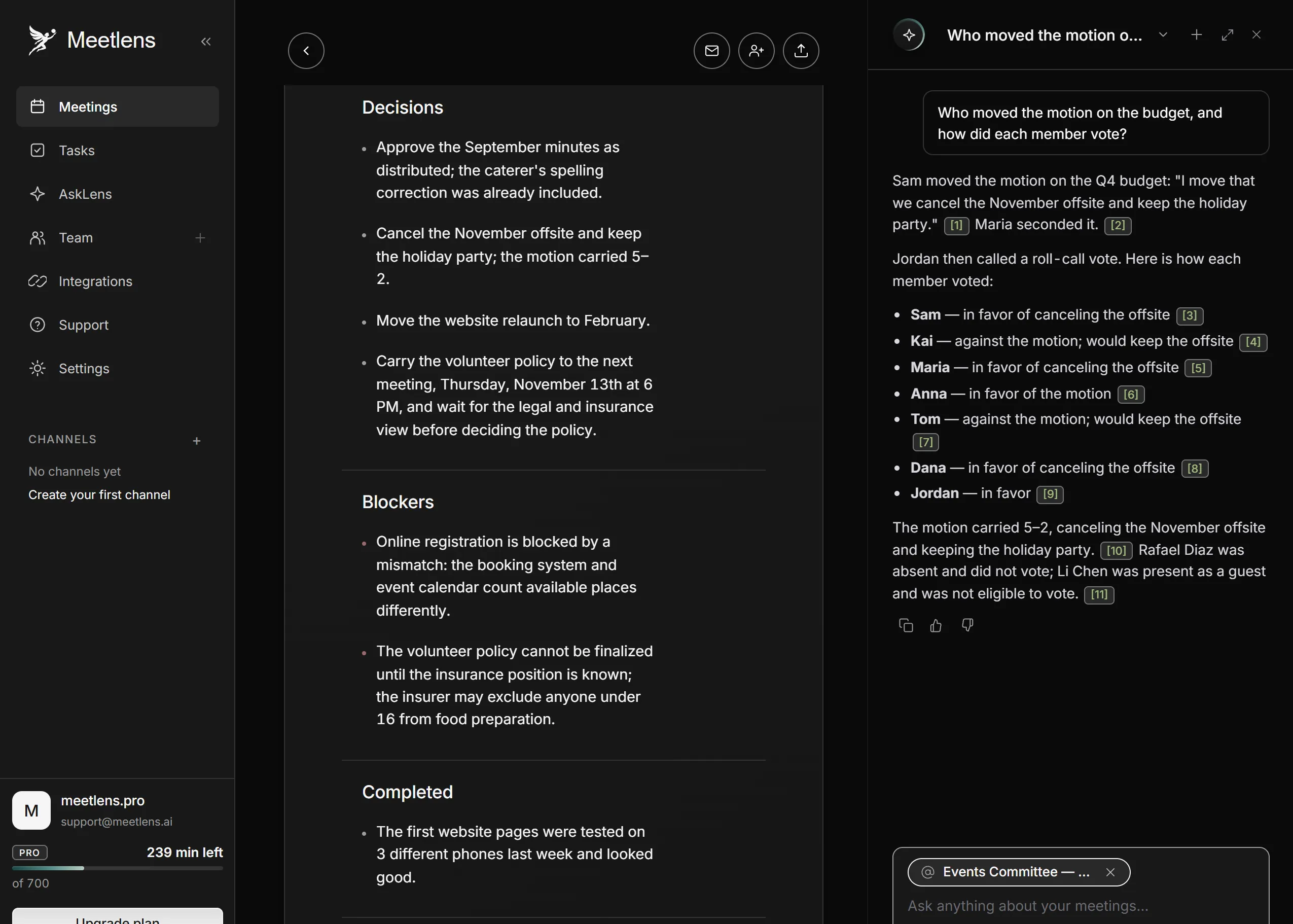
For virtual board meetings, Meetlens covers the recording and the first draft. It is a Chrome extension that records the audio of a browser meeting in Google Meet, Zoom Web, Microsoft Teams Web or Webex, without a bot joining the call; desktop Zoom and Teams apps aren't captured, so the secretary joins from the browser. Meetlens drafts the record: decisions, open questions and action items with owners and dates, and its timeline links each decision and task to its moment in the recording. General Meeting, the default report format, has Brief, Meeting Topics, Decisions, Tasks and Open Questions, which gives you AI notes for virtual board meetings.
The secretary still adds attendance, the quorum, the exact motion wording, the vote counts, any dissent and the signature. The meeting chat speeds that up: after the meeting, ask "Who moved the motion on the budget, and how did each member vote?" Pick the meeting with Add context so the chat looks only at it; the answer links to the moments in the recording it draws on and often quotes the exact words; play them back before you write the vote into the minutes. No bot also means no recording notice from Meetlens, so the chair announces the recording. One recording runs up to an hour on Free, 90 minutes on Pro and two hours on Business. For an in-person meeting, record on a phone or voice recorder and upload the audio or MP4 file.
Do you need formal minutes, or are board meeting notes enough?
Board meeting notes vs. board minutes
A director's board meeting notes are personal working papers, while board minutes are the official record the board approves. Board notes can still surface in a dispute: a subpoena under Federal Rule of Civil Procedure 45 can command a person to produce documents "in that person's possession, custody, or control," so don't keep personal notes longer than you need them, unless a dispute is pending or expected. A personal board meeting notes template can be the agenda with space under each item. To document a meeting without a board, such as a staff or project meeting, use the general meeting minutes format: the same order of fields, without a director quorum, an executive session or resolution wording.