What Are Meeting Minutes? Definition, Purpose, and Types
 Meetlens Editorial8 min read
Last reviewed: October 9, 2026. Legal references checked against the linked statutes and IRS instructions.
On this page
Meeting minutes, also called minutes of meeting, are the official record of what a group decided at a meeting and who took on which task. Below: what meeting minutes are for, what they look like on the page, the main types, who takes them, when the law expects them, and how they differ from notes, meeting transcripts and recordings.
What are meeting minutes?
Meeting minutes are the official written record of a meeting: who attended, what was decided, and who agreed to do what next. Once approved, the minutes become an official document of the organization, the version people consult when memories differ.
Minutes record the outcome of decision-making, not the conversation behind it. The FAQ on the official Robert's Rules of Order website puts it in one line: "Minutes are a record of what was done at a meeting, not a record of what was said." Robert's Rules of Order is a manual of parliamentary procedure, and groups that follow it keep each member's opinion and verbatim dialogue out of the record.
Whatever the format, the minutes document answers three questions: which attendees were present, what was decided, and who does what next, with an owner and a due date for each action item.
Meeting minutes or minutes of meeting?
Both forms are correct and name the same document. "Meeting minutes" works as a title; "the minutes of the meeting" reads naturally inside a sentence, as in "the minutes of the March 4 meeting." Minutes of meeting is sometimes shortened to MoM. The word "minutes" here means "notes," not sixtieths of an hour, as Wikipedia's entry on minutes explains, citing Merriam-Webster.
What is the purpose of meeting minutes?
The purpose of meeting minutes is to put each decision and its owner in writing, so the group can act on it and later prove what was decided. That one record serves five uses:
- Accountability. Every action item carries a name and a date, so the question "Who was sending the contract?" is settled by the minutes, not by memory.
- Absentees. People who missed the meeting read the decisions instead of asking for a retelling, and members and other stakeholders get transparency about how each decision was reached.
- Institutional memory. A year later, a new treasurer can look up when the dues increase was approved and by what vote. Institutional memory, also called organizational memory, lives in the minutes, not in people's heads.
- Evidence and compliance. Approved minutes are evidence that a decision was properly made. An auditor checks them during an audit, and a tax examiner or a court may ask for them.
- Continuity. The next meeting opens with the open action items from the previous meeting, so nothing assigned last time disappears.
What do meeting minutes look like?
In practice, a typical set of meeting minutes for an hour-long meeting is one to two pages: a header, an attendance list, one short entry per agenda item with its decision or parliamentary motion, an action-item list, and a closing line with the adjournment time and the secretary's signature.
One page of meeting minutes, part by part
-
HeaderWho met, when and where, and when the chair opened the meeting.
Northgate Community Association
IllustrativeEvents Committee: minutes of the October meeting
Place: community center Called to order: 6:00 p.m. by J. Kim, chair
-
Attendance and quorumWho was there and whether the group could do business.
Present: J. Kim (chair), S. Patel (treasurer), K. Brown (communications lead), M. Lopez, A. Ruiz, T. Nguyen, D. Owens (secretary)
Absent: R. Diaz Guest: L. Chen (auditor)
Quorum: present, 7 of 8 members
-
Previous minutesTheir approval.
1.September minutes. The minutes of the September meeting were approved as distributed. Vote: 7 in favor, 0 opposed.
-
Agenda items and decisionsOne entry per item; a vote appears as a motion, a formal proposal put to a vote, with its result.
2.Q4 events budget. The treasurer reported that Q4 event spending is projected to exceed budget by $8,000.
Motion (S. Patel): cancel the November offsite and keep the holiday party. Vote: 5 in favor, 2 opposed (K. Brown, T. Nguyen). Motion carried.
3.Website relaunch. The communications lead reported that design work is behind schedule. The committee agreed, without a vote, to move the launch to February.
4.Volunteer policy. After discussion, no decision was reached; the item moves to the next meeting.
-
Action itemsWho does what by when.
Action items Task Owner Due date Cancel the offsite booking M. Lopez November 15 Send the new website schedule K. Brown Before the next meeting Request a legal review A. Ruiz Not set -
Next meetingWhen the group meets again.
Next meeting: Thursday, November 13, 6:00 p.m., community center
-
Adjournment and signatureWhen the meeting ended and who certifies the record.
The meeting was adjourned at 6:20 p.m.
D. Owens, Secretary
The structure of meeting minutes, top to bottom:
- Header: who met, when and where, and when the chair opened the meeting.
- Attendance and quorum: who was there and whether the group could do business.
- Previous minutes: their approval.
- Agenda items and decisions: one entry per item; a vote appears as a motion, a formal proposal put to a vote, with its result.
- Action items: who does what by when.
- Next meeting: when the group meets again.
- Adjournment and signature: when the meeting ended and who certifies the record.
Meeting minutes follow the meeting agenda (in parliamentary terms, the order of business): each agenda item becomes one entry, in the same order, so a reader can check what happened to every item, deferred ones included. Ready-to-copy formats for Microsoft Word and Google Docs, with filled-in examples, are in the meeting minutes template.
What are the types of meeting minutes?
Meeting minutes differ in two ways: by level of detail (action, discussion or verbatim minutes) and by how formal the body that keeps them is.
| Type | What it records | Typical use |
|---|---|---|
| Action minutes | Decisions and action items, with a one-line reason for each decision | Team meetings, project check-ins, staff meetings, most committees |
| Discussion minutes | The same, plus two or three lines on the main arguments | Contested decisions, committees whose work others will review |
| Verbatim minutes | Every word spoken, often taken down by a court reporter | Only when governing documents or a legal requirement call for it, as in court proceedings |
Action, discussion and verbatim formats side by side.
Discussion minutes record the reasoning, not the debate. Bodies that follow Robert's Rules skip this layer: FAQ 15 on the same Robert's Rules page calls summarizing discussion improper.
Formal minutes are kept by boards, committees, nonprofits and public bodies. They name each motion, record the result of the voting, and become official only after approval.
Informal meeting minutes are kept by teams. They list decisions reached by consensus, without a vote, plus action items, and usually go out the same day with no approval step.
By the body that meets, the common kinds are:
- Board of Directors. The most formal set. A board keeps board minutes that add motions with vote results, executive sessions, and a record of how directors met their fiduciary duty: the record plaintiffs examine when that duty is challenged.
- Committee meeting minutes. Discussion minutes when the parent body will review the committee's recommendations; otherwise action minutes.
- Staff meeting minutes. Usually action minutes.
- Annual shareholder meeting. Formal minutes, kept with the board's.
Who takes meeting minutes?
Meeting minutes are taken by a designated secretary: in a formal body, the elected secretary or clerk; on a team, a member appointed before the meeting who is not running it.
Robert's Rules separates the two jobs. A meeting needs a presiding officer and a recording clerk, and the secretary is the recording clerk for the assembly. The chairperson runs the discussion, and nobody can lead a debate and capture each decision accurately at the same time. In city government, the job belongs to the municipal clerk, who maintains the official council minutes.
Teams often rotate the minute-taker. For sensitive or contested meetings, some organizations bring in a professional minute-taker with no stake in the outcome. The record can be taken in shorthand by a typist or court reporter, typed during the meeting, or written up later from notes or a recording.
Taking minutes in a meeting means capturing decisions, votes and tasks as they happen, then writing them up afterward. The full process is in how to take meeting minutes.
Are meeting minutes legal documents?
For corporations, tax-exempt nonprofits and public bodies, approved meeting minutes are official records that state law, tax rules or open-meetings laws expect them to keep; for an internal team meeting, they are an ordinary business record.
Corporations. In corporate governance, the duty comes from state law. Section 142(a) of the Delaware General Corporation Law says: "One of the officers shall have the duty to record the proceedings of the meetings of the stockholders and directors in a book to be kept for that purpose." Maine's Business Corporation Act, § 1601(1), adapted from the Model Business Corporation Act, requires a corporation to "keep as permanent records minutes of all meetings of its shareholders and board of directors."
Nonprofits. Under the Instructions for Form 990, a tax-exempt nonprofit organization files the full Form 990 with the Internal Revenue Service when its gross receipts are $200,000 or more or its total assets are $500,000 or more at the end of the tax year; private foundations file Form 990-PF instead, and churches are not required to file. Part VI, lines 8a and 8b, ask whether the organization contemporaneously documented every meeting and written action of its governing body and of committees with authority to act for it. Contemporaneous means by the later of the next meeting or 60 days after it, approved minutes count as documentation, and a "No" answer must be explained on Schedule O. Smaller nonprofits may file Form 990-EZ or submit Form 990-N, which don't ask this question; state law and bylaws still apply.
Public bodies. New York's open-meetings rule, Public Officers Law § 106, requires minutes of every open meeting, with a record or summary of all motions, proposals, resolutions and votes, available to the public within two weeks.
Other requirements depend on jurisdiction and on the organization's bylaws.
How are meeting minutes approved and corrected?
Meeting minutes are approved at the next meeting: the secretary circulates a draft, members propose corrections, and the group adopts the minutes as an accurate record. Under Robert's Rules, corrections go into the text, and the new minutes say only that the previous ones were "approved as corrected" (FAQ 16 on the same Robert's Rules page). Once approved, minutes change only through a separate vote: a motion to amend something previously adopted.
That is the rule for meeting minutes in short: record what was done, not what was said, and approve the record at the next meeting.
How long should you keep meeting minutes?
Corporations under statutes like Maine's keep meeting minutes as permanent records; other organizations follow their bylaws and record-retention policy. Store the approved version, not the draft, in one archive, such as a shared folder or a document management system, so a future board or auditor can find any decision by date.
If you record or transcribe a meeting, do you still need minutes?
Meeting minutes vs. notes, transcripts, and recordings
A meeting transcript, the word-for-word text of the call, and a recording are raw material; meeting minutes are the approved record drawn from them; notes are the unofficial version for yourself or your team. In most organizations, a recording doesn't replace minutes, because no one approves a recording.
| Meeting minutes | Notes | Transcript | Recording | |
|---|---|---|---|---|
| Purpose | Official record of decisions and action items | Memory aid for a person or team | Every word as text | A sound recording of the meeting |
| Who approves it | The group, at the next meeting | No one | No one | No one |
| Typical length | One entry per agenda item | Varies | Every word spoken | The full meeting |
| Legal weight | Official record for boards, nonprofits and public bodies | No official status | Raw material unless rules require a verbatim record | Raw material (New York lets an unabridged one serve as published minutes); consent laws apply to making it |
Figures from a staged test meeting (scripted conversation, synthetic voices): a 13-minute committee meeting produced a Meetlens transcript of 1,975 words in 105 speaker turns.
Official meeting notes are called minutes; anything else is note-taking, and for an informal meeting, notes are enough; our guide to taking meeting notes covers that side. A transcript and a recording keep everything said, confidential remarks included, so they raise privacy questions that minutes avoid. For a fuller comparison, with one meeting written up both ways, see minutes vs notes.
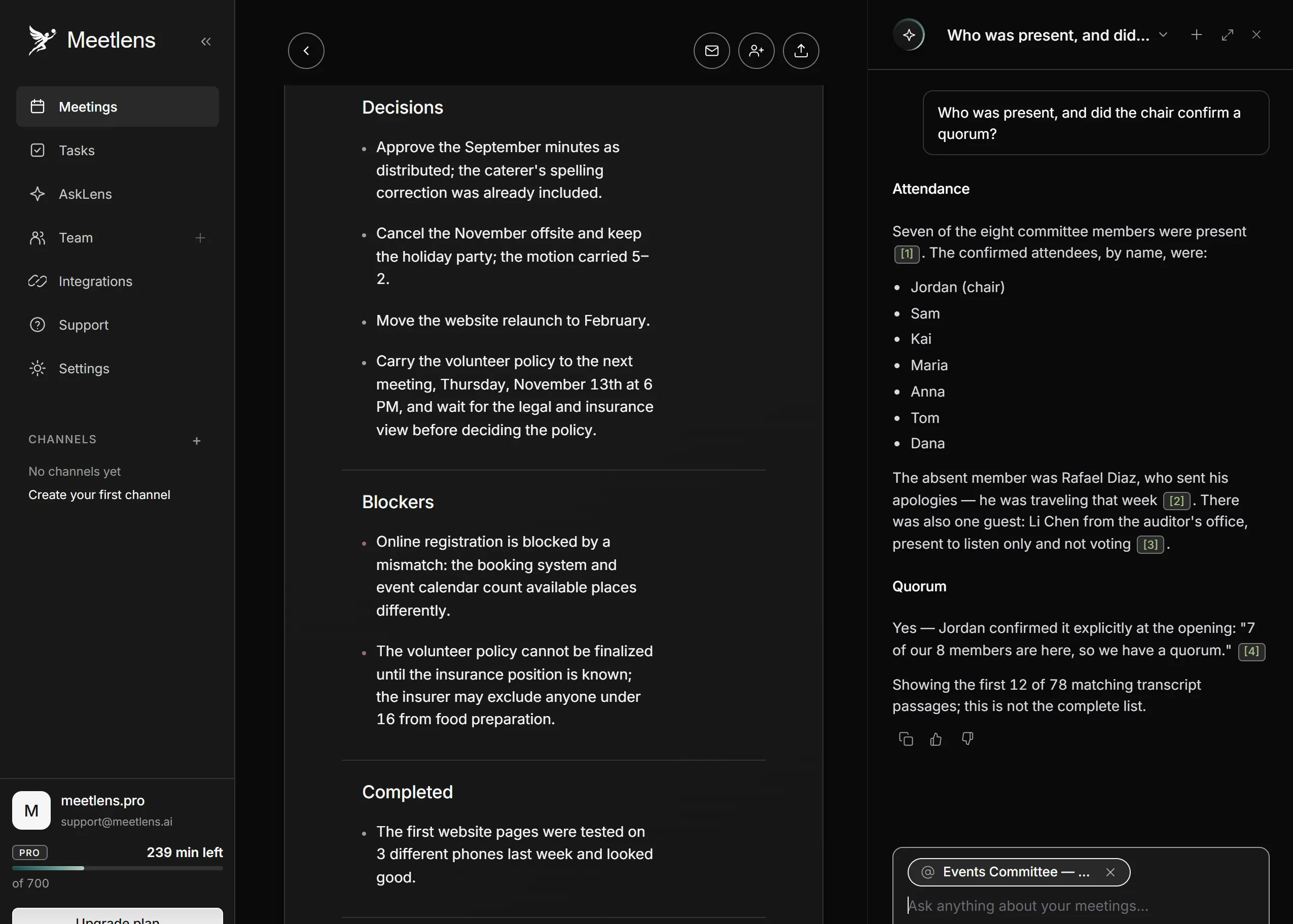
The Meetlens Chrome extension records the audio of browser meetings in Google Meet, Zoom Web, Microsoft Teams Web or Webex, without a bot joining the call, and transcribes it with speaker labels. Meetlens drafts the record: decisions, open questions and action items with owners and dates, and its timeline links each decision and task to its moment in the recording. General Meeting, the default report format, has Brief, Meeting Topics, Decisions, Tasks and Open Questions. That is draft minutes from a call recording, not approved minutes: you add attendance, quorum, motions and votes, and the signature. Since no bot joins, tell participants yourself that you're recording.
For those formal parts, ask the meeting chat after the recording, for example "Who was present, and did the chair confirm a quorum?" Pick the meeting with Add context so the chat looks only at it; the answer links to the moments in the recording it draws on and often quotes the exact words. Play them back before the line goes into the minutes, because the chat knows only what was said aloud.