One-on-One Meetings: What a 1:1 Is, What to Discuss and How to Run It
 Meetlens Editorial11 min readUpdated October 17, 2026
On this page
- What is a one-on-one meeting?
- Why do one-on-one meetings matter?
- How often and how long should 1:1s be?
- What to discuss in a one-on-one meeting
- How to run a one-on-one meeting
- Your first one-on-one with a new employee
- What to talk about in a one-on-one with your manager
- Taking notes in a 1:1 (and when to record)
- Common one-on-one mistakes
- 1:1s and your other recurring meetings
A one-on-one meeting (a 1:1, or 1 on 1) is a recurring private meeting between a manager and a direct report where the employee's priorities, blockers, growth and feedback in both directions come before status updates. Unlike any other recurring office meeting, it is built around a single person. Below: the definition, benefits, frequency, topics, how to run it, the first 1:1 from both sides, notes and mistakes.
What is a one-on-one meeting?
A one-on-one meeting (1:1) is a regular, private conversation between a manager and a direct report about the employee's work, growth and well-being, not a status update. A direct report is an employee who reports to that manager. Mentors and mentees hold 1:1s too, and a skip-level 1:1 pairs an employee with their manager's manager.
A 1:1 differs from a stand-up or a status meeting in its subject: those track a whole team's work, while a 1:1 covers one person's priorities, problems and plans.
One-on-one, 1:1 or 1 on 1: how to write it
Write "one-on-one" with hyphens before a noun (a one-on-one meeting), and use "1:1" as the short form in calendars and chat. Dictionary.com lists one-on-one as an adjective ("a one-on-one discussion") and as a noun meaning a meeting between two persons, so "our one-on-ones" works too. "1 on 1", "1-on-1" and "1on1" are informal spellings.
A one-to-one meeting is the British name: Cambridge Dictionary marks one-to-one as UK usage and one-on-one as the US equivalent. In a calendar, label the meeting with both first names, such as "Alex / Sam 1:1", and agree as a team whose name goes first.
Why do one-on-one meetings matter?
One-on-one meetings are where problems surface early, feedback flows both ways (from manager to employee and back) and trust gets built, and employees who have them regularly are more engaged. Each side gets something different:
- The employee gets a safe space to ask for a decision, clear a blocker or raise a career question.
- The manager hears about workload, conflicts or a job offer elsewhere in time to act, not in an exit interview.
- The company gets better employee retention and an organizational culture where bad news travels up early.
In Gallup research from 2014, only 15% of employees whose manager did not meet with them regularly were engaged, and managers who met with them regularly "almost tripled that level of engagement." That is a correlation, not proof that the meeting causes employee engagement.
Google's Project Oxygen research, a multi-year study of its own managers, found that teams with highly effective managers were more likely to achieve better results, be happier and see lower turnover (Google re:Work). Google's 1:1 guide adds that its higher-scoring managers are more likely to have frequent 1:1s. That regular slot is leadership work: time to coach and build trust.
Why would your boss schedule a 1:1?
A boss schedules a 1:1 to keep a regular channel with each direct report; on its own, the invite says nothing about your performance. If an unexpected invite has no description, ask what to prepare:
Thanks for the invite. Is there anything you'd like me to prepare for our 1:1?
Then note your priorities, one recent win and one blocker.
How often and how long should 1:1s be?
Hold 1:1s weekly for about 30 minutes, or every two weeks for 45–60 minutes; a steady rhythm matters more than the length. How often you meet comes first; the sources agree on its range:
- Baylor University HR: "In most cases this is a 30-minute meeting held once a week," and 45 minutes or even an hour when the employee "has a complex role or manages others themselves."
- Google's 1:1 guide: a consistent time, "generally lasting 30-60 minutes, every week or two."
- Gallup's A Great Manager's Most Important Habit (2023, updated 2026): "15- to 30-minute conversations have a greater impact than 30- to 60-minute conversations if they occur regularly."
- Steven G. Rogelberg, the UNC Charlotte professor who wrote Glad We Met: The Art and Science of 1:1 Meetings, told CNBC in 2025 that research favors weekly meetings and the benefits trail off on a biweekly schedule: it's "less about the actual minutes and more about the consistency."
Regular check-ins work as a habit, and a habit breaks when the slot keeps moving. A starting point for meeting frequency (our recommendations from these sources, not research data):
| Situation | Meeting frequency | Length |
|---|---|---|
| New hire, first three months | Weekly | 30 min |
| Experienced, independent employee | Biweekly | 45–60 min |
| Remote employee | Weekly | 30 min |
| Employee who manages others or has a complex role | Weekly | 45–60 min |
| Manager with more than 8 direct reports | Biweekly | 30 min |
What to discuss in a one-on-one meeting
In a one-on-one meeting, talk about what the employee needs to do their best work: wins, priorities, blockers, feedback in both directions, career growth and workload. Ask open-ended questions that start with "what" or "how". Six blocks with sample questions:
- Wins. "What went well since we last met?" Start here: in the same Gallup article, recognition or appreciation for recent work was the top characteristic of a meaningful manager conversation.
- Priorities. "What's the most important thing on your plate before our next 1:1?"
- Blockers. "Where are you stuck, and what do you need from me?"
- Feedback in both directions. Give constructive feedback on one specific moment, then ask to receive feedback: "What's one thing I could do differently to help you?" The same Gallup article reports that 80% of employees who say they received meaningful feedback in the past week are fully engaged.
- Career goals. "What do you want to be doing in two years?" Personal development fits here: courses, stretch tasks, a conference.
- Well-being and workload. "How sustainable is your workload right now?" "What would improve your work-life balance this month?" Ask every time, before overload turns into burnout.
Leave out status updates that could go in a message; Baylor's tip: "Minimize status updates" (on the same page).
How to run a one-on-one meeting
Run a 1:1 in three parts: the employee's topics first, then yours, then agreed next steps, with a shared document before and after. That is the best 1:1 agenda structure: the employee's talking points get the first and longest slot.
Before the meeting
- Open one shared agenda document for the whole series, newest meeting on top. Google's 1:1 guide says "Both the manager and team member should contribute."
- Ask the employee to add talking points a day ahead. Baylor HR has the employee prepare the agenda; Rogelberg calls for a "lightweight agenda" driven "ideally by the employee."
- Reread the last meeting's next steps.
During the meeting
- Check in for 2–3 minutes.
- Cover the employee's topics first, in their order.
- Add your topics: context, feedback, upcoming changes.
- Agree on next steps: each action item gets one owner and one date.
After the meeting
- Write a three-line summary in the same document: decisions, action items, topics for next time.
- Do your own follow-up before the next 1:1.
A 1:1 meeting template turns these steps into a reusable form with time blocks. One week's entry before and after the meeting (a staged 1:1 voiced with synthetic voices; names and topics are invented):
1:1 — Priya / Owen · Tue Oct 13, 2026
Before the meeting: Priya's topics (added the day before)
- Onboarding flow redesign: ready for the Oct 20 design review?
- Design system docs: who owns updates?
- Blocker: engineering estimates for the new flow are late
After the meeting: decisions
- The onboarding flow goes to the Oct 20 design review
- Design review agendas go out a day ahead
After the meeting: action items
- Owen: ask the engineering lead for estimates, by Thu Oct 15
- Priya: send the onboarding flow for review, by Fri Oct 16
- Owen: send the Oct 20 review agenda, by Mon Oct 19
After the meeting: next time
- Who owns the design system docs
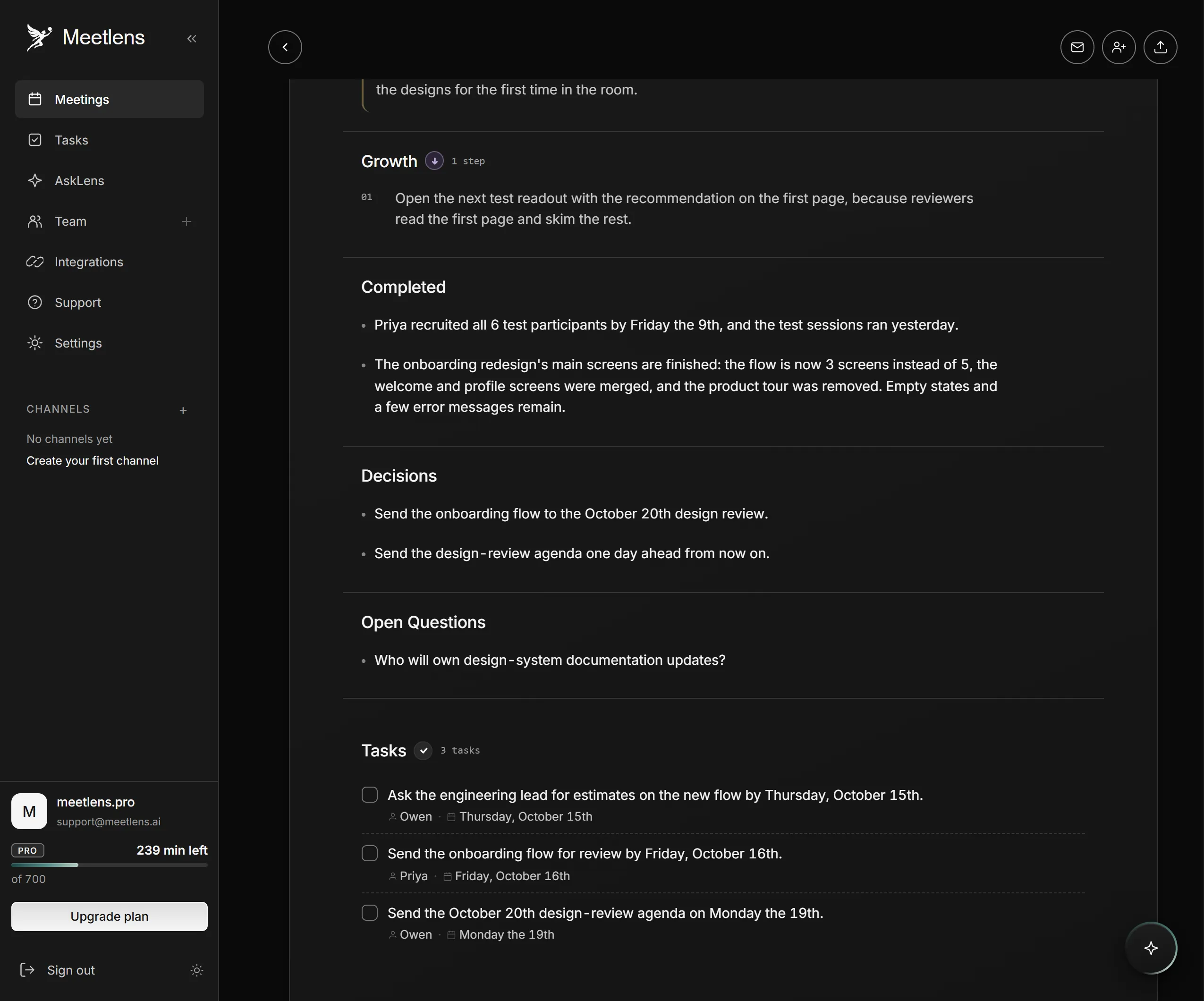
The One-on-One report from the same recording listed the same three tasks under Tasks, each with the same owner and date, and put the docs question, which nobody owns yet, under Open Questions.
A 1:1 before, during and after: one shared document
Before the meeting
- EmployeeAdds talking pointsa day ahead
- ManagerRereads last meeting’s next steps
During the meeting
- Check-in2–3 minutes
- Employee’s topicsfirst, in their order
- Manager’s topicscontext, feedback, upcoming changes
- Next stepsone owner and one date each
After the meeting
- Three-line summarydecisions, action items, topics for next time, written into the same document
- Follow-updone before the next 1:1
Shared running document
One for the whole series, newest meeting on top
Your first one-on-one with a new employee
The first one-on-one with a new employee is for getting to know each other and agreeing how you'll work together, not for reviewing tasks. Set four goals for it:
- Build rapport. Learn what the new hire did before and what they enjoy.
- Learn their communication preferences: how they like to get feedback and which channel to use for what.
- Set expectations for the first 30, 60 and 90 days as written goals. Goal setting now gives later 1:1s a reference point.
- Agree on the rhythm of your 1:1s: day, time and length.
Five questions, one of them about motivation:
- "What did you enjoy most in your last role, and what did you want less of?"
- "What motivates you at work, and what wears you out?"
- "How do you prefer to get feedback: right away, in writing, or saved for our 1:1?"
- "What would make your first three months here a success for you?"
- "Which day and time work best for our 1:1s?"
Share the same about yourself: how you work and decide, when you're reachable, and what a good first month looks like.
A new manager taking over a team should run the first round of 1:1s as a listening tour: ask what works, what doesn't and what each person needs from you, and hold changes until you've heard everyone.
What to talk about in a one-on-one with your manager
In a one-on-one with your manager, bring two or three topics you need your manager for (a decision, a blocker, feedback or a career question) plus one win with a number attached. "Cut onboarding calls from 60 to 40 minutes" gives your manager more to work with than "had a busy week."
Prepare in 10 minutes:
- Reread the last meeting's next steps and mark what you finished.
- Add your topics to the shared document, most important first.
- Next to each topic, write what you need: a decision, advice or a name.
Make feedback requests specific: instead of "Any feedback?", ask about one moment: "In yesterday's client call, what's one thing I should do differently next time?"
Career development needs its own slot. Once a month or quarter, ask for a 1:1 only about your career: "Which skills would you want to see from me before a senior role, and what project could show them?"
First meeting with a new boss: what to say
In the first meeting with a new boss, describe your role and current priorities in three sentences, then ask how they want updates and what success looks like this quarter. Close by agreeing on the rhythm of your 1:1s. A version you can adapt:
I run onboarding for our mid-market customers; this quarter my priorities are the renewal push and the new help center. How would you like updates from me: a short weekly note or our 1:1? And what would a great quarter look like to you?
Taking notes in a 1:1 (and when to record)
In a 1:1, keep one shared running document for agreed next steps and a separate private note for your own observations, and record the meeting only with the other person's explicit consent.
- Running document (shared): decisions, next steps with owners and dates, topics for next time: the meeting notes of the whole series.
- Private notes (yours): observations and examples of good work. Dated notes protect a performance review from recency bias, judging someone by the last few weeks.
- Nothing on paper or on record: health, family matters, a conflict with a colleague or plans to leave, unless the employee asks. Harassment, discrimination or safety concerns are different: follow your company's HR policy.
Federal law requires one party's consent to record, but about 11 states, California among them, primarily require all parties to agree (Reporters Committee for Freedom of the Press). One of you reports to the other, so ask in a way that makes "no" easy.
For a remote 1:1 on a video call in Google Meet, or in Zoom or Microsoft Teams in the browser, Meetlens, a Chrome extension, records the tab's audio, plus your microphone once you allow it, without a bot joining the call. Pick One-on-One in the format drop-down above Start recording. Meetlens describes this format as "Key takeaways and next steps," and tasks with an owner and a due date go into a Tasks block. These AI one-on-one notes come only from what was said, so nonverbal cues such as a frown don't reach the report. Weeks later, add the meeting to the AI chat with Add context and ask "What did we agree about the design review agenda?" and check the answer at the linked moment.
Meetlens records audio only and doesn't record the desktop Zoom or Teams apps or phone calls; for an in-person 1:1, upload an audio or MP4 recording made with consent. No bot means no recording notice, so ask the other person yourself:
Would it be OK if I record today's 1:1 for our notes? It's audio only. If you agree, please say "Yes, I agree to the recording."
Common one-on-one mistakes
Five mistakes turn a 1:1 into a wasted slot: canceling it, filling it with status updates, talking more than the employee, asking the same questions every week and dropping the next steps.
- Canceled meetings. Instead of canceling, reschedule; Baylor's rule is "don't cancel unless sick or there's an emergency."
- Status updates. Checking tasks turns a 1:1 into micromanagement: Rogelberg says many managers "conduct the meeting to monitor their employees' work, and that's not the goal" (CNBC, on the same page). Instead, collect status in writing.
- The manager does most of the talking. Instead, follow Baylor's advice to "talk less, and listen more."
- The same questions every week. Instead, rotate one block from the topic list: career one week, well-being the next.
- Next steps without follow-through. Instead, open each 1:1 with the last meeting's next steps.
Where does a 1:1 fit into the rest of your recurring calendar?
1:1s and your other recurring meetings
In calendar terms, a 1:1 is a standing meeting: it repeats on a fixed schedule with the same two people. A stand-up solves a different problem: it syncs the team on the work in a few minutes. The one-on-one meeting gives one person time for growth, feedback and anything they wouldn't raise in a group, so keep both.