What Is a Kickoff Meeting? Purpose, Agenda and a Project Kickoff Template
 Meetlens Editorial14 min readUpdated October 17, 2026
On this page
- What is a kickoff meeting?
- What is the purpose of a kickoff meeting?
- Types of kickoff meetings
- Who should attend a kickoff meeting?
- How to prepare for a kickoff meeting
- Project kickoff meeting agenda
- Project kickoff meeting template
- Questions to ask in a kickoff meeting
- How to run a kickoff meeting
- What to do after the kickoff meeting
- Common kickoff meeting mistakes
- The project's meeting rhythm after the kickoff meeting
A kickoff meeting is how a project starts: before any work begins, the team agrees why the project matters, what it will deliver and who does what. Unlike an informal meeting, it runs on a set agenda and ends with written decisions and named owners. Read on for purpose, types, attendees, preparation, a timed agenda, a copyable project kickoff template, questions, facilitation, follow-up and mistakes.
What is a kickoff meeting?
A kickoff meeting is the first meeting of a project team, with or without the client, held after the basics of the project are defined, to align everyone on goals, project scope, roles and the plan before work starts. That follows the Wikipedia definition.
In project management, the kickoff meeting introduces the people, confirms the plan and marks the start of the work. It doesn't plan the project in detail: the kickoff meeting guide from the University of Waterloo's Project Management Office (PMO) says the meeting "does not get into granular details of the project implementation."
A kickoff call is a kickoff meeting held over video, a common setup for client projects. Parabol lists launch meeting as a synonym.
Kickoff meeting or kick-off meeting?
Write "kickoff meeting": kickoff is the noun, and kick off is the verb. Merriam-Webster lists kickoff as a noun for the start of something and kick off as a verb, so you hold a kickoff meeting to kick off a project. The hyphenated kick-off is a variant more common in British English, and the AP Stylebook recommends kickoff, according to Grammarist.
What is the purpose of a kickoff meeting?
The purpose of a kickoff meeting is to leave the room with one shared answer to three questions: why we're doing this, what exactly we'll deliver, and who does what by when. Those questions map to the three key components of a project kickoff meeting:
- Project goals and success criteria. Why the project exists and how you'll know it worked. Slack's project kickoff guide recommends goals that meet the SMART criteria: specific, measurable, achievable, relevant and time-bound.
- Scope and deliverables. What the project includes, what it leaves out, and what the team hands over.
- Roles, timeline and communication. Who owns each piece of work, the key dates, and how the team stays in touch.
The kickoff meeting also sets the tone: the PMO guide calls it the project manager's first opportunity to set expectations across the entire project team. It builds buy-in too, and buy-in comes from a two-way discussion rather than a presentation. The result is a shared understanding: every attendee can state the goal and their own role.
Types of kickoff meetings
Kickoff meetings differ by audience: an internal project kickoff aligns your own team, a client kickoff meeting also sets expectations with the customer, and an agile project kickoff prepares a team for its first sprint.
| Kickoff meeting type | Who's in the room | What gets more time |
|---|---|---|
| Internal project kickoff | Project team, sponsor, managers whose people work on the project | Business goal, roles, how the team will work together |
| Client kickoff meeting (external project) | Your team plus client stakeholders: the decision-maker and the day-to-day contact | Project stages, client approvals, how detailed status reports will be |
| Agile project kickoff | Everyone on the team, the product owner, the Scrum Master or coach, a couple of stakeholders | Work for the coming period, how success is defined, working agreements, iteration length |
Two of the client items come from Atlassian's project kickoff guide: talking the client through the project stages and agreeing how detailed the status reports will be; the agile row follows Mike Cohn of Mountain Goat Software, who also suggests a new kickoff meeting when a significant number of team members are new, and at least once a year.
Industry kickoff meetings add their own items: a construction project kickoff meeting covers site safety procedures, site logistics and the change order process. A sales kickoff (SKO) is a different event: an annual gathering of a company's entire sales team, not a project meeting.
Who should attend a kickoff meeting?
Invite the people who will do, approve or depend on the work: the core project team, the sponsor, key stakeholders and, for client work, the client's decision-maker and day-to-day contact. Too many attendees lead to unfocused discussions.
- Project manager. Leads the kickoff meeting; the PMO guide notes it is "typically led by the project manager."
- Executive sponsor. Opens with the why and lends authority to the goals.
- Core project team. The leads and contributors who will produce the deliverables.
- Key stakeholders. People with decision-making power over the project or whose work it changes, such as budget owners.
- Client contacts. On client projects, the person who approves the work and the day-to-day contact.
People who only need to stay in the loop get the recap instead of a seat. If the group gets large, run two kickoff meetings: a short one where leaders settle open decisions, then the full team kickoff.
How to prepare for a kickoff meeting
Prepare the decisions, not the slides: a few days before the kickoff meeting, share a project brief or project charter with a draft project scope, timeline and RACI matrix that the meeting will confirm or change. Slack recommends sending pre-read materials a few days ahead; the PMO guide notes that most of what a kickoff meeting presents comes from the project charter.
Use this checklist:
- Write the project charter, the document that formally authorizes the project, or a one-page brief with the business goal, the budget range and the sponsor. For client work, attach the statement of work: Atlassian notes the kickoff usually follows once it is finalized.
- Draft the goals and how you'll measure them.
- Draft the timeline with the dates you already know.
- Draft the RACI matrix, a responsibility assignment matrix naming who is responsible, accountable, consulted and informed for each deliverable.
- Send your questions in advance, "so they'll have time to think about their answers," as Atlassian puts it.
- Book the logistics: room or video link, agenda in the invite, link to the pre-read.
- Announce the recording in the invite if you plan to record.
Walk the sponsor through any sensitive point beforehand; the PMO guide recommends it to avoid major disapproval in the room. For item 7:
We'll record this kickoff meeting to capture decisions and action items accurately. If you'd prefer not to be recorded, reply to this invite and we'll take notes by hand.
Project kickoff meeting agenda
A typical project kickoff meeting agenda runs one hour: introductions, purpose, project scope, timeline, roles, communication plan, risks and next steps. Every item in the meeting agenda below has a lead, a time box and the result the room should leave with. Copy the table into your invite.
| Time | Agenda item | Lead | Result |
|---|---|---|---|
| 0–5 min | Welcome and introductions (optional: a warm-up question) | Project manager | Everyone knows names and roles |
| 5–15 min | Why this project: background and business goal | Sponsor | Shared purpose |
| 15–25 min | Project scope, deliverables and success criteria (in and out) | Project manager | Agreed project scope |
| 25–35 min | Timeline and key milestones | Project manager | Dates for key milestones |
| 35–45 min | Roles and responsibilities (RACI matrix) | Project manager and leads | Named owners |
| 45–50 min | Communication plan: status reports, meeting rhythm, where documents live | Project manager | Working rhythm |
| 50–55 min | Risks, assumptions, open questions | Everyone | Risk list with owners |
| 55–60 min | Next steps and action items | Project manager | Owners and due dates |
- Introductions. One warm-up question is enough: "What's one thing this project must not repeat from your last one?"
- Project scope and key milestones. Write two lists, in and out, and give firm dates only for project milestones the team controls.
- Communication plan. Agree on how often status reports go out and where questions go, for example a project Slack channel.
- Risks. Collect potential risks in one list; risk management continues in the project plan.
For a 90-minute version, add a 30-minute working session between risks and next steps. In an agile project kickoff, use it to draft the goals of the first iteration; in a client kickoff meeting, walk through the approval process.
How long should a kickoff meeting last?
A kickoff meeting usually lasts 60 to 90 minutes for a moderately complex project and longer for an agile project kickoff; these ranges are practitioners' guidance, not a standard.
| Kickoff meeting | Length | Source |
|---|---|---|
| Moderately complex project | 60–90 minutes | Slack |
| Project kickoff presentation with questions, depending on project size | 1–2 hours | University of Waterloo PMO |
| Agile project kickoff | 2–4 hours, no more than a full day | Mike Cohn, Mountain Goat Software |
If the agenda doesn't fit the time, the meeting is doing planning work: move detailed planning into a separate session, as Parabol advises.
Project kickoff meeting template
Use one kickoff document that starts as the pre-read and ends as the record: the same headings hold the draft before the meeting and the decisions after it.
One kickoff document, from pre-read to record
-
Before
Sections 1–7 marked DRAFT, sent to attendees as the pre-read
-
During
On a shared screen: drafts edited, decisions typed into section 8
-
After
DRAFT labels removed, sections 8–10 filled, linked from the recap email
Project kickoff meeting — [Project name] · [Date]
Sponsor: [name]    Project manager: [name]
Attendees: [name — role]

1. Purpose — why we're doing this: [business goal]
2. Success criteria — [metric] reaches [target] by [date]
3. Project scope — in: [ ] / out: [ ]
4. Deliverables and key milestones — [deliverable] — [date]
5. Roles (RACI matrix) — [area]: R [ ] / A [ ] / C [ ] / I [ ]
6. Communication plan — status update: [how often, channel]
   Decisions logged in: [document]    Escalation: [name]
7. Risks and assumptions — [risk] — [owner] — [mitigation]
8. Decisions made at the kickoff meeting
   [#] — [decision] — decided by [name] — why: [reason]
9. Action items — [owner] — [action] — [due date]
10. Open questions — [question] — [owner] — answer by [date]How to use the kickoff template:
- Before: fill sections 1–7, mark them DRAFT and send the document, in Google Docs or Word, as the pre-read.
- During: edit it live on the shared screen and keep the decision log under heading 8, one line per decision: "Mobile app is out of project scope for phase 1 — decided by the sponsor — why: the budget covers the web app only."
- After: remove the DRAFT labels, complete sections 9 and 10 and link the document from the recap. It becomes the project's source of truth for decision-making questions such as who agreed to what.
Filled in from a staged kickoff (synthetic voices, invented names): an internal localization project; the recording runs about 14 minutes and covers all eight items of the one-hour agenda in order — a compressed staging, not a timed run.
Project kickoff meeting — Spanish version of the invoicing app, phase 1 · Oct 12, 2026
Sponsor: Gabriel (head of growth)    Project manager: Irene
Attendees: Gabriel — sponsor; Irene — project manager; Hugo — engineering lead; Sofia — content and localization lead; Lucas — support lead

1. Purpose — about 1 in 5 new trials come from Spanish-speaking countries, but only 4% of them become paying customers (11% for English-speaking trials); the app is English only
2. Success criteria — paid conversion from Spanish-speaking trials reaches 7% (from 4%) by Mar 31, 2027
3. Project scope — in: web app interface, sign-up and onboarding emails, the 50 most-read help center articles / out: mobile app (phase 1), phone support in Spanish
4. Deliverables and key milestones — translated interface texts from the agency — Nov 20; testing — Nov 23–27; 50 help center articles live in Spanish — Nov 27; launch — Dec 1
5. Roles (RACI matrix) — Interface translation: R Sofia / A Irene / C Hugo / I Lucas
   Engineering (language switch, date and number formats, testing): R Hugo / A Irene / C Sofia / I Gabriel
   Help center articles: R Lucas / A Irene / C Sofia / I Gabriel
6. Communication plan — status update: weekly, Thursdays by noon, written, in the project channel; first status check-in Oct 22
   Decisions logged in: this kickoff document    Escalation: Gabriel
7. Risks and assumptions — the agency delivers late — Sofia — check-in call with the agency every Monday until Nov 20
   Spanish text is about 20% longer; buttons and menus break — Hugo — test the five longest screens first with sample Spanish text
8. Decisions made at the kickoff meeting
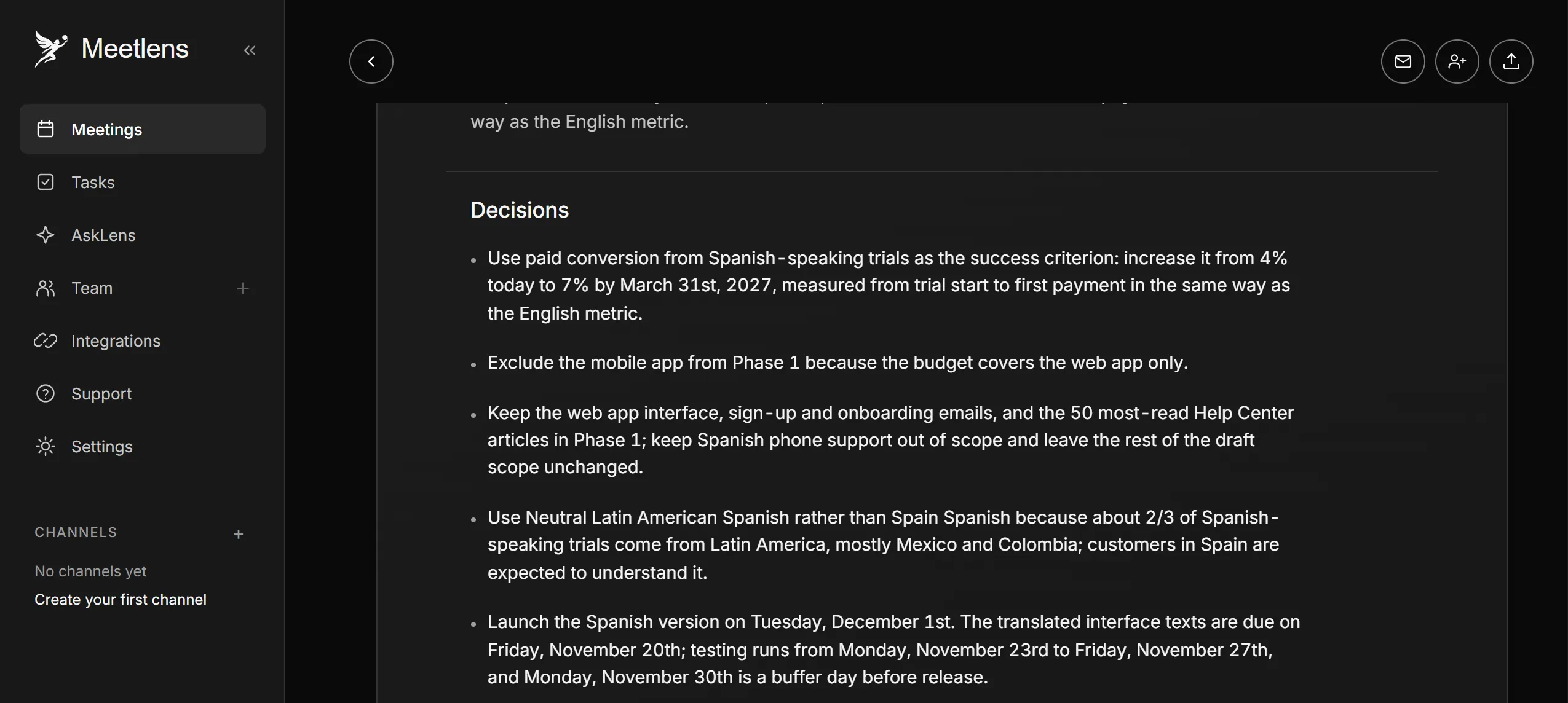
   1 — Mobile app is out of project scope for phase 1 — decided by Gabriel (sponsor) — why: the budget covers the web app only
   2 — Write neutral Latin American Spanish, not Spain Spanish — decided by Sofia — why: two thirds of Spanish-speaking trials come from Latin America
   3 — Launch the Spanish version on Tue Dec 1 (not Nov 17 as drafted) — decided by Gabriel (sponsor) — why: the translated texts arrive Nov 20 and testing needs a full week
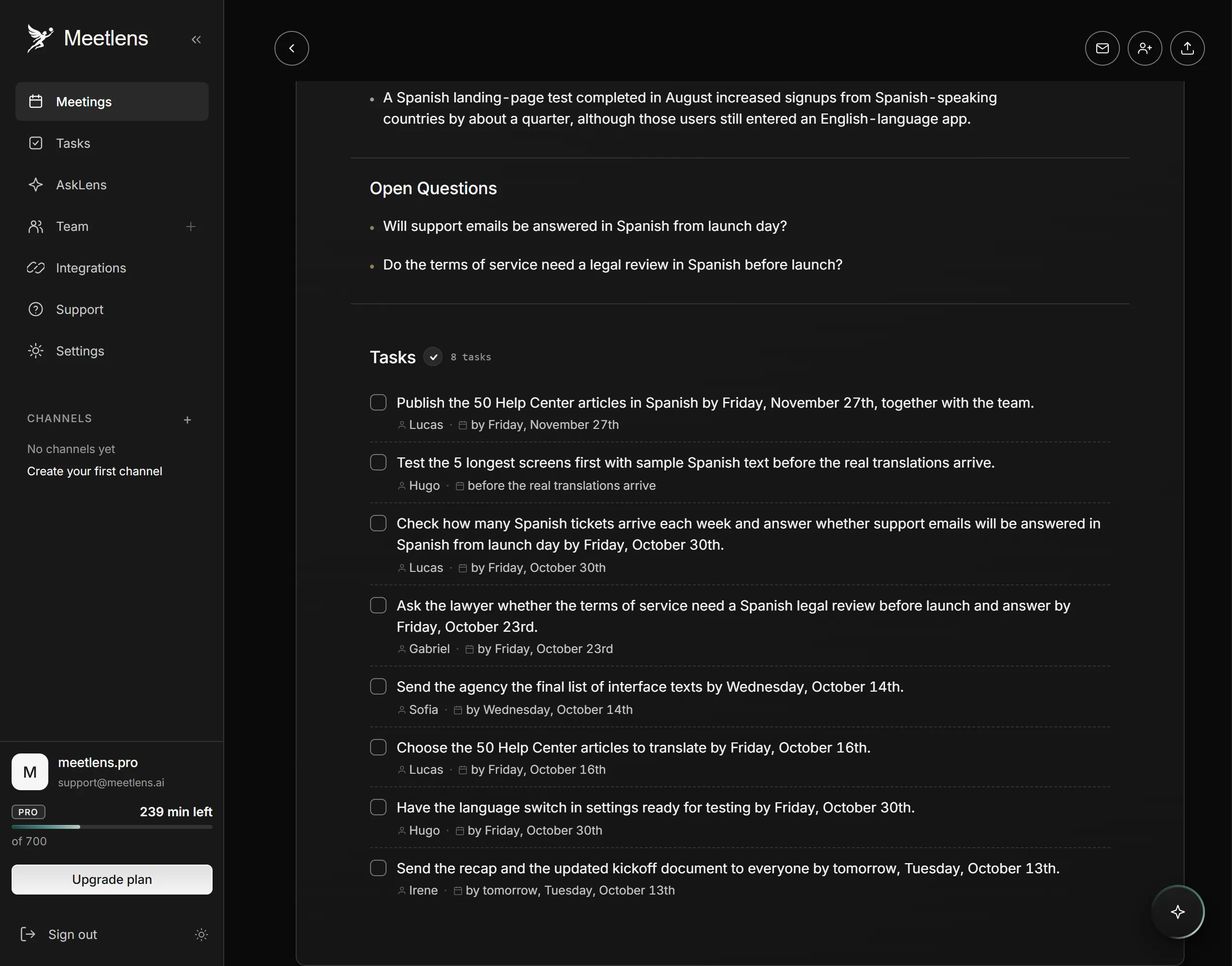
9. Action items — Sofia — send the agency the final list of interface texts — Oct 14
   Lucas — choose the 50 help center articles to translate — Oct 16
   Hugo — language switch in settings ready for testing — Oct 30
   Lucas — publish the 50 help center articles in Spanish — Nov 27
   Irene — send the recap and the updated kickoff document — Oct 13
10. Open questions — Do we answer support emails in Spanish from launch day? — Lucas — answer by Oct 30
    Do the terms of service need a legal review in Spanish before launch? — Gabriel — answer by Oct 23
Kickoff meeting deck outline
If your organization expects slides, build a 7-slide kickoff meeting deck from the same document:
- Purpose
- Goals and success metrics
- Project scope: in and out
- Timeline: a simple Gantt chart of key milestones
- Team and RACI matrix
- How we'll work: team norms, meeting rhythm, tools
- Risks and next steps
The PMO guide also suggests sharing the kickoff presentation with people who join the project later.
Questions to ask in a kickoff meeting
Ask the questions that expose hidden assumptions: what success looks like, who decides, what falls outside the project scope and what could stop the project.
For the client or sponsor:
- "What has to be true in three months for you to call this a success?"
- "Who gives final sign-off on each deliverable, and how long does it take?"
- "What did previous attempts at this get wrong?"
- "How much flexibility is there if the budget or the timeline has to change?"
For the project team:
- "Which deadline can't move, and which one can?"
- "What are we assuming that nobody has confirmed?"
- "What could stop this project in the first month?"
- "When someone asks to add work later, who decides whether it's in?" This is the scope creep question: new requests go to whoever approved the original project scope.
Write the answers into the kickoff document; assumptions nobody in the kickoff meeting can confirm go to open questions with an owner.
How to run a kickoff meeting
Run the kickoff meeting as a working session: start with why, time-box project scope debates, write decisions down as they're made and close with named owners and dates. Slack describes a kickoff as "a strategic working session" rather than a routine status update. The facilitator, usually the project manager, keeps the room on the agenda.
- Let the sponsor open. The why gives every later trade-off a reference point.
- Time-box each item with a visible timer; a project scope debate that outlasts its time-box moves to open questions with an owner.
- Write decisions down as they're made, on a screen everyone can see, so people can flag a wrong entry on the spot.
- Give every risk an owner. Try a pre-mortem: the team imagines the project has failed and works backward to the causes.
- Read back before you close: the decisions and action items, owner by owner. Mike Cohn also asks each participant whether their expectations for the meeting were met.
For a remote kickoff meeting, keep cameras on, share one screen with the kickoff document, and ask a second person to watch the chat. If you record, announce it again at the start.
What to do after the kickoff meeting
Within 24 hours, send a kickoff meeting recap with the decisions, action items with owners and dates, a link to the kickoff document, and the date of the first status check-in. Atlassian recommends sending a summary and the action items to all attendees; the PMO guide adds stating what you expect from everyone at the first status meeting.
Send four things:
- The kickoff recap email, to attendees and to anyone who needs to stay in the loop.
- The updated kickoff document, with drafts replaced by decisions.
- Invites for the recurring meetings: status check-ins, stand-up meetings or sprint events.
- An answer date for each open question.
If your kickoff meeting runs in Google Meet, Zoom Web, Microsoft Teams Web or Webex, Meetlens can supply most of the recap's content. It's a Chrome extension that records the call's audio without a bot joining, then produces a transcript with speaker labels and a structured AI report. For AI kickoff meeting notes, keep General Meeting, the default report format, in the format drop-down above Start recording. The Meetlens General Meeting report lists Decisions, Tasks with owners and due dates, and Open Questions (when any came up), matching sections 8–10 of the template. On Pro and Business plans, Meetlens also drafts the follow-up email; you edit and send it yourself, so check every owner first.
Three limits apply. One recording runs up to an hour on Free, 90 minutes on Pro and 120 minutes on Business, so the version with a working session doesn't fit into one Free recording, and a half-day agile kickoff doesn't fit into one recording on any plan. Meetlens records audio only, so slides and the shared document aren't in the report. With no bot, the platform shows no recording notice, which is why the announcement in your invite matters.
Common kickoff meeting mistakes
Most kickoff meetings go wrong by trying to do too much, planning the whole project in the room, or too little, broadcasting slides without making decisions. Watch for these five:
- Mixing the kickoff with detailed project planning. Parabol advises keeping the two meetings separate unless the project is small; otherwise the kickoff meeting becomes "a draining and confusing event."
- Running an information broadcast. In Atlassian's words, a project kickoff meeting "shouldn't be an 'information broadcast.'" Background belongs in the pre-read.
- Inviting too many people. Every attendee needs a part in the decisions or in the work.
- Leaving decisions unwritten. Without a decision log, the first disagreement reopens the decision.
- Skipping the recap. People who missed the kickoff meeting learn the plan secondhand, and attendees can't check their notes.
What happens in the first weeks after the kickoff meeting?
The project's meeting rhythm after the kickoff meeting
The kickoff meeting hands the project over to its regular meetings. An agile team goes straight into its first sprint planning, where the work agreed at the kickoff becomes the first sprint's backlog. If the project brings new people onto your team, hold a first one-on-one with each of them in the first week. Everyone else moves to the status check-ins set in the recap.